

The 8th Central Pay Commission has moved into a much more practical phase, and that changes what employees, pensioners, defence personnel and associations need to do next. For months, most of the public conversation around the Commission revolved around fitment factor, minimum pay, pension revision, allowances and possible recommendations. Now the process is becoming more direct. The official system is opening the door for stakeholder interaction, and that means the focus is no longer only on what people want to demand. The focus is now on how those demands are officially submitted and carried into the consultation process.
That is why the appointment link update matters.
This development is important because it tells stakeholders that the 8th CPC consultation process is no longer limited to reading notices and discussing issues from a distance. The Commission has now created a route through which eligible stakeholders can seek a meeting for scheduled city visits. In simple terms, the process has moved from passive monitoring to active participation.
But there is one rule that stands above everything else.
A stakeholder cannot treat the appointment link as the starting point. The first step is the memorandum. Only after the memorandum is submitted online does the system generate a Memo ID. That Memo ID is what gives a stakeholder an official reference inside the process. Without it, the appointment request loses its foundation. This is why the most valuable takeaway from the current update is very straightforward: if your issue is serious, your first task is not to chase the meeting. Your first task is to enter the issue properly into the system.
This is where many people can go wrong.
In many government processes, people assume a physical letter, a PDF attachment, an email, a forwarded note or a printed file may be enough. But the current 8th CPC process is clearly more structured. The route is digital, time-bound and sequential. First comes the online memorandum. Then comes Memo ID. After that comes the city-specific appointment form. This order matters because it keeps the consultation process organised and traceable.
The new appointment mechanism is especially relevant because the Commission’s city visits are not symbolic. They are consultation opportunities. Hyderabad, Srinagar and Leh represent three different administrative and service environments, and each of them can bring different kinds of concerns before the Commission. That is why this update is not merely technical. It is an operational opening for those who want their issues to be heard in a more formal and structured setting.
Hyderabad is likely to matter for a wide range of Central Government employees, pensioners, institutions and defence-linked stakeholders from Telangana and nearby regions. It is a major urban base with strong administrative presence and a broad mix of serving and retired personnel. Issues related to pay structure, pension revision, allowances, promotion anomalies, medical support and service conditions can all find organised representation there.
Srinagar carries its own importance. The region brings together administrative concerns, climatic factors, transfer-related realities, pension and service delivery issues, and a different set of hardships linked to location. If stakeholders from that region want these realities to reflect properly in the Commission’s thinking, they cannot depend only on general national narratives. They need to place their points in a focused way through the official mechanism.
Leh is perhaps even more distinct. Ladakh cannot be looked at through an ordinary posting lens. Distance, altitude, climate, logistics and hardship conditions all affect service life in a unique way. That is why a structured representation from this region carries importance not only for civilian employees but also for defence-related stakeholders whose service conditions are tied closely to difficult terrain and high-pressure environments.
The real significance of the appointment link is that it connects two things that should always go together in a Pay Commission process: documentation and explanation.
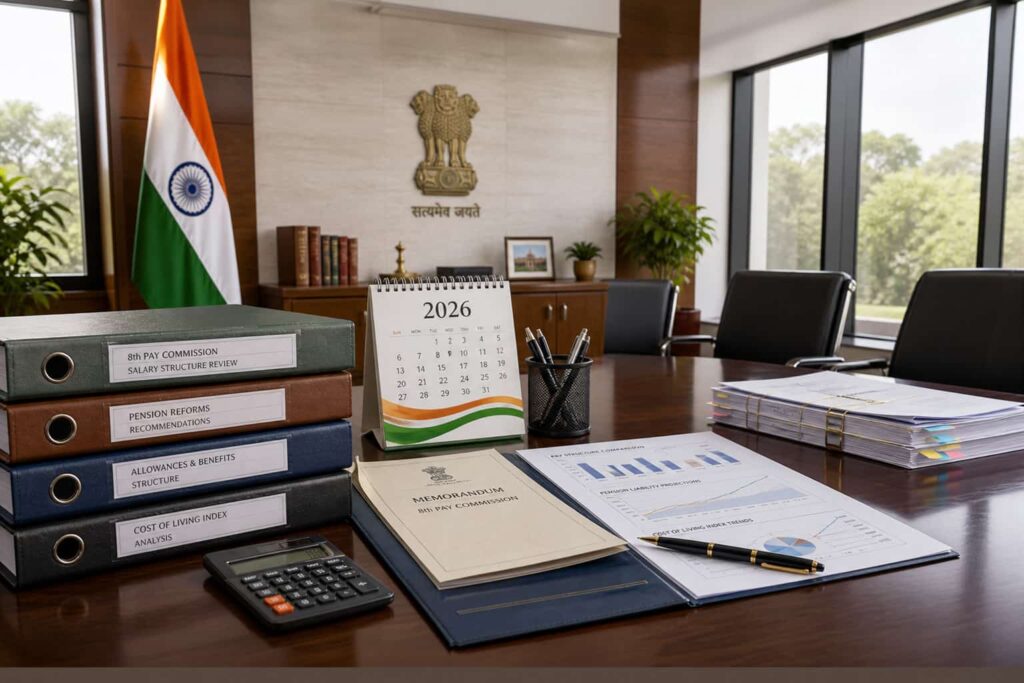
A memorandum records the issue. A meeting helps explain why that issue deserves attention. One without the other may weaken the case. A memorandum alone may put the point on paper, but a meeting gives the stakeholder a chance to clarify the impact, present priority concerns and underline the urgency. At the same time, a meeting without a properly prepared memorandum may not leave a lasting institutional record. The best results come when both parts support each other.
This is why preparation matters.
Stakeholders should not approach these meetings casually. If a union, association or recognised group secures an appointment, the representatives going there should be fully prepared. They should know exactly what has been submitted, what the priority demands are, what facts support those demands and what solution is being proposed. A meeting is not simply an opportunity to speak emotionally. It is an opportunity to present a case clearly and professionally.
That is also why the likely representative limits in the appointment process make practical sense. A smaller, prepared delegation is usually more effective than a large, unstructured group. The Commission needs clarity, not noise. If two representatives attend with a sharp issue summary, clean supporting points and a disciplined presentation, the chance of the concern being understood properly becomes much stronger.
The memorandum itself should follow the same principle.
A strong submission is usually issue-based, not scattered. Instead of writing a long general complaint, stakeholders should break down their demands into clear points. For employees, this could include minimum basic pay, fitment factor, pay matrix revision, HRA, TA, annual increment, MACP or department-specific anomalies. For pensioners, it could include pension revision, family pension, commutation, DR, gratuity and medical support. For defence personnel and ex-servicemen, the priorities may include OROP-related concerns, MSP, hardship allowances, disability matters, early retirement patterns, pension parity and service-specific anomalies.
When each demand is separated and explained simply, the Commission can process it more effectively.
Another important point is timing. Many stakeholders make the mistake of assuming that if the overall submission window is open, there is no urgency. But city-based appointment opportunities operate on earlier, visit-linked deadlines. That means waiting until the final submission date may result in missing the appointment opportunity for a particular city interaction. Those who genuinely want to participate should move early, not late.
That is especially true in an online system. Technical problems, OTP delays, incorrect entries, last-minute confusion or missed confirmations can all create avoidable trouble. A careful stakeholder should prepare the points in advance, submit the memorandum early, save the Memo ID immediately and only then move to the appointment stage for the relevant city.
For readers, the larger message is clear. The 8th Central Pay Commission is no longer only a subject of expectation. It is now a live consultation process with visible steps, deadlines and formal channels. That makes this phase more important than many earlier headline-driven updates. It is the stage where serious stakeholders can shift from opinion to official representation.
In the end, the rule is simple and should not be forgotten: the appointment link may be live, but the real entry point is still the Memo ID.
That is what puts the issue into the system. That is what gives the stakeholder a valid reference. And that is what turns a general grievance into something the Commission can actually examine. For anyone serious about pay, pension or service-related concerns, that is the step that deserves full attention now.

Leave a Reply