

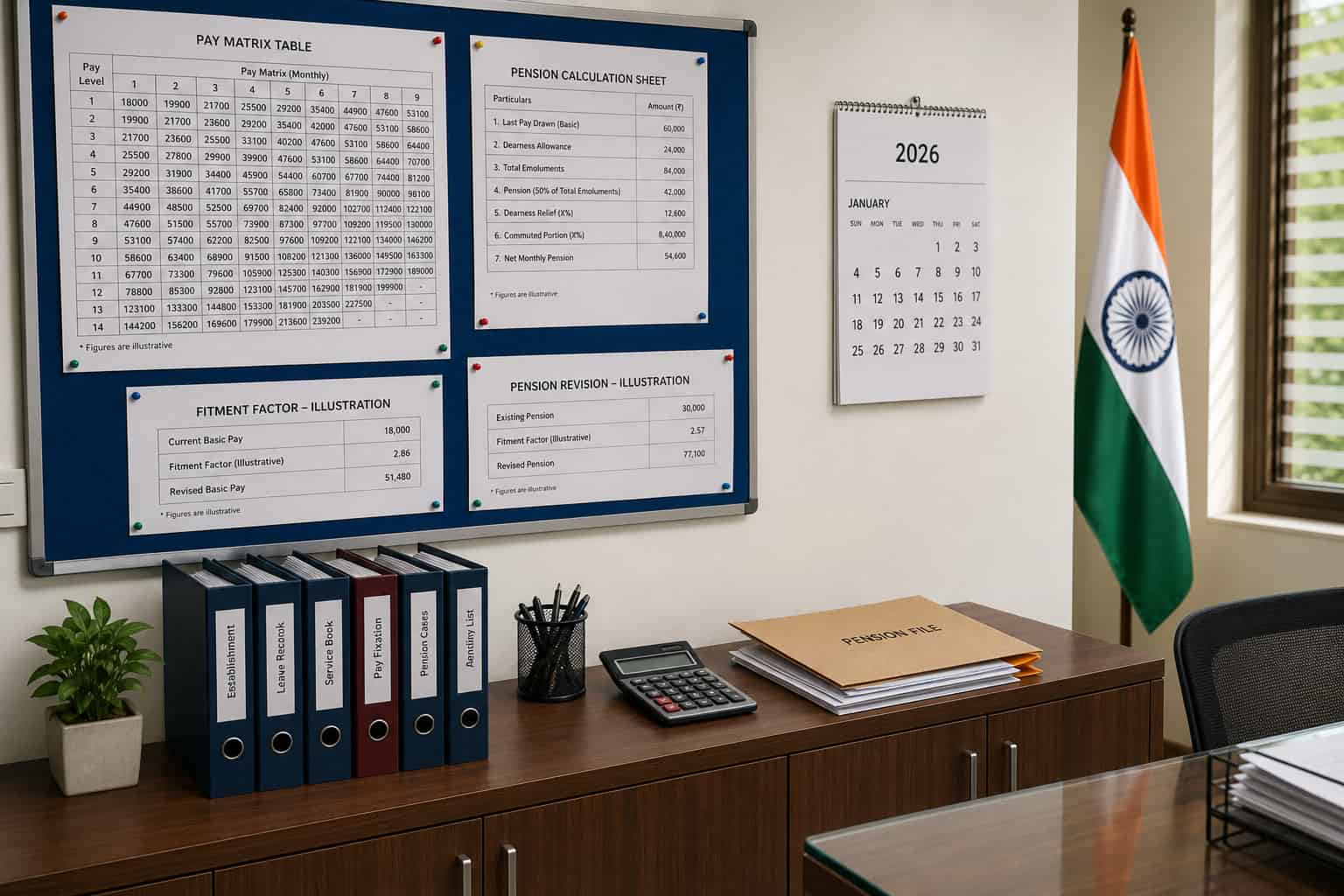
When people search for 8th Pay Commission updates today, they are no longer looking only for one headline like minimum pay or fitment factor. They are increasingly looking at full projected tables showing revised salary from Pay Level 1 to Pay Level 18. That is because employees, pensioners, defence personnel and family pensioners want to understand where they may stand if a new fitment formula is eventually accepted.
But this is exactly where confusion begins.
The official 8th Central Pay Commission is still in the consultation stage. Its website says the Commission has invited representations and memorandums from central government employees, defence forces personnel, pensioners, service associations, ministries and other eligible stakeholders, and the current last date for submission is 31 May 2026. The same official page also makes it clear that submissions are to be made only through the prescribed online route.
That means the numbers circulating online right now are not official pay orders. They are projections.
This distinction is the most important point in the entire Pay Level 1 to 18 debate. A projection is built by assuming a fitment factor and then applying that assumed multiplier to existing basic pay. An approved salary revision, by contrast, comes only after the Commission studies the demands, submits its recommendations, and the government decides what to accept. Until that happens, even the most widely shared salary table remains only an estimate.
That is why Pay Level 1 to 18 has become such a big topic.
Under the present pay structure, salary is linked to the pay matrix and the prescribed pay level. Department of Expenditure documents under the 7th CPC framework define basic pay in the revised pay structure as the pay drawn in the prescribed level in the pay matrix. So when people build 8th CPC projection charts, they usually start from the current basic pay attached to a level and then apply an assumed factor to calculate a possible revised basic pay.
The method looks simple, but the assumptions can vary sharply.
One projected chart may apply a factor of 2.0. Another may use 2.57. A more aggressive chart may assume 3.0, 3.68 or 3.83. Once that assumption changes, the resulting salary number also changes immediately. That is why two viral charts for the same pay level can show very different future pay figures. The chart is not necessarily wrong in calculation. It may simply be using a different assumption. And that is exactly why employees should not confuse a calculator output with an approved revision. This is an inference from how fitment-based projections are commonly built, but it is grounded in the official structure that current pay is level-based and that the 8th CPC has not yet announced a final multiplier.
The second source of confusion is the difference between basic pay, gross salary and in-hand salary.
A projected revised basic pay is not the same as final take-home salary. Department of Expenditure circulars under the current system define basic pay separately, while allowances and deductions continue to affect what a person actually receives every month. So when a chart says a certain pay level may become a certain figure, that generally refers to revised basic pay, not necessarily the amount that will land in the employee’s bank account after deductions.
This is also why pension calculations are attracting so much attention.
Many pensioners are now checking projected pension tables alongside employee salary tables. That is understandable because any major pay revision can later influence pension fixation logic. The 7th CPC highlights had already shown how pay matrix based notions could shape pension calculation for past pensioners, including defence pensioners. But the same caution applies here too: no final 8th CPC pension formula has yet been approved. So any pension table circulating today should be read as a scenario, not as a government decision.
This is where the debate becomes more serious than a simple “salary kitni badhegi” discussion.
The real issue is not whether people are calculating wrongly. The real issue is whether they understand what they are calculating. A projected table can be useful if it is clearly labelled as an estimate based on an assumed fitment factor. It becomes misleading only when it is shared as if the 8th CPC has already approved that figure. That is the difference your readers need to understand.
The current 8th CPC process makes that even more important. The official homepage shows that the Commission has already moved into an active working phase, with memorandum submission, city visits and stakeholder interactions. In other words, this is still the stage where arguments are being placed before the Commission, not the stage where final pay levels have been notified.
This is exactly why demand and approval should never be treated as the same thing.
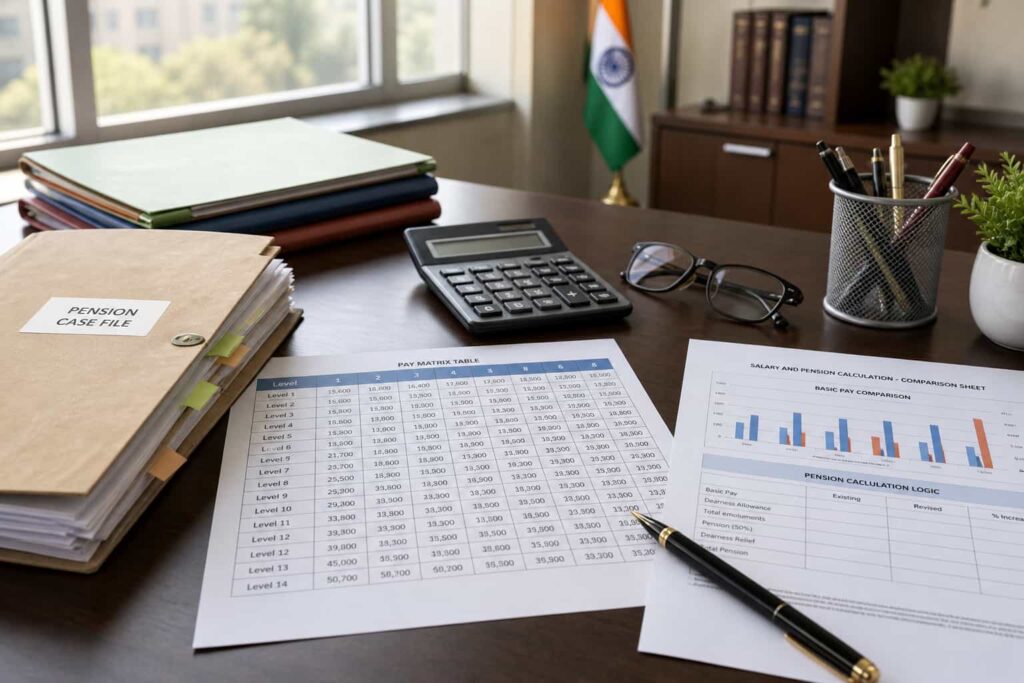
Employee bodies may demand a higher fitment factor, higher minimum pay, larger annual increment, wider allowance revision and stronger pension correction. Those demands are part of the process. But the Commission still has to examine them against fiscal conditions, structure, parity, pension burden and feasibility. After that, the government still has to decide what is actually accepted. So when readers look at Pay Level 1 to 18 charts, the right question is not “Is this my final new salary?” The right question is “Which assumption is this chart using?”
That is also why the memorandum stage matters more than viral tables.
If employee groups want a certain fitment logic, certain level correction, or certain pension method, this is the stage to justify it. The Commission’s own portal is still open for structured submissions until 31 May 2026, and it is inviting employees, pensioners, defence personnel and associations to place their issues formally on record. Viral charts may shape public excitement, but official memorandums are what shape the Commission’s actual input pool.
The safest way to explain the Pay Level 1 to 18 debate, therefore, is simple.
These tables are useful tools for understanding possibilities. They are not proof of approval. They can help employees and pensioners see how a given fitment assumption may affect current basic pay, but they cannot tell anyone with certainty what the final 8th CPC order will be.
That is why this topic has become the biggest 8th Pay Commission discussion. It sits exactly at the point where hope, calculation and policy uncertainty meet. And until the Commission gives its recommendations and the government takes a final decision, every pay level chart should be read with one sentence in mind: this is a projection, not yet a promise.




Leave a Reply