


When a headline mentions DA arrears, pay commission, pension revision or Supreme Court, it naturally grabs attention. Employees and pensioners know that even a small change in these areas can affect monthly budgets, arrears payments and family planning. That is why viral claims spread so fast. But this also creates a problem. Once one headline is mixed with another, confusion starts replacing facts.
That is exactly what is happening in the current debate around DA arrears and the “45 days pay commission” claim.
At first glance, both may look connected. Both involve employees, pay revision and financial relief. But in reality, they come from two different contexts. One is linked to the West Bengal DA arrears dispute and later state-level arrears notifications. The other comes from a political claim in West Bengal about implementing the 7th Pay Commission within 45 days if a new government were formed there. Neither of these should be mistaken for an official announcement that the 8th Central Pay Commission will be implemented for Central Government employees in 45 days.
That distinction matters a lot.
The DA arrears issue is tied to a long-running West Bengal dispute over Dearness Allowance under the state framework. The legal side of that matter reached the Supreme Court, which is why the case received national attention. For employees and pensioners in West Bengal, this was not just another court headline. It was connected to real money that had remained pending and to a larger fight over financial parity and arrears.
Later, the West Bengal Finance Department issued notifications for phased payment of DA and DR arrears for specific categories. That gave the matter a more practical shape, because it moved beyond legal debate and into the question of who would be paid, for which period, and in what manner. This part is important for state employees and pensioners who fall under those applicable rules.
But this is where people started making a common mistake. Many assumed that because the DA arrears issue was being discussed widely, any other headline about pay commission and time-bound implementation must also be connected to the same national process. That is not correct.
The “45 days pay commission” claim comes from a very different setting. It has been linked to the West Bengal political context, where reporting said that the 7th Pay Commission would be implemented within 45 days if a particular political outcome took place. That is a state-level political promise linked to West Bengal. It is not the same as a formal Central Government notification on the 8th Pay Commission.
This is the point employees must understand clearly: a state-specific 7th Pay Commission promise should not be confused with the Central Government’s 8th Pay Commission process.
The 8th Central Pay Commission follows its own official route. It has been constituted by the Government of India, it is working through consultations and submissions, and it has a defined time window to study pay, pension, allowances and related issues before giving its report. That process involves memoranda, meetings, stakeholder inputs and detailed examination. It does not move on the strength of a viral headline or a political slogan.
For Central Government employees, this is the most important takeaway. If you see a claim such as “pay commission in 45 days,” the first question should not be whether it sounds good. The first question should be: which pay commission is this talking about? Is it a state pay commission or the central one? Is it an official notification, a media interpretation, a court-related development or a political statement? Without that clarity, a headline can create false hope very quickly.
The same logic applies to DA arrears.
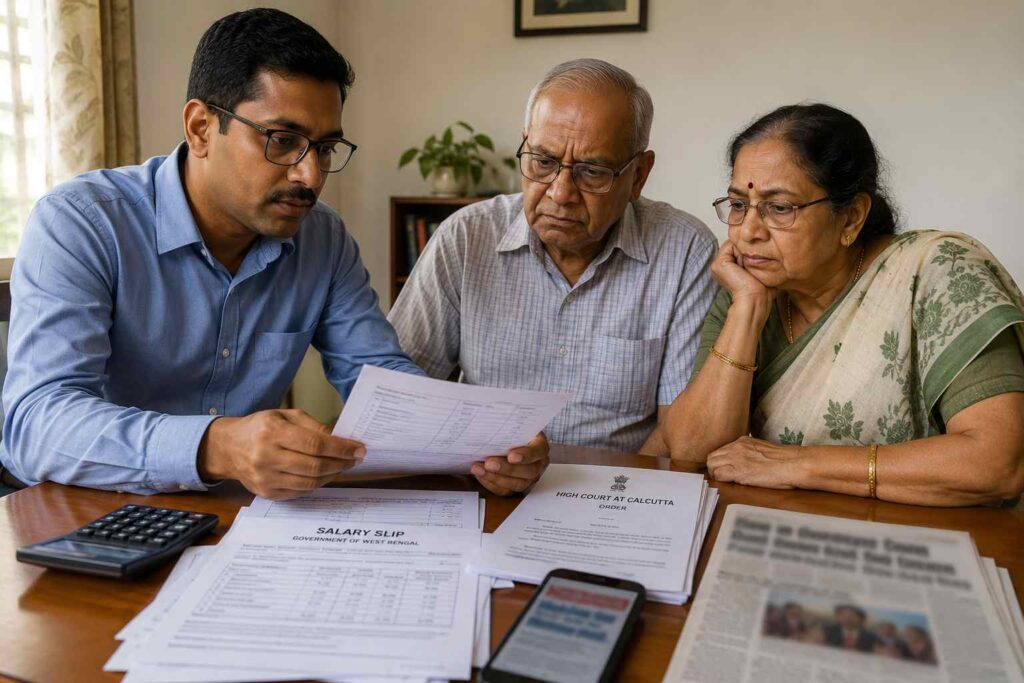
A court case in one state does not automatically mean that every employee in every government setup will get the same relief. Dearness Allowance disputes depend on the service rules, the employer, the legal background, the pay structure and the final order that applies to a particular category. A state-level arrears order is not a universal national arrears order. That is why copying one update into a much broader national context can be misleading.
This confusion becomes even more serious when employees start making financial decisions based on incomplete news. Some may begin expecting early arrears, some may assume the 8th CPC is about to be implemented, and others may start forwarding the claim as confirmed truth. By the time the full context becomes clear, the misunderstanding has already spread.
That is why careful reading matters more than ever.
The safest way to understand any such update is to check three basic things. First, identify the authority behind the news. Is it a court order, a government notification, a pay commission notice or a political statement? Second, identify the category affected by the news. Is it for Central Government employees, a specific state’s employees, pensioners, family pensioners or another group? Third, identify the stage of the development. Is it a promise, a proposal, a legal decision, a department notification or a final implementation order?
These three checks can save employees and pensioners from a lot of unnecessary confusion.
This is also an important lesson for content creators and social media pages. In topics related to pay, pension, DA and arrears, a half-accurate headline can do a lot of damage. It may attract quick attention, but it can also mislead families who depend on such updates for real financial planning. Clarity matters more than speed when the subject is salary, pension or arrears.
For West Bengal employees and pensioners, the DA arrears issue remains important in its own right. They should follow the relevant state notifications, payment schedules and applicability conditions carefully. For Central Government employees, the lesson is different. They should continue to track only the official 8th CPC process, government notices and reliable reporting, rather than assuming that every dramatic pay commission headline applies to them.
In the end, both stories matter, but for different reasons.
The DA arrears story is about a state-specific legal and financial dispute that later moved into phased payment. The “45 days pay commission” claim is about a West Bengal political promise related to the 7th Pay Commission. Neither should be presented as proof that the 8th Central Pay Commission is about to be implemented within 45 days.
That is the real point employees and pensioners need to keep in mind. In pay and pension matters, one misunderstood headline can spread faster than the actual truth. And when financial expectations are involved, that confusion can become costly.
The best approach is simple. Read beyond the headline, check the official source, confirm who is covered, and only then decide whether the update applies to you.




Leave a Reply