

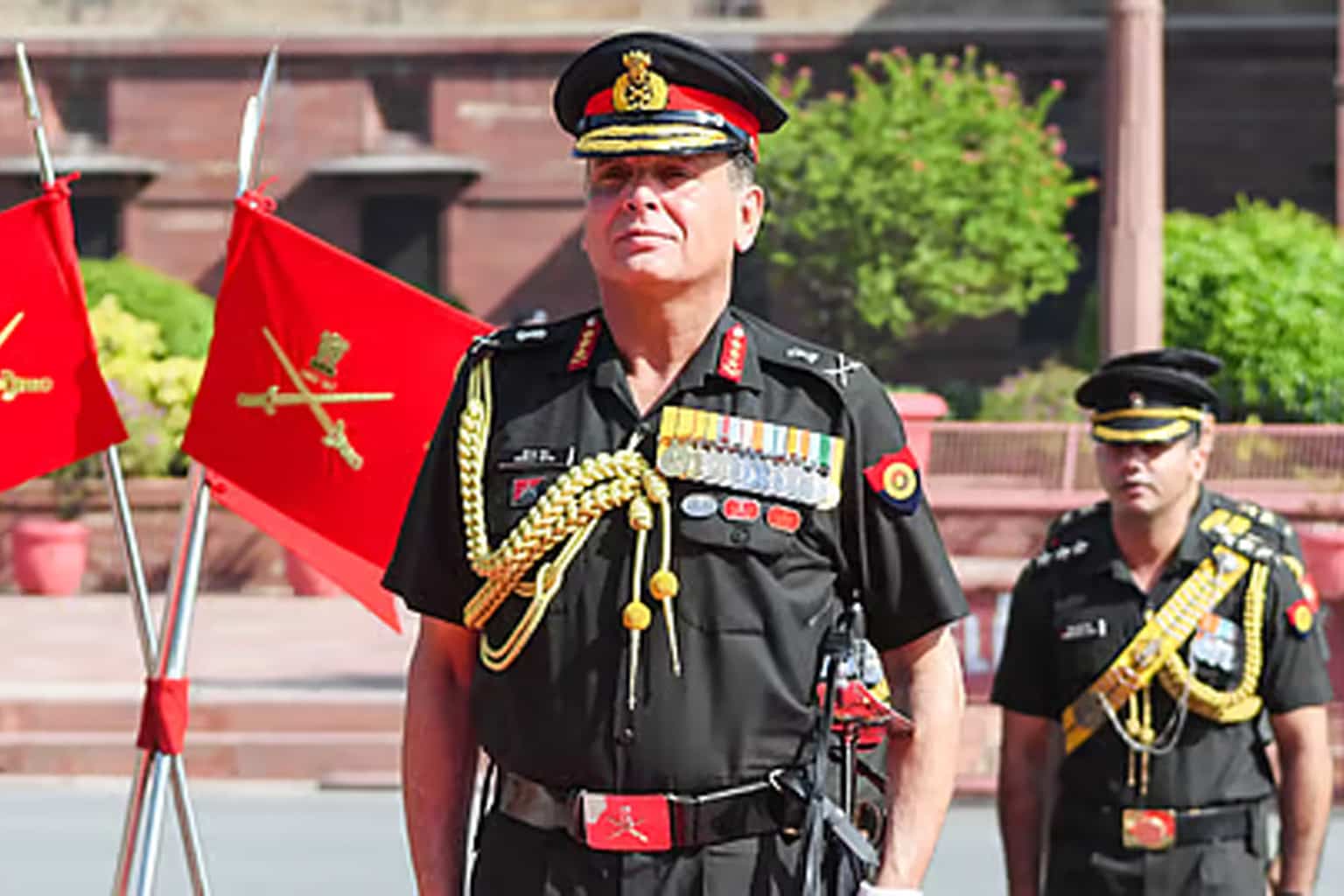
Lt Gen Dhiraj Seth will take over as Chief of Army Staff on 30 June 2026. Know what his appointment may mean for Army modernisation, technology, operational readiness, manpower and soldiers’ welfare.
The appointment of a new Army Chief is never only a change of name at the top.
It also brings attention to the direction in which the Indian Army may move in the coming years.
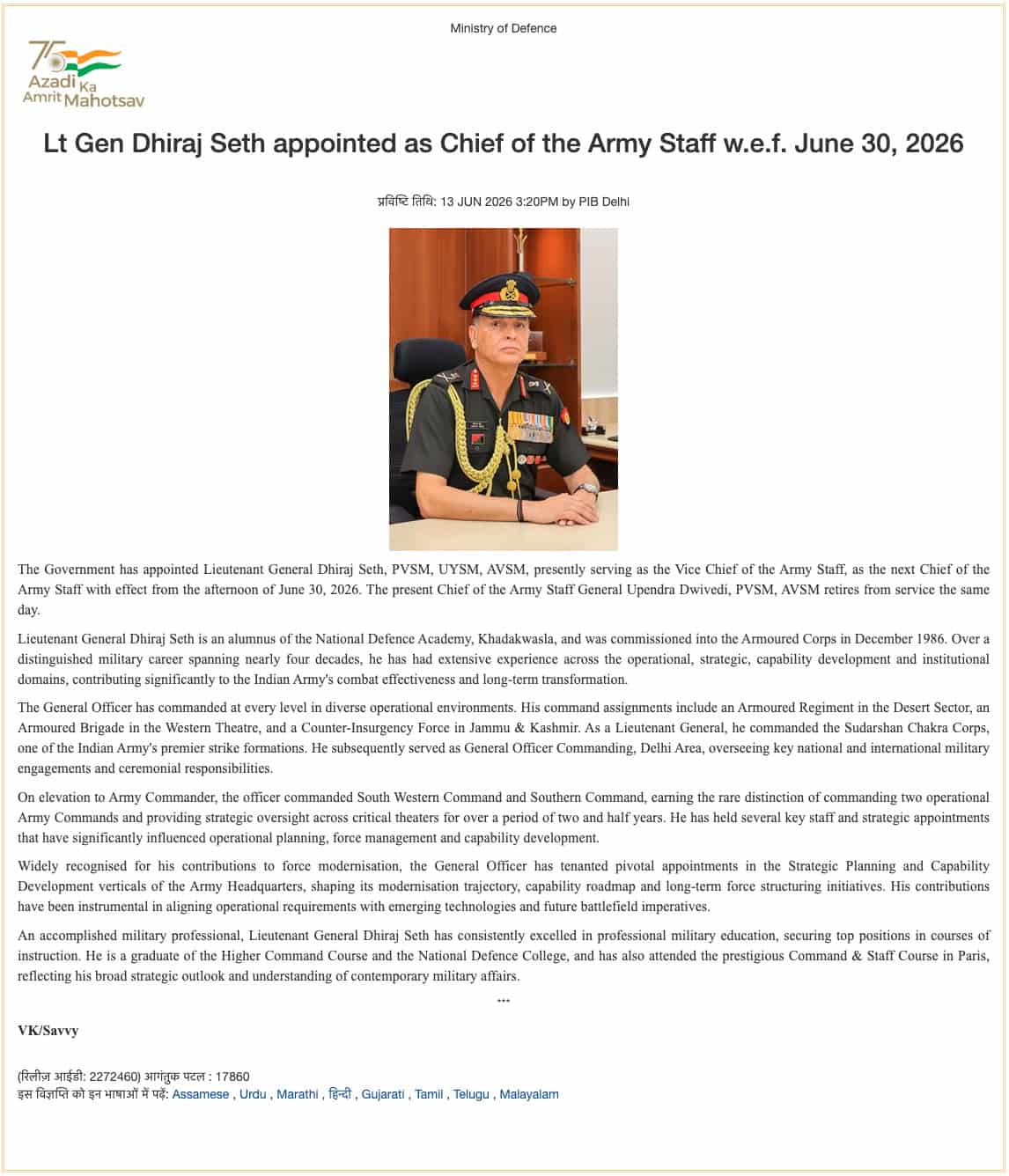
Lt Gen Dhiraj Seth, PVSM, UYSM, AVSM, presently serving as Vice Chief of the Army Staff, has been appointed as the next Chief of Army Staff. He is scheduled to assume charge on 30 June 2026, after the retirement of Gen Upendra Dwivedi the same day.
For soldiers, veterans, defence families and policy watchers, the important question is not only “who is the next Army Chief?” The larger question is: what priorities will matter now?
Why this appointment comes at an important time?
The Indian Army is operating in a period where traditional military strength and future battlefield technology must move together.
Border preparedness remains important. Counter-insurgency experience remains relevant. But new challenges are also rising: drones, electronic warfare, long-range precision systems, cyber threats, battlefield surveillance, secure communication and multi-domain operations.
The next Army leadership will have to balance all of this.
The Army cannot leave behind its old strengths. But it also cannot prepare for tomorrow with yesterday’s methods alone.
Official appointment details
Lt Gen Dhiraj Seth is currently the Vice Chief of the Army Staff. He will take over as Chief of Army Staff from the afternoon of 30 June 2026.
He succeeds Gen Upendra Dwivedi, who took charge as the 30th Chief of Army Staff in June 2024 and is retiring after completing his tenure.
This makes the transition significant because the Vice Chief’s role already involves close exposure to Army Headquarters, planning, capability development and institutional priorities.
A combat-arm officer with wide command exposure
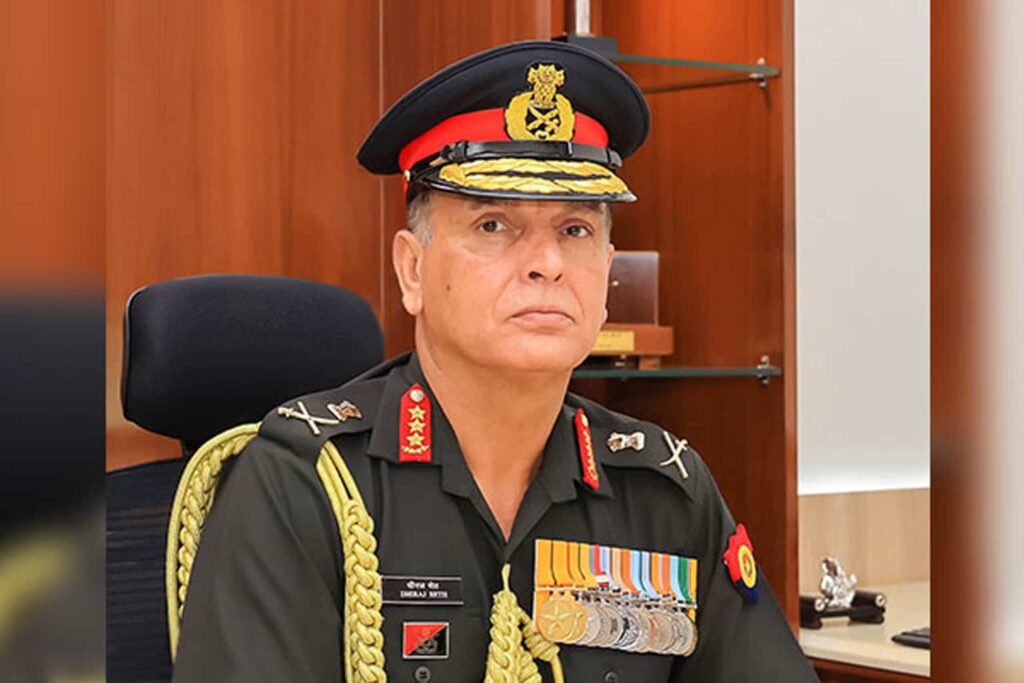
Lt Gen Seth was commissioned into the Armoured Corps in December 1986 after graduating from the National Defence Academy, Khadakwasla.
An Armoured Corps background brings a certain operational mindset: speed, mobility, firepower, manoeuvre, terrain appreciation and coordination between different arms.
But his profile is not limited to one combat arm. His career has reportedly included command and staff exposure across different theatres and levels, including operational, command and strategic appointments.
That matters because the Army Chief has to think beyond one formation, one sector or one arm. He has to look at the entire Army as a national instrument.
What may be the key priorities?
The next phase of Army leadership is likely to remain focused on five broad areas.
First, operational readiness. The Army must stay prepared for present security challenges across sensitive borders and internal security-linked environments.
Second, technology absorption. New tools such as drones, counter-drone systems, surveillance platforms, AI-enabled decision support, electronic warfare and secure networks are becoming central to modern combat.
Third, training transformation. New equipment is useful only when troops are trained to use it in realistic conditions.
Fourth, jointness. Future warfare will require closer coordination among Army, Navy, Air Force, cyber, space, intelligence and logistics systems.
Fifth, manpower and morale. No modernisation can succeed if the soldier’s confidence, family welfare and dignity are ignored.
Why modernisation is not only about new weapons?
Modernisation is often misunderstood as only buying new equipment.
That is incomplete.
True modernisation also means faster decision-making, better logistics, digital command systems, reliable communication, ammunition confidence, maintenance support, theatre-level coordination and field-level adaptability.
A drone is useful only if the unit knows how to deploy it. A new vehicle matters only if spares and maintenance are available. A modern communication system matters only if it works under pressure.
So the real test of modernisation is not the announcement. It is field performance.
Why soldiers’ welfare remains central?
The Chief of Army Staff is not only responsible for combat readiness. The office also carries institutional responsibility towards soldiers, officers, JCOs, veterans and families.
Issues linked with pay, pension, dignity, service conditions, promotion pathways, accommodation, family support, medical care and morale remain important for the Army’s long-term strength.
A force can have advanced technology, but its fighting spirit still depends on the soldier.
This is why welfare and readiness should not be treated as separate subjects. They are connected.
A confident soldier strengthens operational capability.
Why this matters for defence aspirants?
For young defence aspirants, Lt Gen Dhiraj Seth’s journey gives a practical lesson.
Military leadership is not created quickly. It develops through years of training, field responsibility, command appointments, staff exposure and continuous professional learning.
A young officer starts with basic command, but the journey towards senior leadership requires performance in many conditions: field, staff, operations, training, administration and planning.
For aspirants, the message is clear: joining the forces is only the first step. The real test begins after wearing the uniform.
What should readers not assume?
This appointment should be reported carefully.
Lt Gen Dhiraj Seth has been appointed as the next Army Chief, but he will take charge on 30 June 2026. Until then, Gen Upendra Dwivedi remains the serving Chief.
Also, no new welfare policy, pay decision, pension change, recruitment reform or operational doctrine should be attributed to him unless it is officially announced.
A leadership transition is important, but speculation should not be presented as fact.
Comment
The Indian Army is standing at a point where tradition and technology must work together.
Its strength still comes from discipline, leadership and soldiers on the ground. But future readiness will require faster adaptation, smarter equipment, better networks and stronger coordination.
Lt Gen Dhiraj Seth’s appointment will be watched closely because the Army’s next phase must balance battlefield preparedness with institutional welfare.
The best Army leadership will be the one that prepares for future threats without losing sight of the soldier who carries the burden of every order.
Final takeaway
Lt Gen Dhiraj Seth’s appointment as the next Chief of Army Staff marks an important transition for the Indian Army.
His Armoured Corps background, Vice Chief role and wide command experience make this change significant at a time when the Army is focusing on readiness, modernisation and future warfare.
For soldiers and veterans, the key expectation will remain simple: strengthen combat capability, protect morale and keep welfare at the centre of institutional responsibility.
A modern Army needs technology.
But it also needs leadership that understands the battlefield, the organisation and the soldier.
Sources:-
Akashvani/News on AIR report:
https://newsonair.gov.in/lt-gen-dhiraj-seth-appointed-as-chief-of-army-staff-with-effect-from-june-30-2026/
Times of India report:
https://timesofindia.indiatimes.com/defence/news/centre-appoints-lt-gen-dhiraj-seth-as-next-chief-of-army-staff/articleshow/131701535.cms
Indian Express report:
https://indianexpress.com/article/india/lt-gen-dhiraj-seth-next-chief-of-army-staff-10737878/
Hindustan Times report:
https://www.hindustantimes.com/india-news/lt-general-dhiraj-seth-appointed-as-next-army-chief-to-assume-office-on-june-30-101781343580912.html




Leave a Reply