

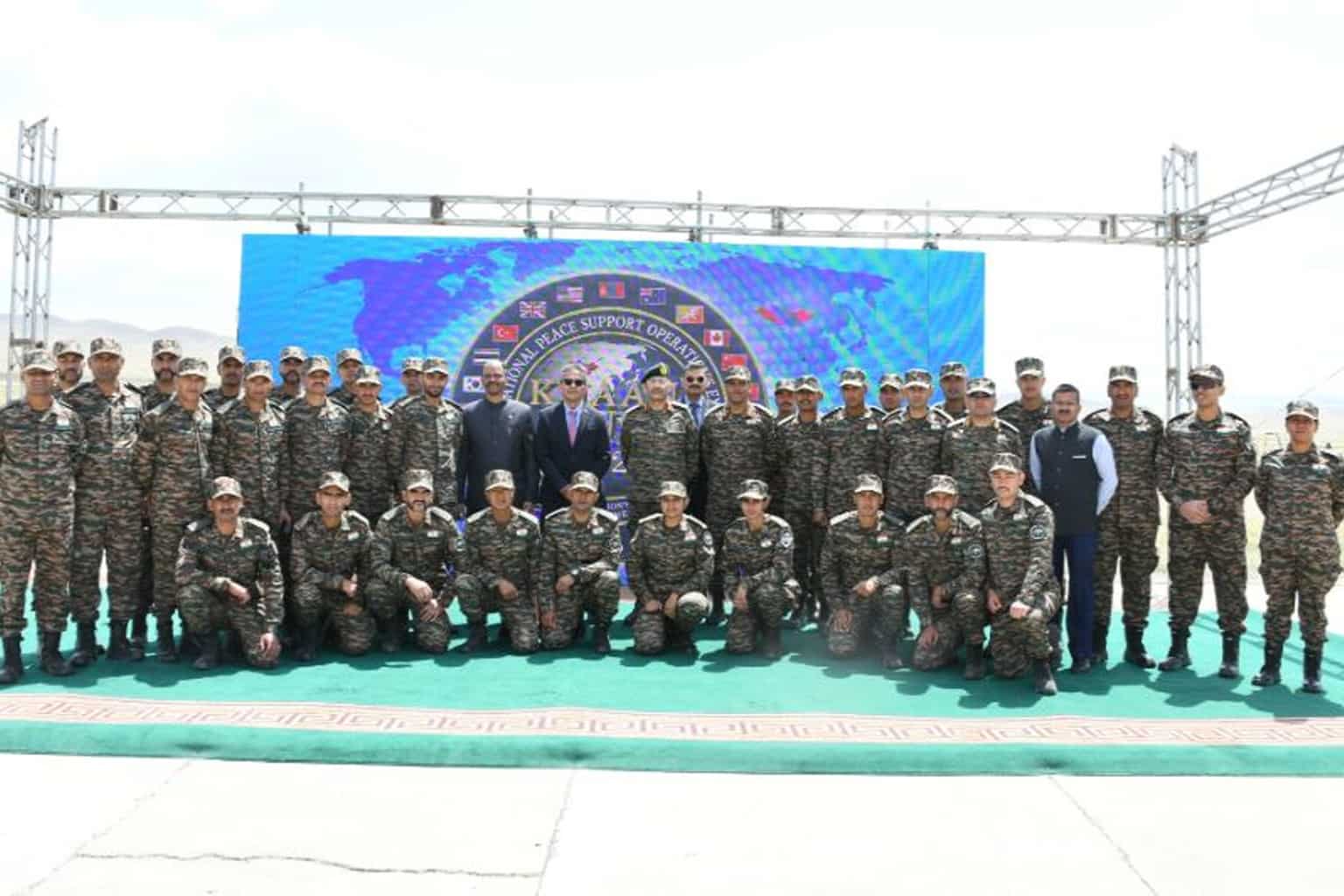
Exercise KHAAN QUEST 2026 will be held in Mongolia from 20 June to 03 July. Indian Army’s 40-member contingent will train for UN peacekeeping, joint planning, counter-IED drills and multinational operations.
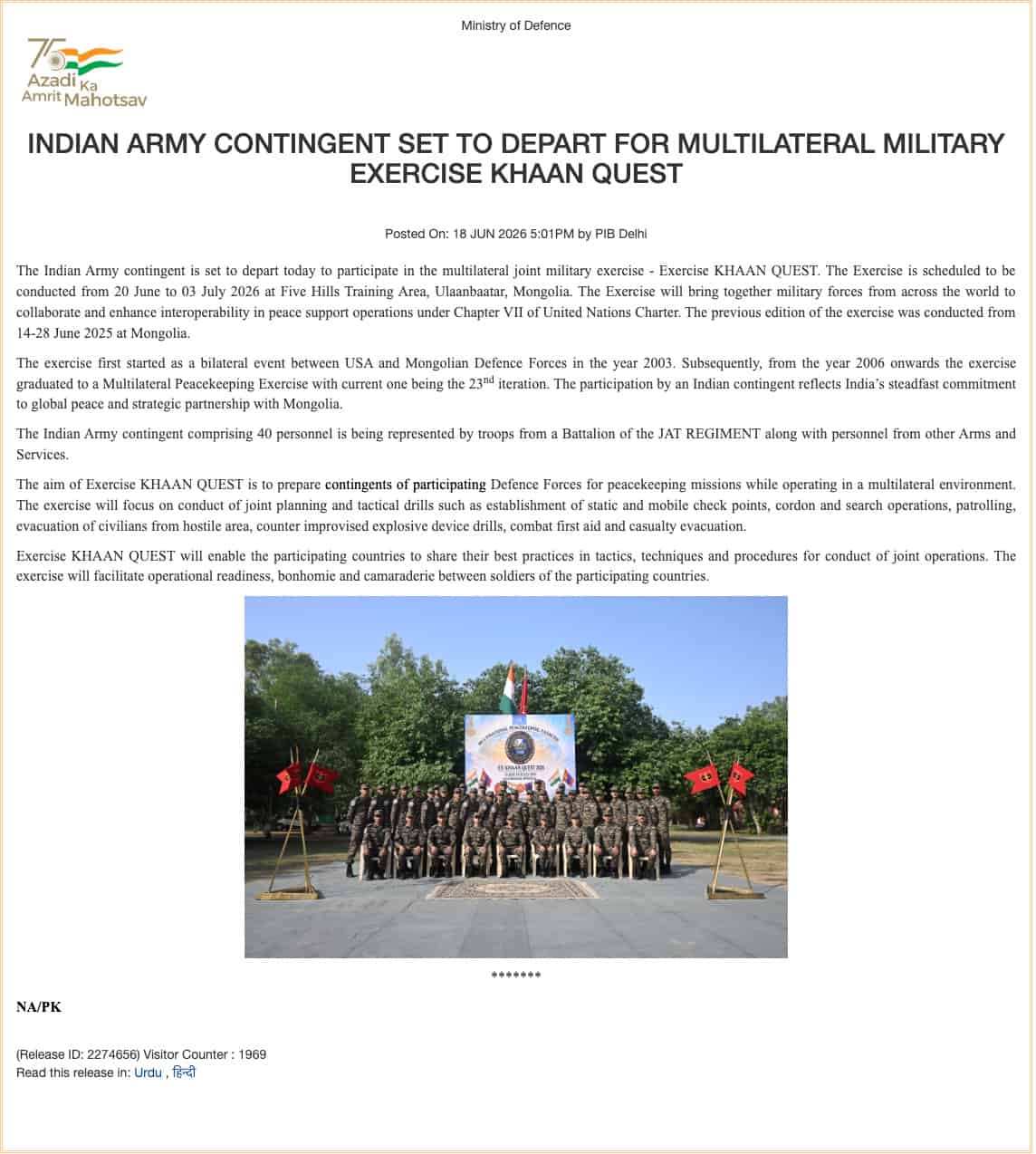
The Indian Army’s participation in Exercise KHAAN QUEST 2026 is not just another military exercise update.
It is a reminder that modern soldiering is not limited to border defence or conventional combat. Indian soldiers are also trained to operate in international peacekeeping environments, where discipline, restraint, coordination and quick decision-making matter as much as firepower.
Exercise KHAAN QUEST 2026 will be conducted in Mongolia from 20 June to 03 July 2026 at the Five Hills Training Area, Ulaanbaatar. The Indian Army contingent includes 40 personnel, mainly from a battalion of the JAT Regiment, along with personnel from other Arms and Services.
This participation matters because India has a long and respected history in United Nations peacekeeping. Training with foreign armies helps Indian troops remain prepared for complex missions where military skill must be combined with humanitarian responsibility.
What is Exercise KHAAN QUEST 2026?
Exercise KHAAN QUEST is a multinational military exercise hosted in Mongolia.
It began in 2003 as a bilateral exercise between the United States and the Mongolian Defence Forces. From 2006 onwards, it became a multilateral peacekeeping exercise. The 2026 edition is the 23rd iteration of this training event.
The main focus is to prepare troops for peace support operations in a multinational environment.
This means soldiers do not train only with their own formations. They operate with troops from other countries, follow common mission objectives and learn how different armies approach peacekeeping tasks.
Why Mongolia is important for this training?
The exercise is being held at the Five Hills Training Area near Ulaanbaatar.
This location gives participating troops exposure to a different terrain, climate and training culture. For Indian Army personnel, such foreign exercises are useful because they create learning outside familiar field conditions.
Peacekeeping missions can take soldiers to unfamiliar countries and difficult regions. Training in a foreign environment helps troops adjust to new terrain, communication styles and multinational command arrangements.
Why JAT Regiment participation is significant?
The Indian Army contingent is represented by troops from a battalion of the JAT Regiment, supported by personnel from other Arms and Services.
Infantry remains central to peacekeeping tasks because soldiers on the ground are often responsible for patrolling, checkpoints, civilian protection, cordon tasks and area domination.
At the same time, personnel from other Arms and Services add important support in communication, logistics, medical response, planning and field coordination.
This mix reflects the real nature of peacekeeping. It is never only one-arm work. It requires teamwork across the military system.
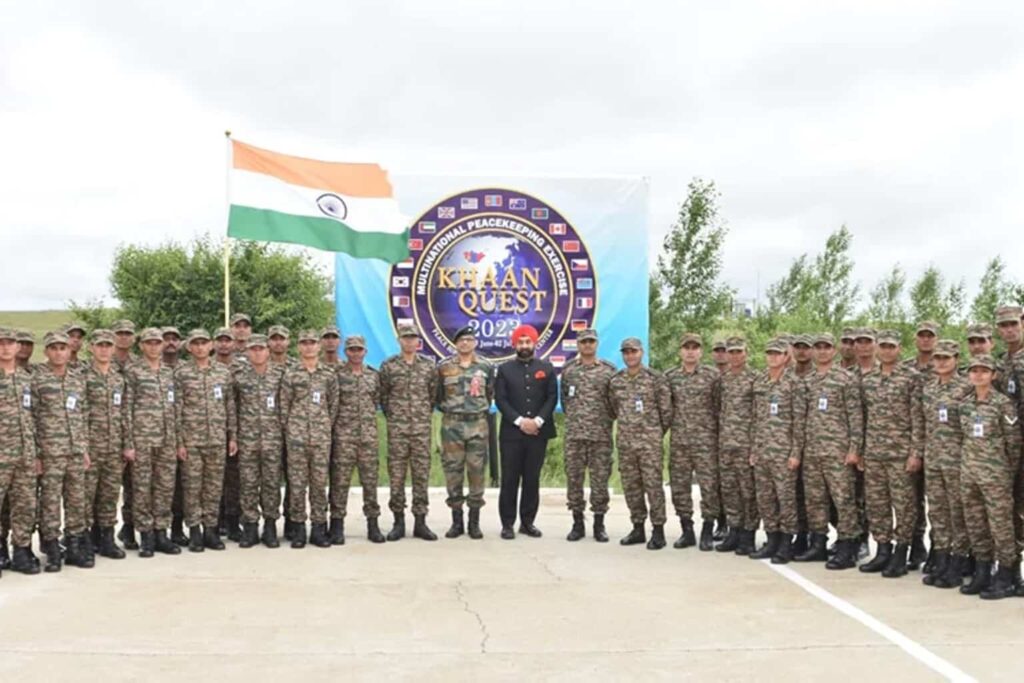
What kind of training will be conducted?
Exercise KHAAN QUEST 2026 will focus on practical peacekeeping drills.
The training activities include:
Static and mobile checkpoints
Cordon and search operations
Patrolling
Evacuation of civilians from hostile areas
Counter-IED drills
Combat first aid
Casualty evacuation
Joint planning in a multinational environment
These drills are important because peacekeeping missions often happen in unstable areas where civilians, armed groups, local tensions and security risks may exist together.
A soldier must know how to act firmly without losing restraint.
Why Chapter VII of the UN Charter matters?
The official update refers to peace support operations under Chapter VII of the United Nations Charter.
In simple terms, Chapter VII deals with action related to threats to peace, breaches of peace and acts of aggression.
For soldiers, this means the training is not only about symbolic peacekeeping. It involves real operational situations where troops may need to protect civilians, control hostile areas, respond to threats and maintain security under difficult conditions.
This is why Exercise KHAAN QUEST is relevant for practical mission readiness.
Why peacekeeping training is different from normal field training?
Peacekeeping requires a different mindset.
In a normal combat situation, the aim may be to defeat the enemy. In peacekeeping, the aim may be to stabilise an area, protect civilians, support humanitarian movement, prevent escalation and maintain trust among local communities.
A peacekeeper must be alert but not aggressive without reason.
He must understand rules of engagement.
He must communicate clearly.
He must work with foreign troops.
He must respect civilians.
He must respond quickly when danger appears.
This balance makes peacekeeping training very important.
prepares for peace support, humanitarian response, multinational coordination and civilian protection.
This is where Indian soldiers carry a larger responsibility.
They do not only wear the uniform of their regiment. They also carry India’s image in front of the world.
That is why exercises like KHAAN QUEST matter.
Final takeaway
Exercise KHAAN QUEST 2026 will be conducted in Mongolia from 20 June to 03 July 2026.
The Indian Army is sending a 40-member contingent, represented mainly by troops from a battalion of the JAT Regiment, along with personnel from other Arms and Services.
The exercise will focus on UN peacekeeping-style training, including checkpoints, patrolling, cordon and search, civilian evacuation, counter-IED drills, combat first aid and casualty evacuation.
For India, this is a defence cooperation opportunity.
For soldiers, it is professional exposure.
For defence aspirants, it is a reminder that the Indian Army’s role is not limited to one battlefield.
A strong Army protects the nation at home and represents its values abroad.
Sources:-
PIB / Ministry of Defence official release:
https://www.pib.gov.in/PressReleasePage.aspx?PRID=2274656&lang=1®=48
News on AIR / Akashvani report:
https://newsonair.gov.in/indian-army-contingent-leaves-for-mongolia-to-participate-in-exercise-khaan-quest-2026/
PIB 2025 background release:
https://www.pib.gov.in/PressReleasePage.aspx?PRID=2135590



Leave a Reply