

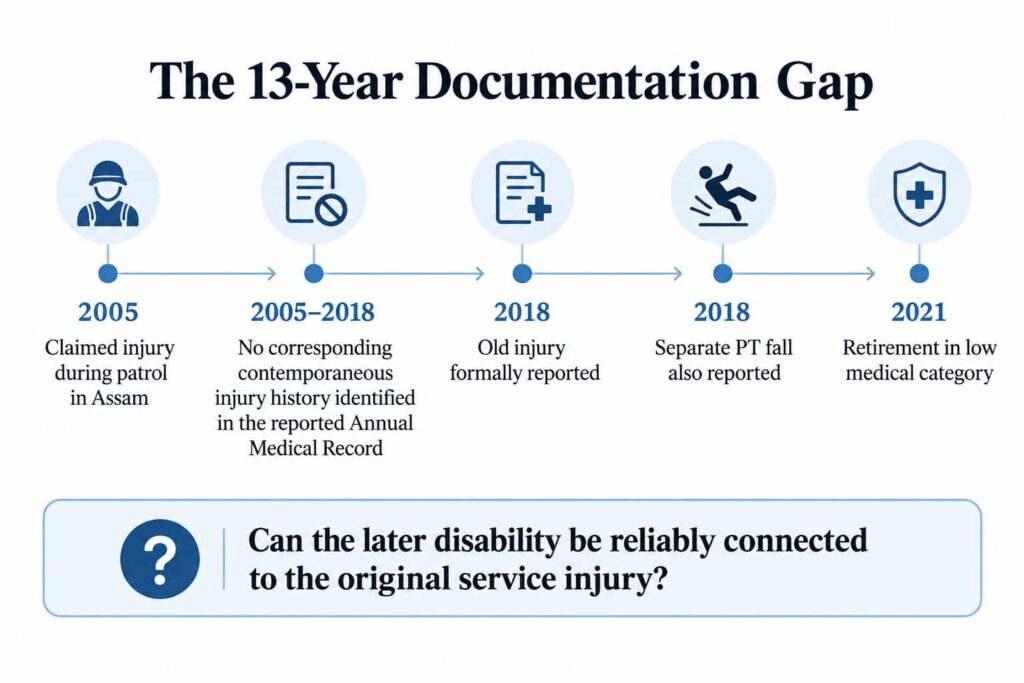
A disability claim in military service is rarely decided by one document or one medical opinion. In many cases, the real question is whether the records created over the years form a reliable chain connecting the original incident with the disability that exists at retirement.
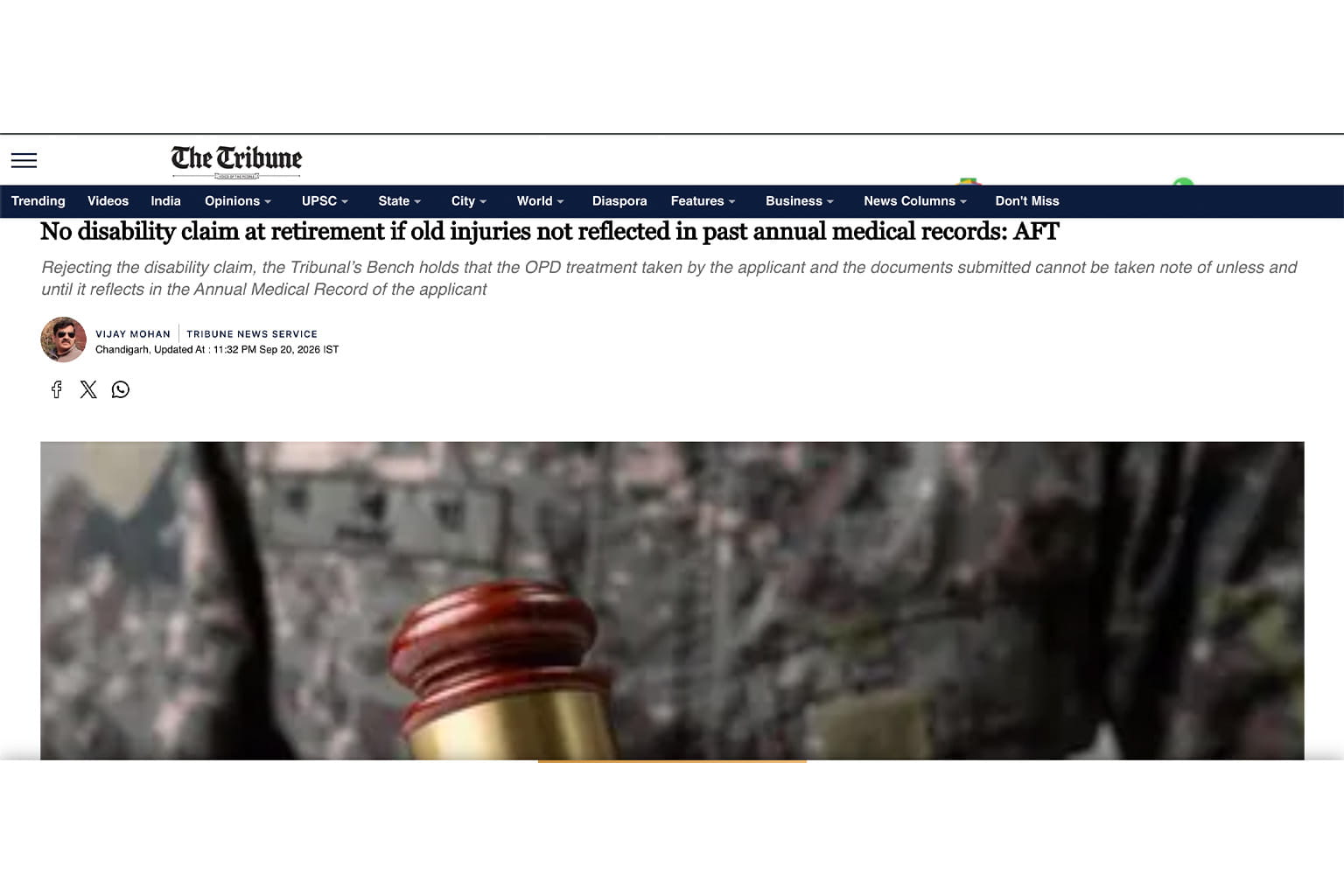
A recently reported Armed Forces Tribunal case involving a retired Brigadier illustrates this issue particularly well.
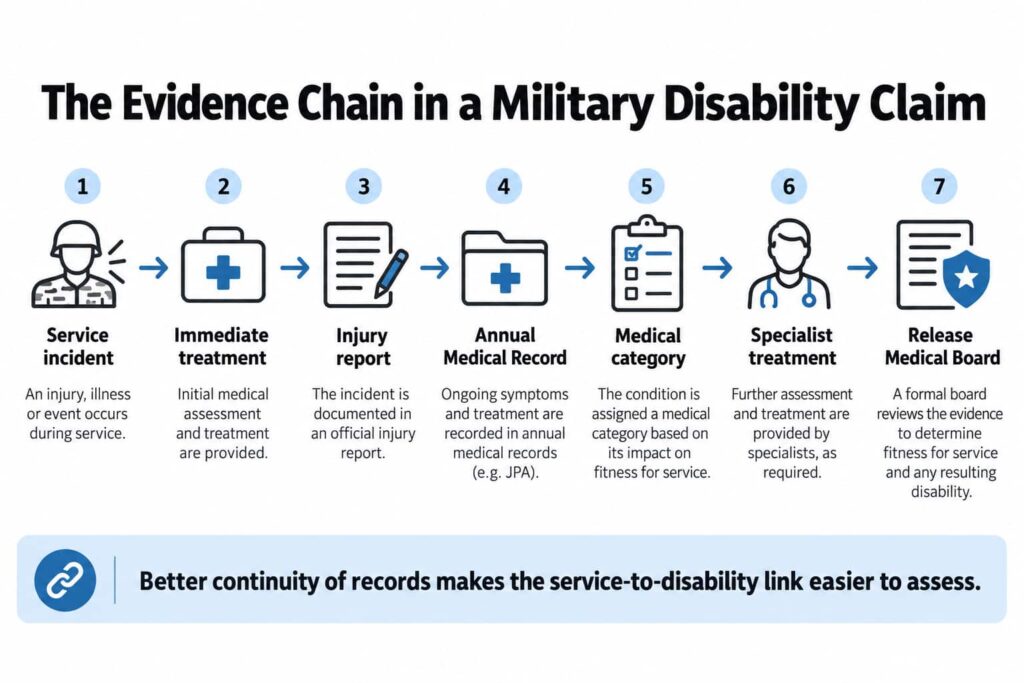
The officer claimed that an injury suffered during counter-insurgency duty in Assam in 2005 later contributed to his medical condition. The difficulty was that the alleged injury did not enter the formal medical record until 2018—more than 13 years later. When the Tribunal examined the available records, that gap became an important part of its assessment.
The significance of the case is therefore broader than a simple headline saying that a disability claim was rejected. It raises an important practical question for every serving person:
If an injury may affect you years later, what documentary trail exists to prove what happened and how the condition developed?
The case was not simply about a 13-year-old injury
The officer was commissioned in December 1986 and retired in March 2021 while in a low medical category.
According to the reported case, he stated that in January 2005, while posted at Lekhapani in Assam and engaged in counter-insurgency duties, he was on patrol when he and three other soldiers fell into a stream.
His version was that the other personnel were evacuated for treatment while he received first aid.
The major evidentiary difficulty arose because the alleged 2005 injury was reportedly brought formally to the notice of medical authorities only in April 2018.
That distinction matters.
The problem was not merely that the injury was old.
The Tribunal had to consider whether the available service and medical records reliably demonstrated that the old incident had continuing medical consequences that ultimately contributed to the disability at retirement.
2018 created a second layer in the case
The officer also reported another incident in 2018.
While posted at Sriganganagar, he reportedly fell during morning physical training and suffered injuries affecting his knee and back.
His case was that these were the same areas injured in 2005 and that the fresh episode effectively aggravated or reactivated the older injury.
That argument made the documentary chronology even more important.
If the 2005 injury had produced a continuing condition, the record could potentially have shown some medical history between the original incident and 2018.
If the 2018 incident itself produced a fresh injury, documentation of that episode would also become relevant.
The Tribunal reportedly noted an unusual feature: an injury report and Court of Inquiry were later initiated in relation to the 2005 incident, but there was reportedly no separate injury report or Court of Inquiry for the fresh 2018 incident.
Why did the Annual Medical Record become so important?
This appears to have been one of the most important parts of the Tribunal’s reasoning.
The original Annual Medical Record reportedly showed the officer as SHAPE-1.
The Tribunal considered the later OPD papers and documents but found that the claimed history was not sufficiently supported by the original annual medical records. It also noted that the officer had continued to receive promotions during service and that the old injury was reported much later.
This does not mean that SHAPE-1 status automatically prevents a person from receiving disability benefits later.
A person can be fit at one point in service and subsequently develop an attributable or aggravated disability.
The important point in this case was different: the Annual Medical Record formed part of the evidence used to test the claim that an injury dating back to 2005 had continuing consequences.
The real issue was continuity, not simply delay
It would be misleading to convert this case into a rule saying:
“If an injury is reported late, the disability claim must fail.”
That is not the useful lesson.
A delayed report may still be capable of being supported by other reliable evidence.
The difficulty becomes greater when several factors appear together:
an old incident is reported many years later, the intervening medical history does not clearly reflect it, later documentation is created retrospectively, and the link between that event and the eventual disability remains uncertain.
According to the reported reasoning, the Tribunal was ultimately not satisfied that there was a demonstrable causal or aggravating connection between military service and the onset or progression of the disability claimed.
Why a later Medical Board finding may not end the dispute?
According to the reported facts, a subsequent medical process treated the old injury as connected with military service.
But the Judge Advocate General’s Department reportedly questioned the injury report and Court of Inquiry because both had been initiated after a delay of more than 13 years.
This highlights another important feature of disability cases.
A favourable medical conclusion can be important, but the underlying records and reasoning may still be examined.
Similarly, a negative medical opinion is not necessarily beyond scrutiny simply because it was given by a Medical Board.
The reliability of a disability determination often depends on whether the conclusion is supported by the chronology, clinical findings and service records available in the case.
What does the case tell serving personnel?
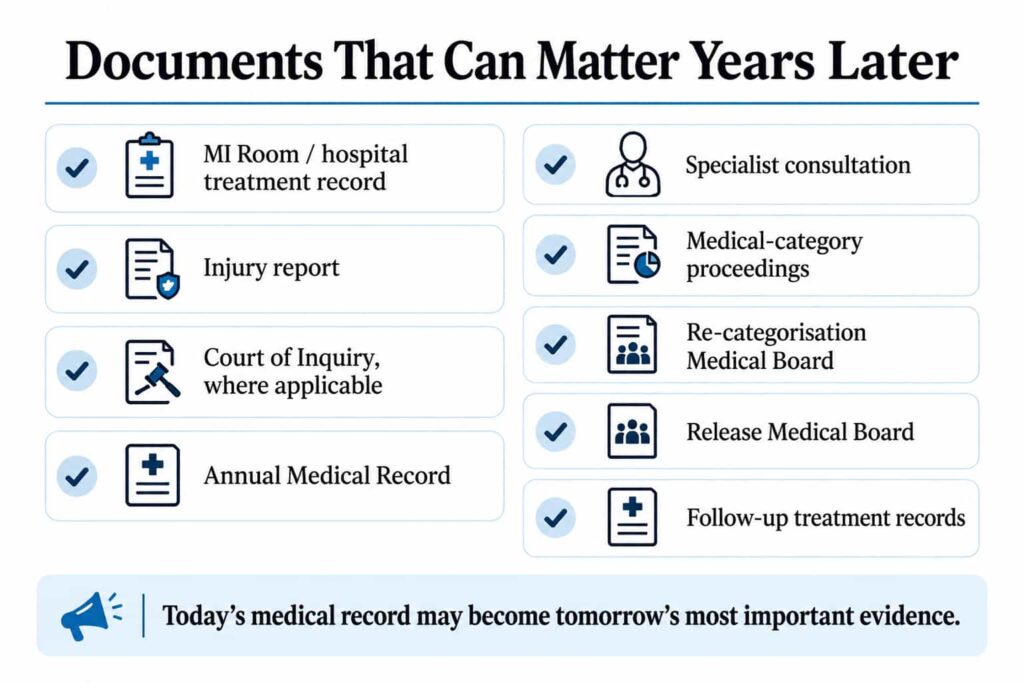
The practical value of this case lies in documentation.
A soldier may recover from an injury and continue performing duties for years. At the time, the incident may appear minor.
But if the same knee, spine, shoulder or other body part causes significant problems later, records created near the time of the original incident may become extremely important.
That does not mean every minor injury requires litigation-oriented paperwork.
It means that when a genuine service injury requires treatment, personnel should ensure that the medical and service documentation accurately reflects what actually happened.
Does one missing Annual Medical Record entry automatically defeat a claim?
No such universal conclusion should be drawn from the reported case.
Disability claims are fact-specific.
There may be cases where an injury is supported through hospital admission records, imaging, specialist treatment, operational documents, witnesses, injury reports or other contemporaneous evidence even if one particular annual examination does not contain a detailed entry.
The lesson from the Brigadier’s case is therefore not that one missing entry automatically destroys entitlement.
The more accurate lesson is that a long period without supporting records can make it harder to establish continuity when an old incident is relied upon many years later.
What about injuries that become serious only after several years?
That situation is entirely possible.
Some musculoskeletal conditions can worsen gradually. An initially manageable injury can later produce degenerative or functional problems.
But for disability-entitlement purposes, a medical possibility and a legally established service connection are not always the same thing.
The evidence may still need to show why the later disability is attributable to or aggravated by military service.
That is why chronology matters.
A record showing the original injury, treatment, recurring symptoms, specialist review and eventual medical downgrading can tell a very different evidentiary story from an old incident that appears for the first time shortly before retirement.
This case should not create unnecessary concern among veterans
Veterans with delayed or old disability claims should not conclude from one reported AFT decision that their claim is automatically weak.
The publicly available report concerns the particular evidence before the Tribunal in this case.
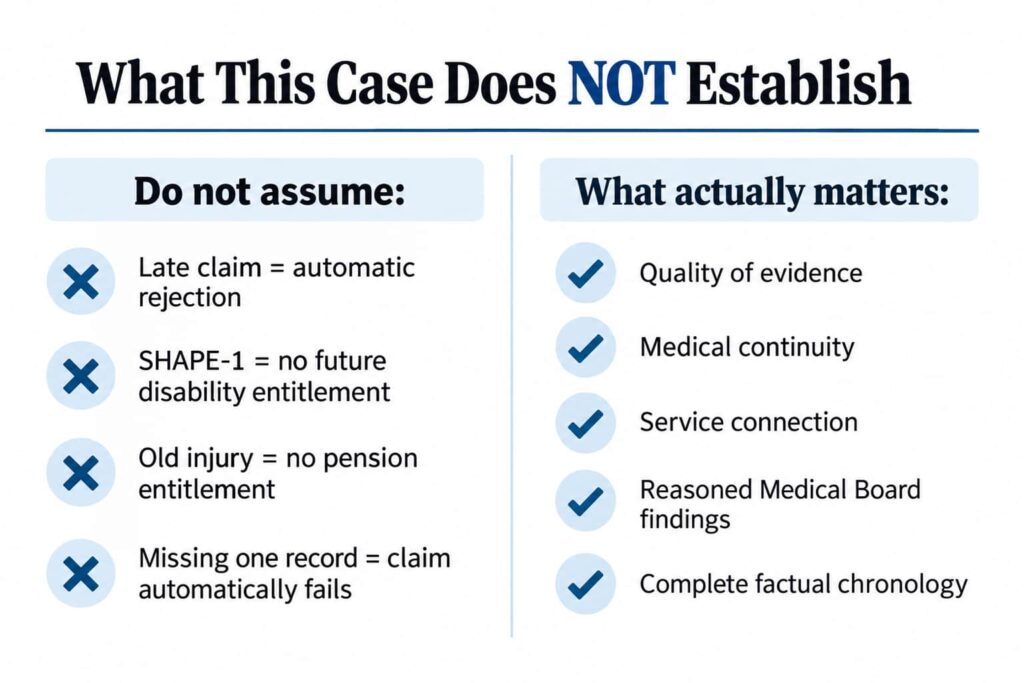
It does not establish that:
- every late-reported injury must be rejected;
- every SHAPE-1 record defeats a future disability claim;
- an old injury can never lead to disability benefits;
- every favourable Medical Board finding can be ignored; or
- a specific number of years automatically determines entitlement.
Each claim must ultimately be examined against its own medical and service record.
Why this case is especially relevant after recent disability-pension litigation?
The Brigadier’s case has emerged at a time when disability-pension law is receiving renewed judicial attention.
In September 2026, the Supreme Court dismissed hundreds of government appeals arising from disability-pension matters and examined issues relating to medical boards, attributability, aggravation and burden of proof.
That broader litigation is important, but it should not be treated as eliminating the need for evidence in individual cases.
A claimant may benefit from legal presumptions or burden-of-proof principles in the applicable framework, while the Tribunal may still need to examine whether the factual and medical material supports the claimed connection between service and disability.
That is why the two discussions—legal entitlement rules and quality of evidence—should not be confused.
The most useful way to read this AFT development
The value of this case is not in creating another rigid rule for veterans.
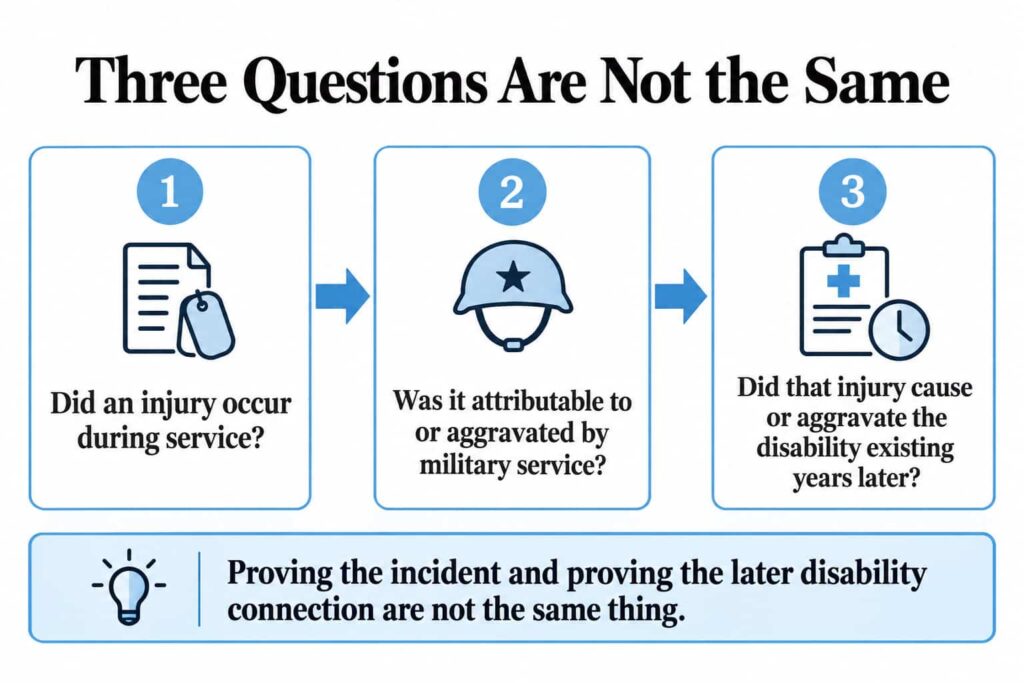
It is in showing how a disability claim can become difficult when three stages of the story do not connect clearly:
the original service incident, the medical history that follows, and the disability existing at retirement.
A strong record does not guarantee a particular legal outcome.
But a consistent contemporaneous record gives Medical Boards, pension authorities and courts a much clearer basis on which to assess the case.
For serving personnel, that is the practical lesson worth remembering:
Do not wait until retirement to reconstruct an important service injury if proper medical documentation can be created when the event actually occurs.
Important source clarification
The detailed facts regarding the retired Brigadier are based primarily on The Tribune’s report published on 20 September 2026 and the subsequent Sainik Welfare News analysis. The available official Armed Forces Tribunal material confirms that Justice Nandita Dubey and Administrative Member Rasika Chaube have served together on the Principal Bench.
However, the original order in this specific Brigadier’s matter, including the OA number and applicant’s identity, was not located in the publicly searchable material reviewed for this article.
For that reason, this article does not insert an unverified case number, disability percentage or additional finding that is absent from the available source material.
Sources
The Tribune — 20 September 2026
No disability claim at retirement if old injuries not reflected in past annual medical records: AFT
Armed Forces Tribunal — Principal Bench
Official AFT website
Sainik Welfare News — source analysis
AFT rejects Retired Brigadier’s Disability claim: Why a 13-year gap in Medical Records became crucial?





Leave a Reply