

For Central Government Nursing Officers, the discussion before the 8th Central Pay Commission is developing into something larger than a routine demand for higher basic pay.
The core question is increasingly about where nursing work should sit within the Government’s pay hierarchy when qualifications, clinical responsibility, night shifts, occupational exposure and round-the-clock patient care are considered together.
During the 8th CPC’s Chandigarh consultations, officially scheduled for 16–18 September 2026, nursing representatives placed several pay and service-condition concerns before the Commission. The Nurses Welfare Association’s most prominent reported proposal is to move the entry pay of Nursing Officers from Pay Level 7 to Pay Level 10.
The real debate is about the value attached to the post
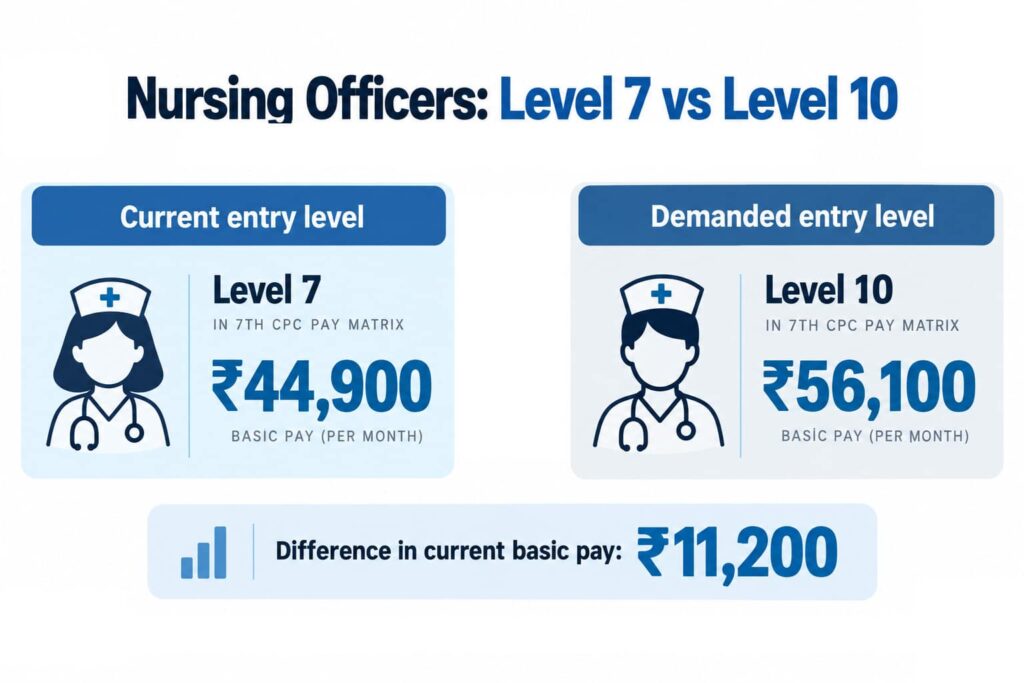
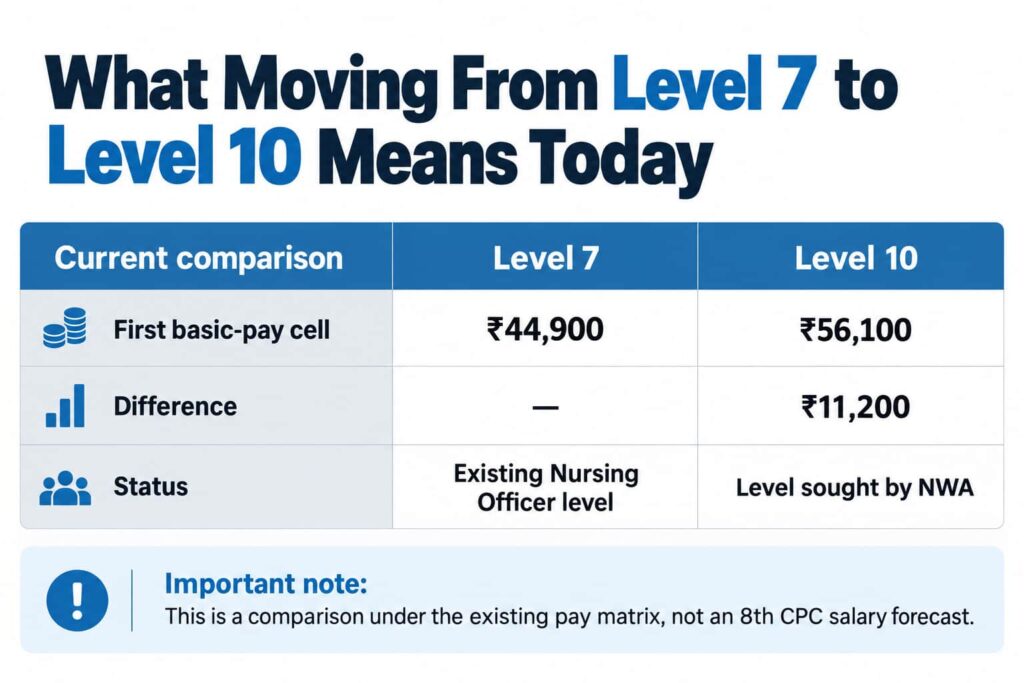
A Nursing Officer in a Central Government institution is generally placed in Pay Level 7. Official Ministry of Health recruitment rules show Level 7 at ₹44,900–₹1,42,400, while current recruitment material for Central Government healthcare institutions also reflects Nursing Officer posts at the same level.
The NWA is seeking entry at Level 10.
Under the existing 7th CPC pay matrix, Level 10 begins at ₹56,100. This creates a first-cell difference of ₹11,200 in basic pay compared with the Level 7 starting basic of ₹44,900.
But this comparison must be read carefully.
It does not mean that Nursing Officers will receive ₹56,100 as their 8th CPC entry pay. Both figures belong to the current 7th CPC matrix. They are useful only for understanding how large a structural jump the association is seeking.
Why are Nursing Officers referring to the Military Nursing Service?
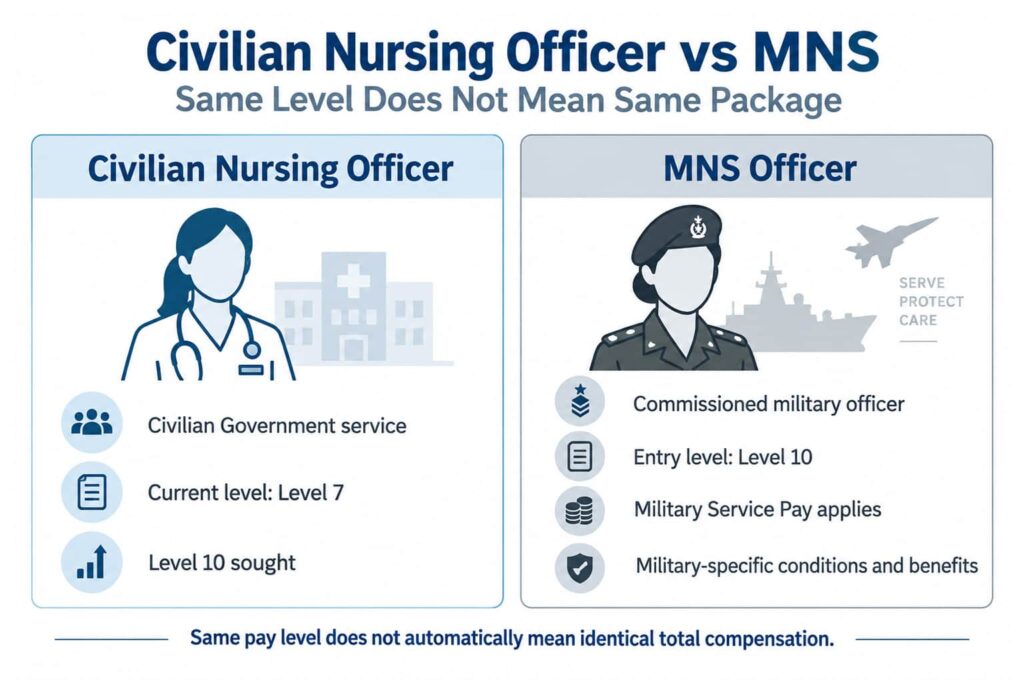
The association’s Level 10 argument is linked in part to the Military Nursing Service (MNS).
Under the applicable military pay structure, a newly commissioned MNS officer enters as a Lieutenant at Level 10. This gives nursing associations a comparator when arguing that professional nursing responsibilities should receive a higher entry placement. The reported NWA representation uses this comparison as part of its case for upgrading civilian Nursing Officers.
However, describing this simply as a demand for “full MNS salary parity” would be misleading.
An MNS officer is a commissioned military officer. In addition to the Pay Matrix level, eligible MNS officers receive military-specific compensation, including Military Service Pay of ₹10,800 per month under the existing framework. That element does not automatically arise merely because a civilian Nursing Officer is placed in the same Pay Level.
So the more accurate interpretation is:
Level 10 parity is being sought as a pay-level comparison; it would not by itself create identical MNS and civilian nursing compensation.
That explains why the representation goes beyond Level 10.
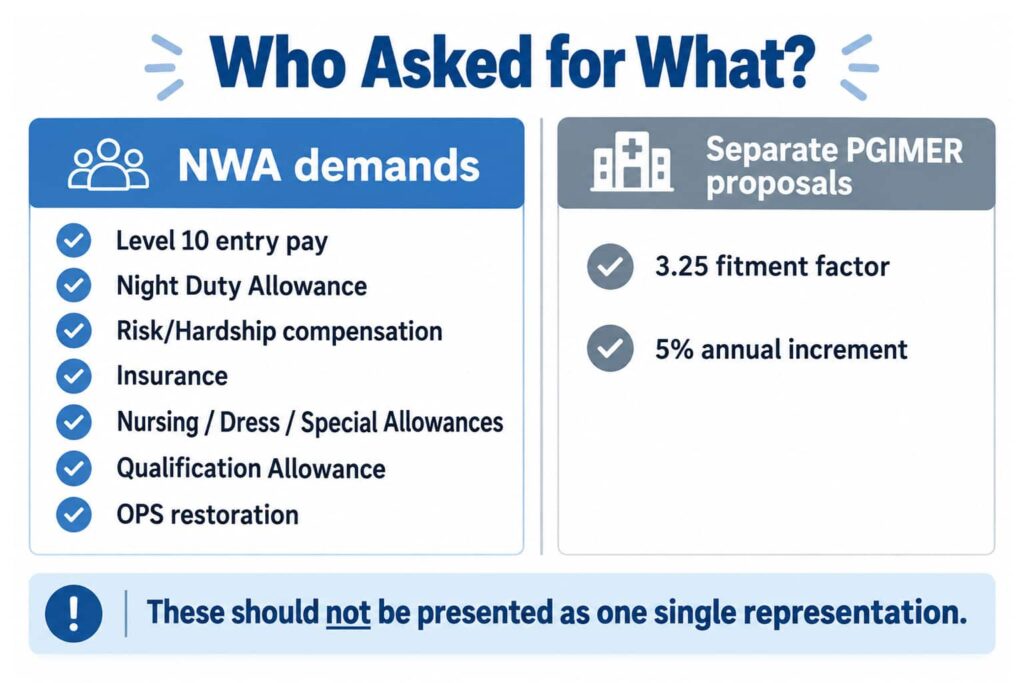
Reported NWA demands include a dedicated or improved Night Duty Allowance, Risk and Hardship compensation, better insurance protection, enhanced Nursing/Dress/Special Allowances, continuation of Qualification Allowance and restoration of the Old Pension Scheme.
Seen together, these demands indicate that the association is asking the Commission to consider not only the employee’s designation but also the conditions under which nursing duties are performed.
This makes the representation a job-evaluation issue as much as a pay-rise issue.
Level 10 and 3.25 fitment factor are not the same representation
This distinction is particularly important because several figures are now circulating together in discussions around nursing employees.
The Level 10 entry-pay proposal is prominently associated with the Nurses Welfare Association.
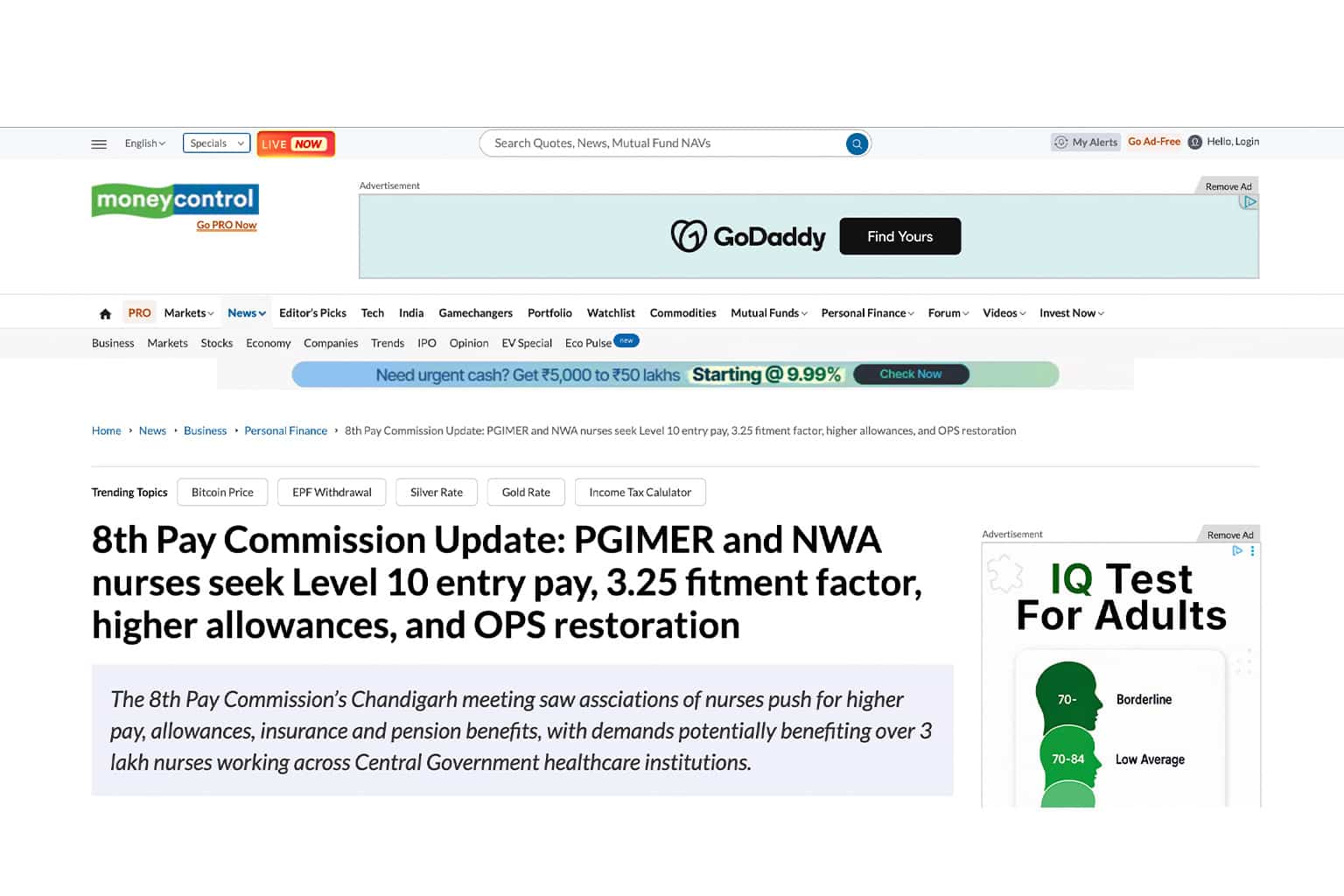
Separately, reports on representatives from PGIMER Chandigarh refer to demands including a 3.25 fitment factor and an annual increment of 5% instead of the existing 3%. Moneycontrol reported these proposals in connection with the Chandigarh interactions.
These proposals may concern overlapping groups of nursing personnel, but they should not be merged into one single demand document.
That distinction matters because otherwise a reader could incorrectly conclude that every nursing association has jointly demanded exactly the same fitment factor, increment and allowance package.
Why a three-level jump would be a major structural change?
The significance of the Level 10 proposal is not limited to the ₹11,200 difference visible in today’s first-cell basic pay.
Moving a post from Level 7 to Level 10 would mean changing its relative position within the Central Government pay hierarchy.
Such a change can have implications for future progression, promotional relationships, comparable cadres and the overall internal structure of pay levels.
That is why the Commission is unlikely to assess the issue only by asking whether nursing work is difficult.
A serious evaluation would also need to look at recruitment qualifications, professional responsibility, comparable posts, promotional structure, institutional hierarchy and financial implications.
The 8th CPC’s official work includes consultations with associations and extensive data collection, suggesting that stakeholder demands will ultimately have to be tested against a much wider administrative dataset.
The nursing case is also about professional progression
Another important aspect is career value.
If an employee begins at one Pay Level but carries increasing clinical responsibility without a corresponding progression in hierarchy or compensation, associations may interpret the issue as career stagnation, not simply low entry pay.
That is why the nursing representation needs to be viewed together with questions around qualification recognition, promotion, special allowances and responsibility attached to senior nursing positions.
In practical terms, the Commission will have to distinguish between two separate questions:
Should nursing employees receive higher compensation because of working conditions?
and
Should the post itself be placed higher in the basic pay hierarchy?
The first can potentially be addressed through allowances.
The second requires a structural change in Pay Level.
More than three lakh employees? Treat the number carefully
Media reports have said nursing organisations believe the proposals could potentially affect more than three lakh nursing personnel across Central Government healthcare institutions, AIIMS, ESIC facilities, PGIMER and other establishments.
However, this should be described as an association-linked estimate, not an official 8th CPC beneficiary figure.
No official Commission document reviewed here declares that exactly three lakh employees would receive the proposed benefits.
What has the 8th Pay Commission actually approved?
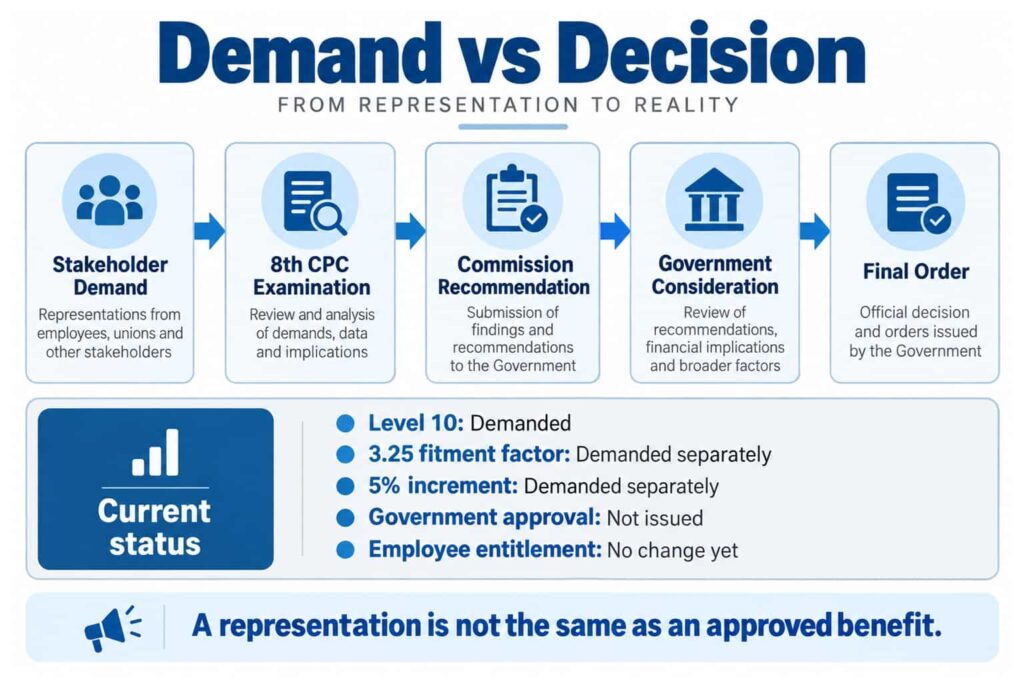
At this stage, none of the major nursing proposals discussed above should be presented as a final Commission decision.
There is currently no official 8th CPC order confirming Level 10 for Nursing Officers, a 3.25 fitment factor, a 5% annual increment, restoration of OPS or acceptance of the proposed nursing allowances. The Chandigarh exercise was part of the Commission’s stakeholder consultation process.
This difference between a representation and a recommendation is crucial.
A stakeholder may ask for Level 10.
The Commission may accept it, modify it, reject it or address the underlying concern in another way.
And even a future Commission recommendation would still require Government consideration before becoming an implemented pay rule.
What employees should watch next?
For Nursing Officers, the next meaningful development is not another salary projection based on an assumed fitment factor.
The stronger indicator will be whether the Commission eventually treats nursing as a case for structural pay-level revision, allowance reform, or a combination of both.
The Level 10 proposal will be particularly important because it asks the Commission to reconsider the Nursing Officer’s starting place in the hierarchy itself.
The MNS comparison may support the association’s argument, but it is not a perfect one-to-one comparator because military commissioning, service conditions and MSP create important differences.
Similarly, the 3.25 fitment factor and 5% increment proposals should continue to be reported as separate stakeholder demands unless a common formal representation establishes otherwise.
The bigger takeaway
The nursing representation before the 8th Pay Commission should not be reduced to one headline number.
The real debate is broader:
How should Government value a profession that combines specialist qualifications, clinical accountability, night work, physical workload and occupational risk?
The answer could come through a higher Pay Level, revised allowances, improved career progression or a combination of measures.
For now, however, one point remains clear:
Level 10 is a demand. MNS parity is an argument supporting that demand. A 3.25 fitment factor and 5% increment are separately reported proposals. None of these has yet become an 8th CPC recommendation or Government-approved benefit.
Sources
8th Central Pay Commission — Chandigarh Visit Notice
Official confirmation of the Commission’s Chandigarh consultations from 16 to 18 September 2026.
Official 8th CPC Chandigarh notice
Ministry of Health & Family Welfare — Nursing Officer Recruitment Rules
Official material showing Nursing Officer in Pay Level 7 (₹44,900–₹1,42,400).
Official Nursing Officer recruitment rules
Department of Expenditure — Seventh CPC Report
Official Pay Matrix source supporting the current Level 7 and Level 10 figures.
7th Central Pay Commission report
Moneycontrol — Nursing representations before 8th CPC
Reports the separate PGIMER proposals including 3.25 fitment factor and 5% increment.
Read the Moneycontrol report
Sainik Welfare News — Original nursing demand report
Provides the detailed distinction between the NWA representation, MNS comparison and separate PGIMER demands.
Read the Sainik Welfare News report


Leave a Reply