


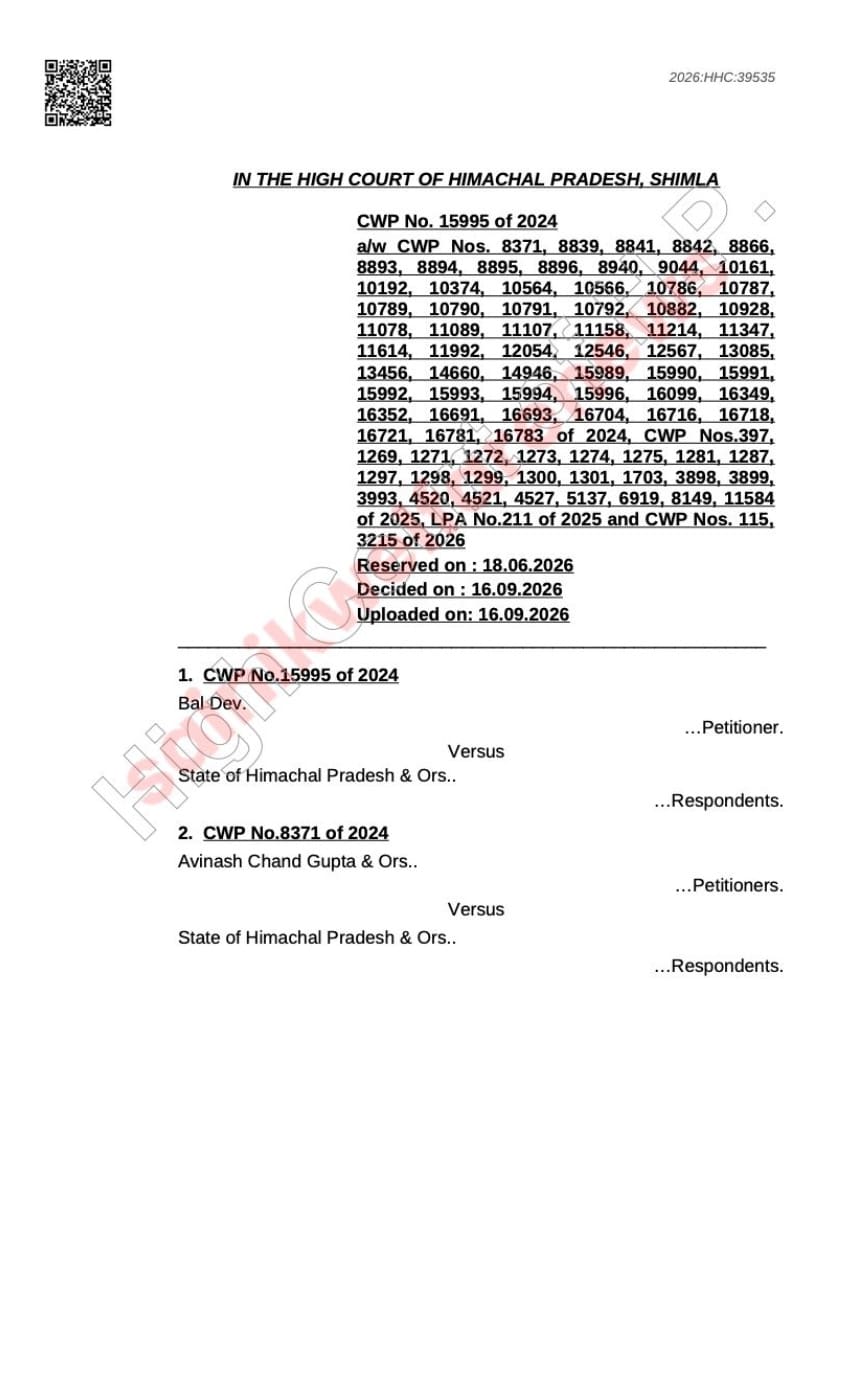
The debate over when commuted pension should be restored has received fresh judicial attention after the Himachal Pradesh High Court examined whether the existing 15-year restoration period still reflects present-day financial and actuarial realities.
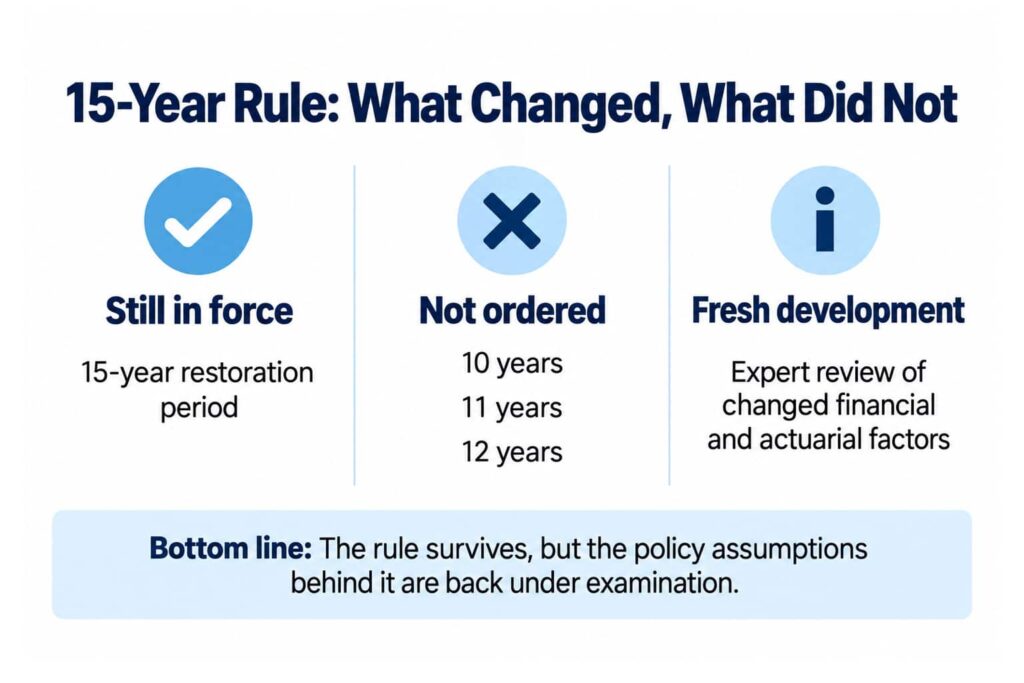
In Bal Dev v. State of Himachal Pradesh & connected matters, decided on 16 September 2026, the Court did not shorten the restoration period and did not invalidate Rule 10-A of the CCS (Commutation of Pension) Rules, 1981.
Yet the judgment is important for another reason.
The Division Bench of Justice Vivek Singh Thakur and Justice Ranjan Sharma observed that several assumptions behind the decades-old 15-year formula have changed over time and said that the issue should now be examined through an Expert Committee before the Government takes a fresh policy view.
Why this case matters beyond a simple pension dispute?
At first glance, the litigation appears to be about a straightforward question:
If the commuted amount has already been financially recovered, why should a pensioner wait 15 years for full pension restoration?
But the Court treated the issue as much broader than an individual recovery calculation.
Pension commutation involves:
- a lump-sum payment at retirement;
- reduction in monthly pension;
- actuarial assumptions;
- mortality risk;
- interest and discount factors;
- life expectancy;
- long-term pension liabilities; and
- financial risk carried by the Government.
That is why the Court did not treat commutation as an ordinary loan transaction.
What did the pensioners argue?
The petitioners were retired Himachal Pradesh Government employees who had opted to commute part of their pension.
Under the applicable framework, the reduced portion is restored after 15 years.
Their argument was that the financial environment today is very different from the period in which the restoration formula was originally developed.
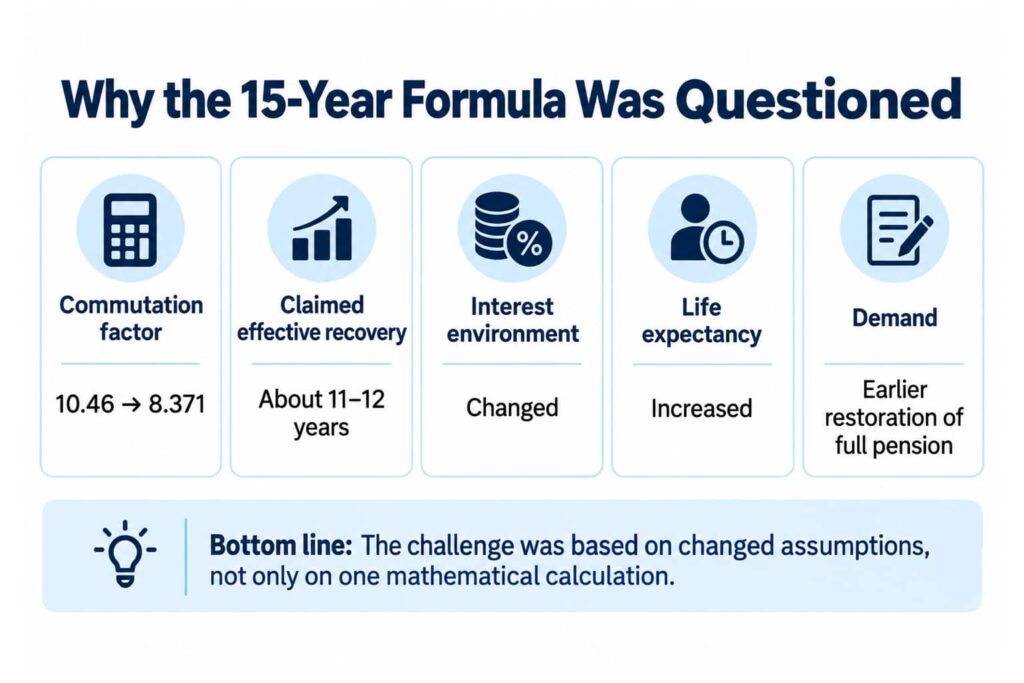
Among the points raised before the Court were:
- the commutation factor applicable around retirement age 58 had moved from 10.46 to 8.371;
- the lump-sum amount received by retirees had therefore reduced in relative terms;
- according to the petitioners’ calculations, the commuted value together with interest could effectively stand recovered in roughly 11 to 12 years;
- life expectancy had increased;
- prevailing interest conditions had changed; and
- continuing pension reduction after effective recovery was argued to be inequitable.
The petitioners therefore wanted the 15-year period to be reconsidered.
Why did the 15-year rule survive?
The High Court declined to substitute the statutory framework with a shorter period merely because some individual calculations suggested earlier recovery.
The judgment relied heavily on earlier legal principles flowing from decisions such as Common Cause and subsequent cases dealing with pension commutation.
The Court accepted that commutation is structured through actuarial balancing, rather than through a simple equation of:
lump sum paid ÷ monthly deduction = recovery period
That distinction is important.
If a pensioner dies before the restoration period is completed, the unpaid balance is not treated like an ordinary recoverable debt from the family. Family pension is also governed separately.
This mortality and financial risk is one of the factors built into the overall commutation framework.
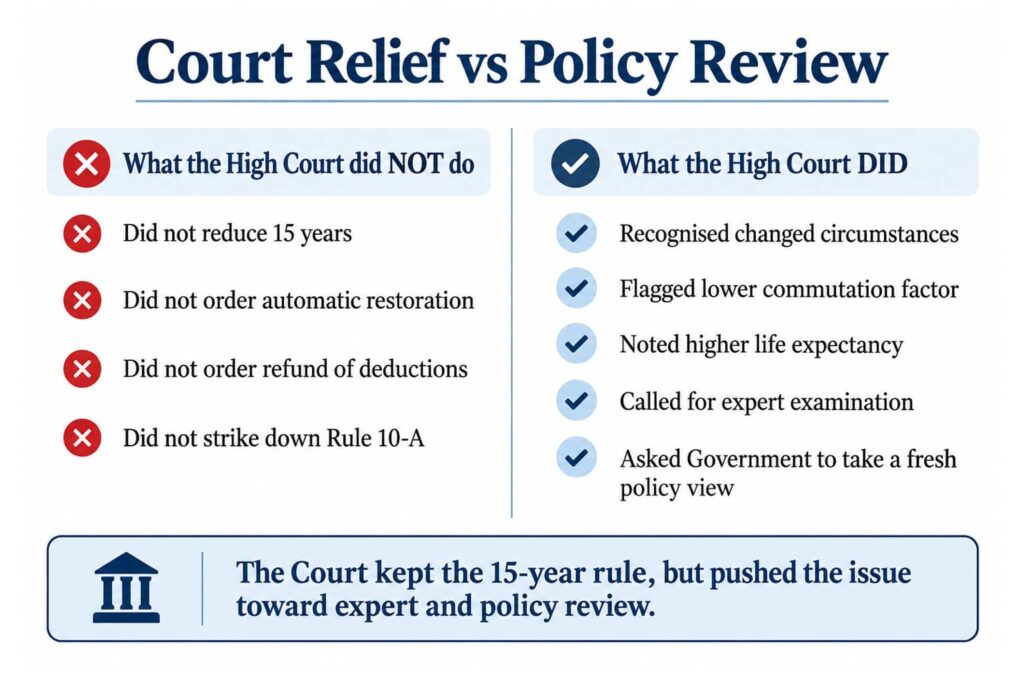
The Court did not cancel Rule 10-A
The judgment should not be presented as an order reducing the commutation period.
The Court did not direct that pension be restored after:
10 years
10 years 8 months
11 years
or
12 years
Nor did it strike down Rule 10-A.
Therefore, the existing legal position remains:
Commuted pension continues to be restored after 15 years under the applicable rule.
Any shorter period would require a policy or rule change by the competent authority.
Then why is the judgment still significant?
Because the Court did not simply say that the old rule should continue without further examination.
The Bench specifically observed that “much water has flown” since the 1987 Common Cause judgment.
The Court took note of several developments that may justify a fresh look at the policy.
These included:
- reduction in the commutation factor;
- changed interest and return conditions;
- higher life expectancy;
- potentially lower mortality-related risk to Government; and
- the passage of several decades since the earlier actuarial assumptions were examined.
This changes the significance of the case.
The Court did not grant an immediate financial benefit, but it clearly recognised that the underlying assumptions deserve re-examination.
The “Sahookar” observation gives the judgment a wider welfare dimension
One of the strongest observations comes near the end of the judgment.
The Court said the State should not act like a private “Sahookar” — money lender.
Instead, it should function as a welfare State and balance the interests of the public exchequer with those of retired employees.
That observation is important because it shifts the discussion away from only:
“Can the Court legally reduce 15 years?”
towards:
“Should Government policy itself now be re-examined?”
The Court emphasised that this exercise should be rational, balanced and undertaken in consultation with relevant stakeholders.
Why the Expert Committee becomes the real next step?
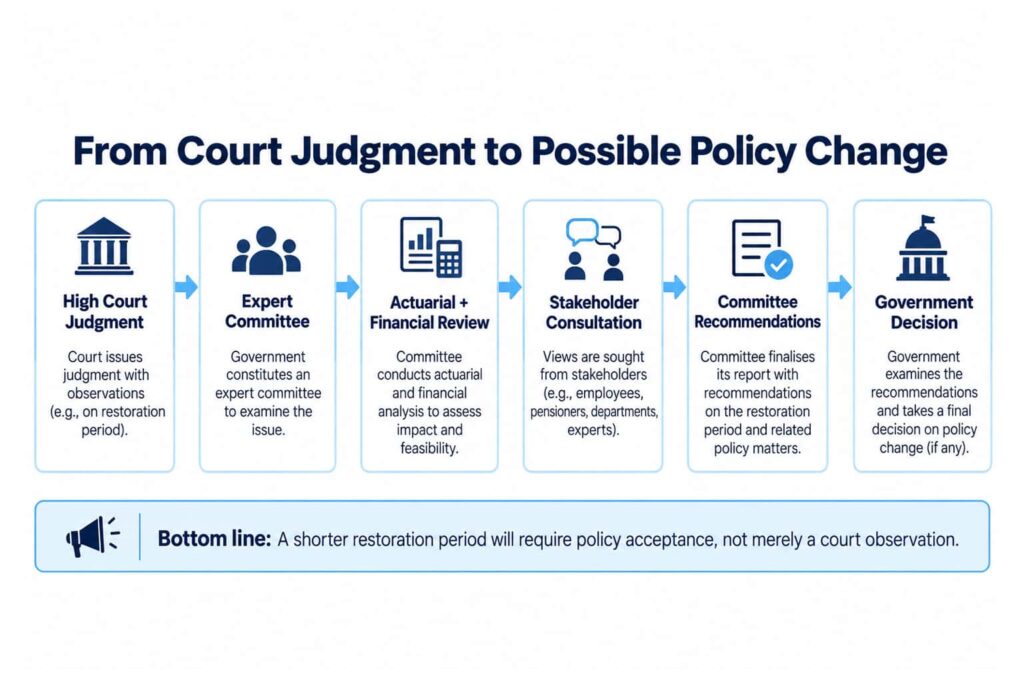
The most important future-facing part of the judgment concerns an Expert Committee.
The Court said the matter should be examined with inputs from stakeholders including:
- retirees;
- the Finance Department;
- Pay Commission;
- concerned Government departments; and
- other relevant authorities.
The judgment ultimately states that an Expert Committee must be constituted to examine changed circumstances and relevant parameters and submit its report/comments, including any proposed changes that may be considered necessary.
The Government is then expected to take the final call as expeditiously as possible.
This means the next major development will not necessarily come from another pension calculation.
It will depend on the policy review process.
Why the Pay Commission reference is especially relevant now?
For readers following the 8th Central Pay Commission, one aspect of the judgment deserves particular attention.
The Court specifically referred to consultation with the Pay Commission and other relevant departments while examining the issue.
This does not mean the 8th CPC has already taken up or accepted any proposal to reduce the commutation period.
But it does reinforce the fact that pension commutation is not merely an administrative calculation.
It sits within the wider framework of:
pension policy, actuarial assumptions, retirement benefits and fiscal planning.
That makes any future expert review potentially relevant to the broader pension debate during the current Pay Commission cycle.
What earlier Pay Commissions did with the 15-year period?
The judgment records that the issue has been examined earlier as well.
The Fifth Central Pay Commission considered aspects of the commutation framework.
The Sixth Central Pay Commission reviewed the matter in greater detail and did not support reducing the restoration period to 12 years.
The Seventh Central Pay Commission also did not recommend changing the 15-year period.
The current commutation table has remained linked to the Sixth CPC-era framework effective from 2006/2008.
The High Court’s point is not that those earlier decisions were invalid.
Rather, the Court observed that circumstances have continued to evolve since then.
Can Central Government pensioners claim immediate benefit from this judgment?
No.
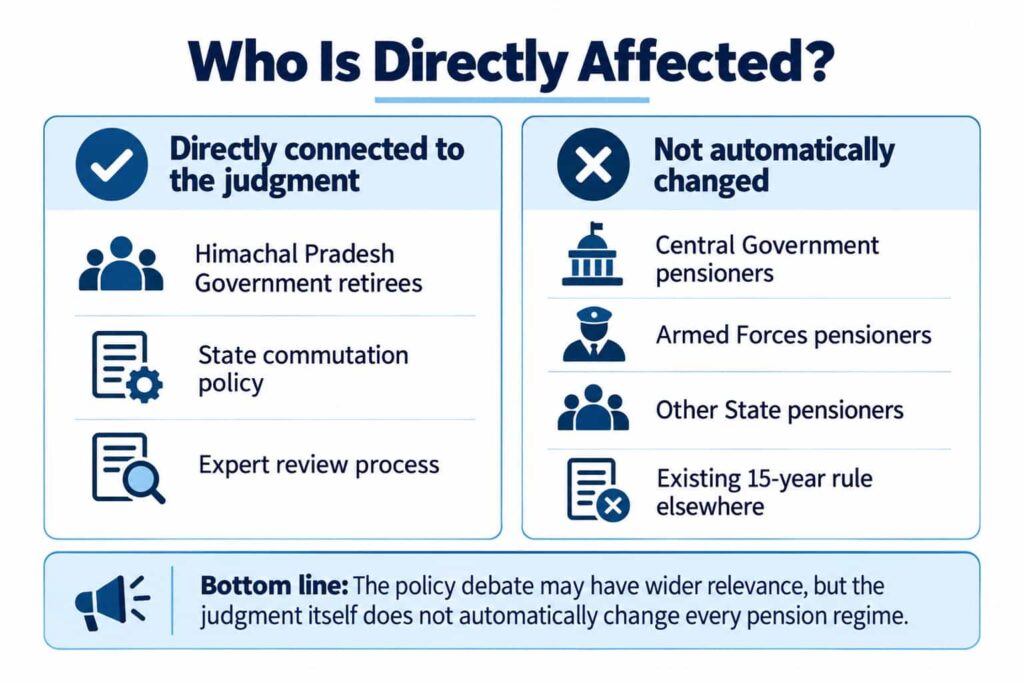
This batch directly concerned retired employees governed by rules applicable in Himachal Pradesh.
The Court itself noted that Central rules do not automatically operate for the State merely because parts of the framework have been adopted.
Therefore, the judgment does not presently change the restoration period for Central Government pensioners.
The wider relevance lies in the policy questions raised by the Court, not in an automatic extension of relief.
What about Defence pensioners?
The judgment refers to the Supreme Court’s Common Cause decision, which historically addressed commuted pension restoration for civilian as well as Armed Forces pensioners.
But the Himachal Pradesh High Court has not issued an order reducing the restoration period for Armed Forces pensioners.
For defence pensioners, the decision is therefore better understood as:
a fresh policy-review signal rather than an immediate pension entitlement.
Until a competent authority changes the applicable rules, the present restoration framework continues.
The bigger question is no longer only “15 years or 12 years?”
The judgment raises a more fundamental issue.
A restoration period that was considered actuarially reasonable decades ago may need to be tested against current data.
That examination would have to consider much more than one retiree’s recovery calculation.
It may include:
mortality data
life expectancy
current interest assumptions
commutation factors
Government pension liabilities
fiscal risk
and
the welfare objective of pension policy
That is why an Expert Committee, rather than a simple arithmetic formula, becomes central to the next stage.
What should pensioners watch now?
The immediate points to watch are:
Whether the Himachal Pradesh Government constitutes the Expert Committee
Who is included in the review process
Whether pensioner associations are consulted
What actuarial data is examined
Whether the Committee recommends any change to the 15-year period
and finally,
Whether the Government accepts or rejects those recommendations
Until that process produces a formal decision, pensioners should not treat the judgment as an order for early restoration.
The key takeaway
The Himachal Pradesh High Court has left the 15-year commutation restoration rule intact, but it has also made clear that the assumptions behind that rule should not remain frozen indefinitely.
The Court recognised that commutation factors, life expectancy, interest conditions and Government risk have changed significantly over the years.
Its solution was not to rewrite the rule judicially.
Instead, it pushed the issue back into the expert and policy domain.
For pensioners, therefore, the most significant development is not an immediate reduction from 15 years.
It is that the case for a fresh examination of the commutation formula has now received explicit judicial recognition.
And any future change will depend on what the Expert Committee recommends—and what the Government ultimately decides.
Sources:-
- High Court of Himachal Pradesh — Judgment PDF
Bal Dev v. State of Himachal Pradesh & connected matters
CWP No. 15995 of 2024 and connected cases
Neutral Citation: 2026:HHC:39535
Decided on 16 September 2026 - High Court of Himachal Pradesh — Official Website
Use the case number CWP No. 15995 of 2024 or neutral citation 2026:HHC:39535 in the court’s judgment/case search.
High Court of Himachal Pradesh official website - Secondary legal/news coverage of the final judgment
This report covers the 15-year commutation rule, the Court’s refusal to shorten it, and the Expert Committee review.
Read the judgment report on HimbuMail





Leave a Reply