


For many Central Government employees, retirement on 31 December creates an unusual pension question.
The employee completes the entire year of service and retires at the end of 31 December. But the next annual increment formally falls due on 1 January—just one day after retirement.
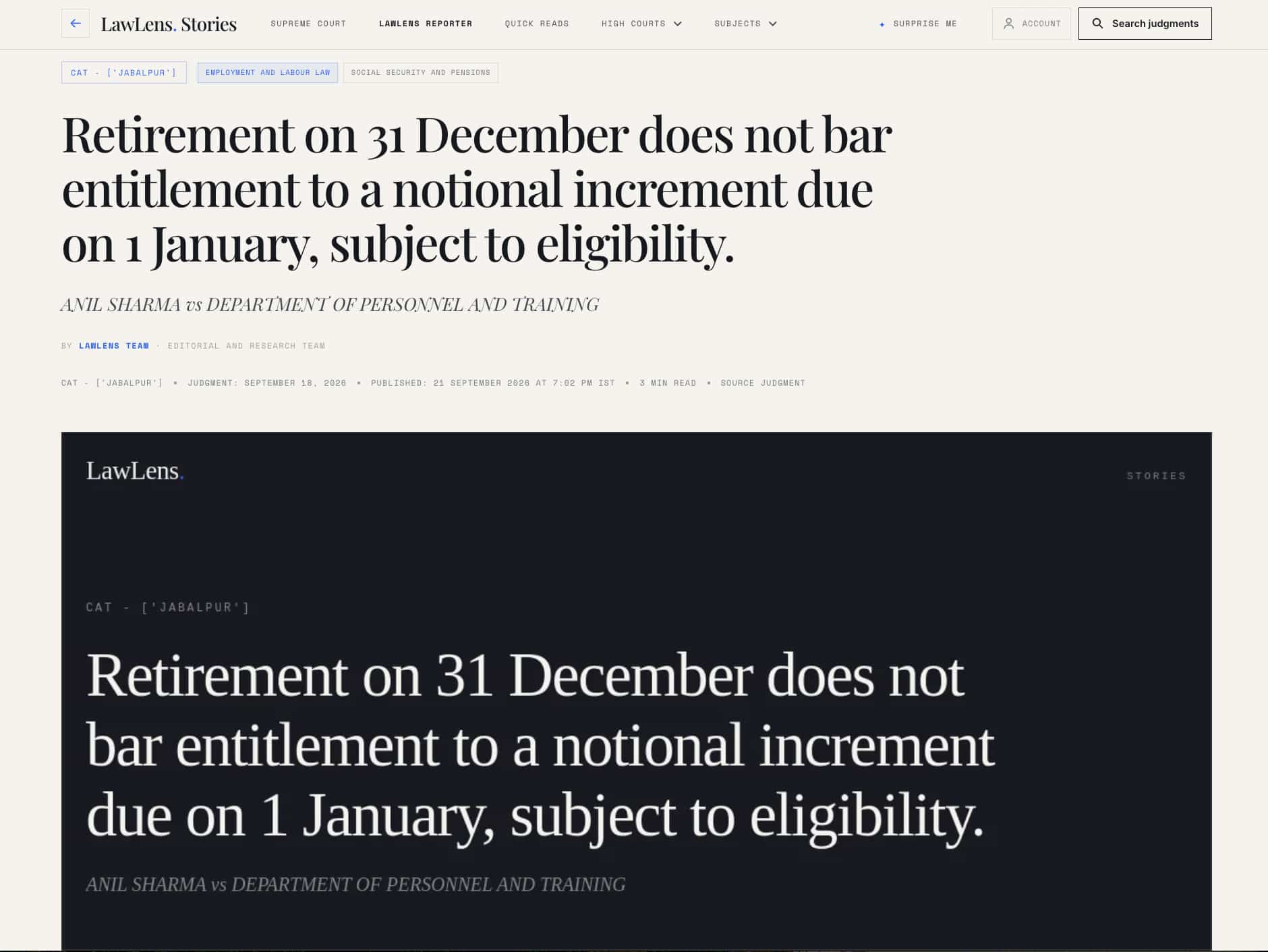
For years, this one-day difference has led to disputes over whether an employee who had already completed the required service should lose the increment merely because the calendar reached the formal increment date after retirement.
A fresh Central Administrative Tribunal (CAT), Jabalpur Bench order dated 18 September 2026 has again brought this issue into focus. The case involved employees connected with 506 Army Base Workshop, Jabalpur, including one employee who retired on 31 December 2016 and whose next increment was due on 1 January 2017.
But the most important point is this:
The CAT did not order an automatic extra pension for every 31 December retiree.
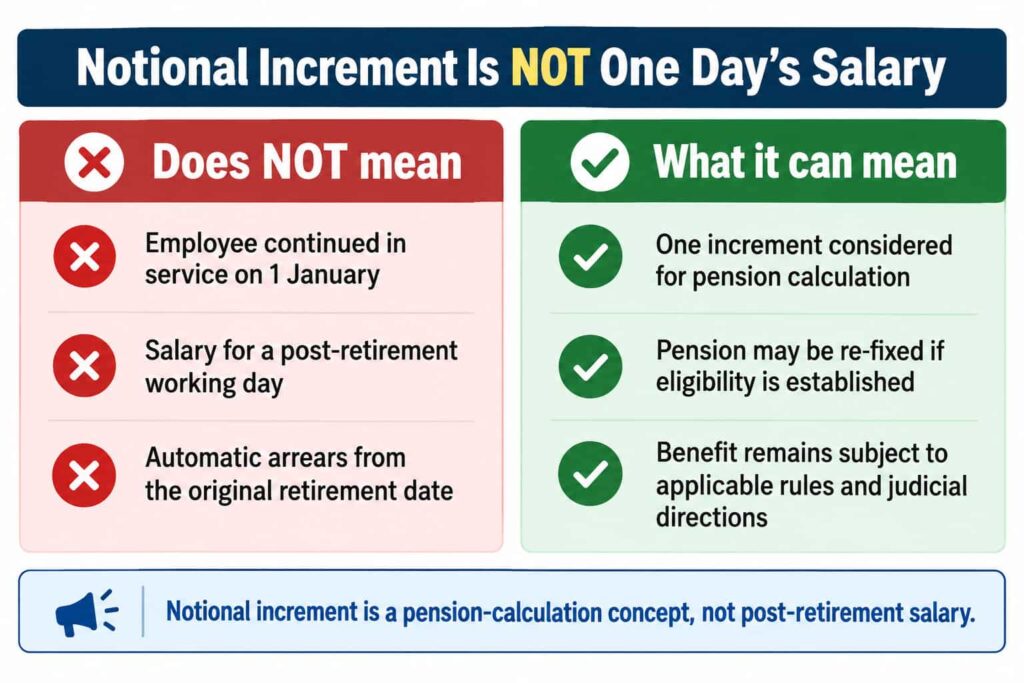
It directed the authorities to examine the applicants’ eligibility and service records first. Only if the applicable conditions are satisfied would the notional increment and consequential pension benefit follow.
Why does one day create such a major pension issue?
An annual increment may formally become payable on a particular date, but it is generally linked to the service rendered during the period preceding that date.
That distinction became central to the Supreme Court’s decision in Director (Administration and HR), KPTCL v. C.P. Mundinamani, decided on 11 April 2023.
The Supreme Court dealt with the principle that an increment is earned through satisfactory service during the preceding period. The fact that the employee retired one day before the formal increment date did not, by itself, justify denying the benefit where the employee had otherwise earned it under the applicable rules.
For Central Government pensioners, this principle later became part of a wider legal and administrative framework involving the M. Siddaraj proceedings and DoPT instructions.
What is a notional increment?
The word “notional” is crucial.
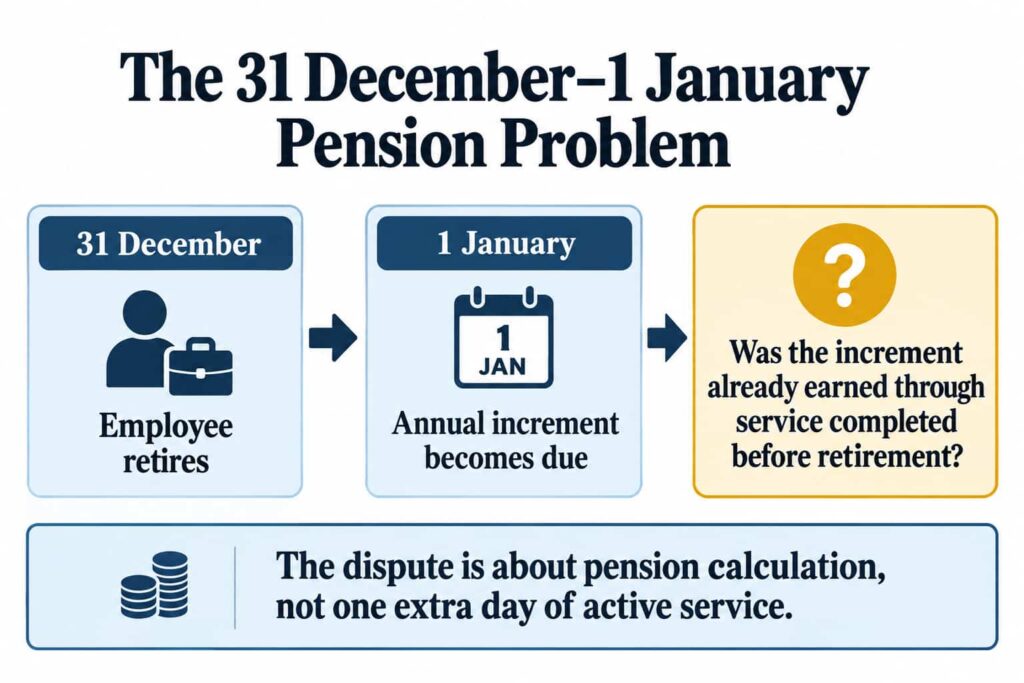
A notional increment does not mean that the person is treated as having remained in Government service after retirement.
It also does not ordinarily mean that the retiree becomes entitled to salary for 1 January despite having retired on 31 December.
Instead, the increment is notionally taken into account for the limited purpose of calculating admissible pension, subject to the applicable rules and eligibility conditions.
In the 506 Army Base Workshop-related CAT matter, the dispute was therefore not about paying a day’s salary for 1 January 2017. It was about whether the increment could be recognised for pension calculation after the employees had completed the preceding period of service.
What happened in the 506 Army Base Workshop case?
The case was Anil Sharma v. Department of Personnel and Training, decided by CAT Jabalpur on 18 September 2026.
Applicant No. 1 had worked under 506 Army Base Workshop, Jabalpur, and retired on 31 December 2016.
The husband of Applicant No. 2 had also been a regular employee of the same establishment and had retired on the same date. He subsequently died in June 2024.
Their increment was due on 1 January 2017.
The applicants’ case was essentially that the required service for earning the increment had already been completed before retirement. They argued that the benefit should not be lost solely because they were technically no longer employees when 1 January arrived.
CAT examined the issue in light of the Supreme Court’s Mundinamani ruling and the subsequent M. Siddaraj directions.
Did CAT directly sanction the increment?
This is where the order needs to be reported carefully.
The Tribunal did not simply direct immediate unconditional payment.
Instead, it directed the respondents to treat the Original Application as a representation and verify the applicants’ service records and eligibility.
If they are found eligible, the increment and consequential benefits are to be granted.
The authorities were directed to complete the exercise within 90 days from receipt of the certified copy of the order.
That means retirement on 31 December can open the door to consideration—it does not, by itself, guarantee payment.
What conditions still matter?
The basic legal reasoning behind notional increment is that an increment is connected to service already rendered.
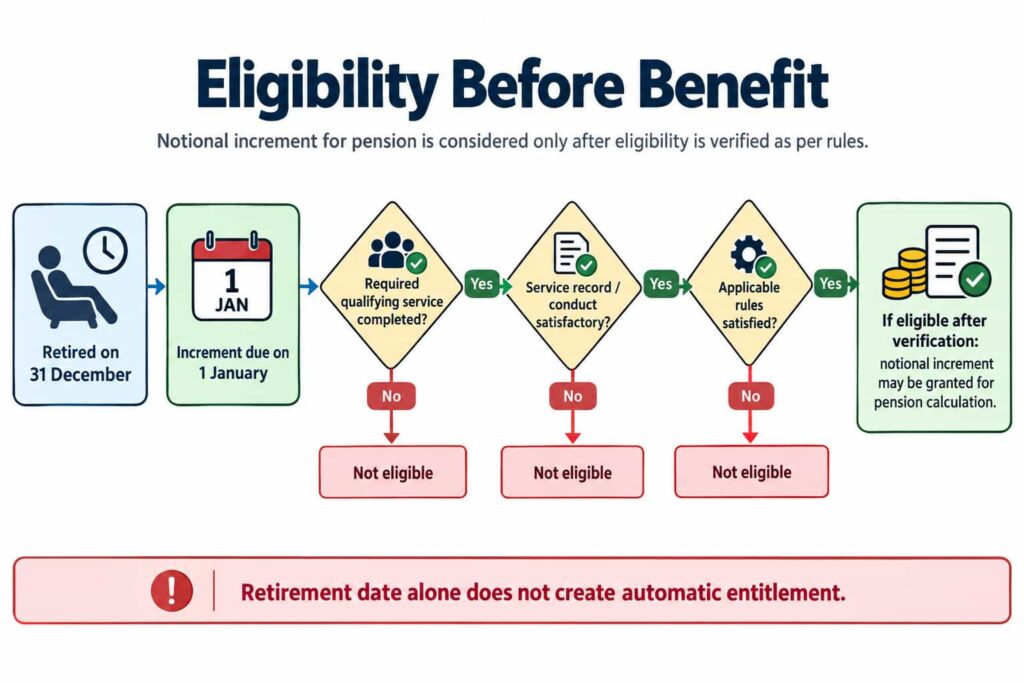
But that also means the employee must have actually satisfied the conditions for earning the increment.
The Tribunal specifically kept the relief subject to verification.
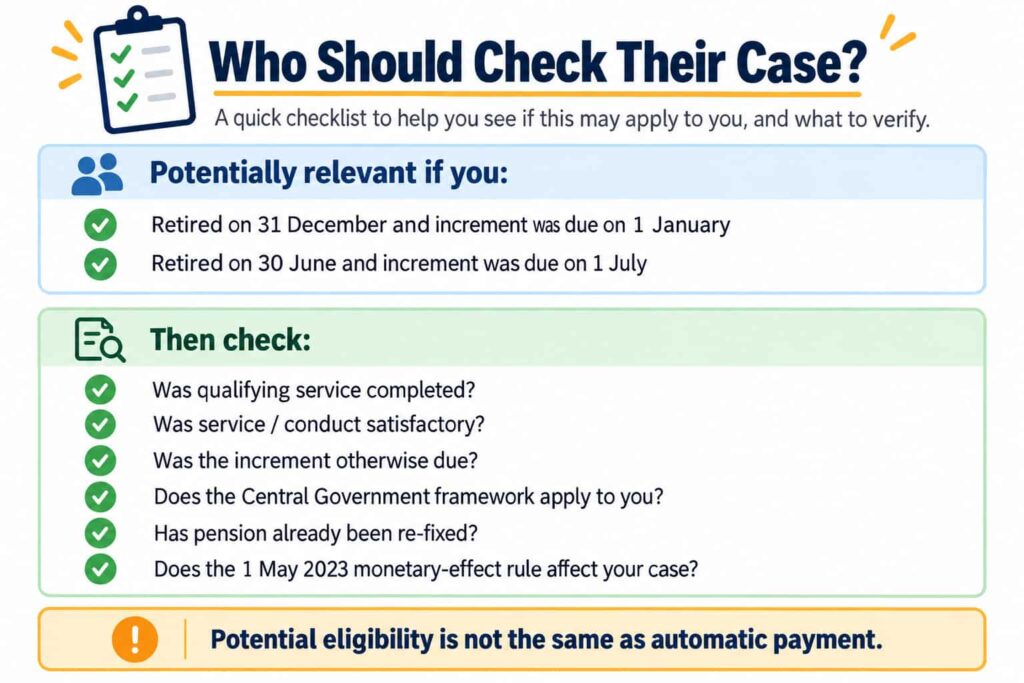
For a similarly placed retiree, relevant issues may therefore include whether the prescribed period of qualifying service had been completed, whether the increment would otherwise have become due, whether service and conduct met the applicable requirements, and whether any rule-based reason existed for withholding the increment.
The Supreme Court’s Mundinamani judgment itself discussed the concept of an increment being earned through service and good conduct rather than existing as an automatic calendar-date payment.
Why are DoPT instructions important for Central Government retirees?
The court decisions did not remain confined to individual litigation.
The Department of Personnel and Training subsequently issued instructions dated 14 October 2024 concerning grant of notional increment on 1 July or 1 January to Central Government employees retiring on 30 June or 31 December, respectively, for pensionary purposes.
DoPT’s own 2024–25 Annual Report records the issuance of these instructions.
The administrative position reflected in subsequent CAT decisions is that qualifying Central Government employees retiring one day before their increment date may be considered for the increment for pension calculation, subject to completion of the required service and satisfactory work and conduct.
This is why the issue is now much more than an isolated court case.
It has developed into a combination of:
Supreme Court principle + monetary-effect directions + DoPT implementation + individual service-record verification.
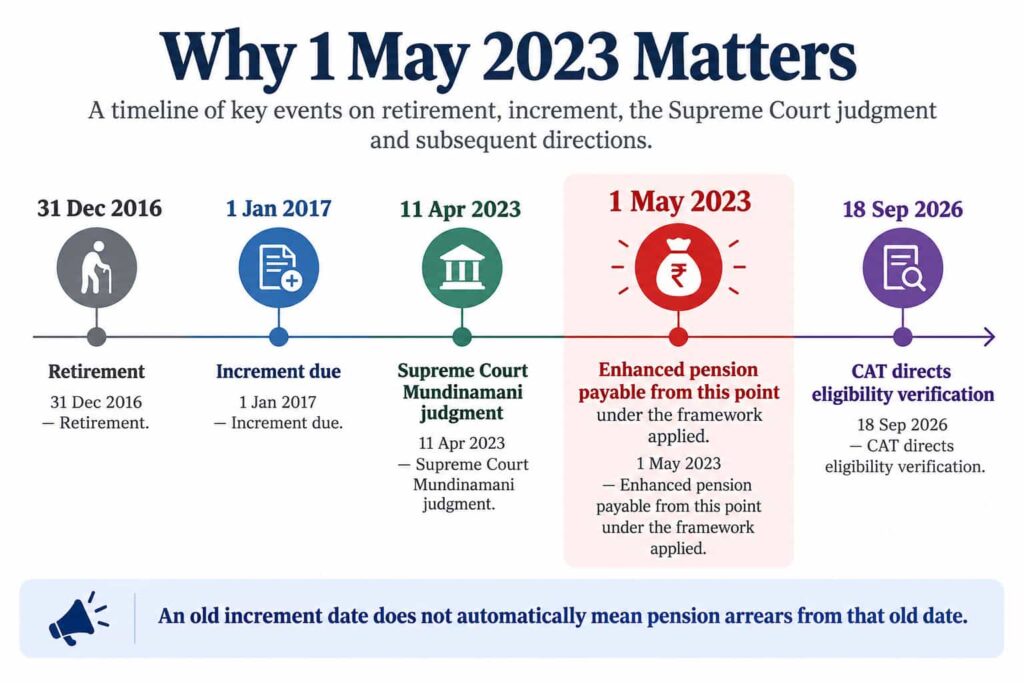
Why does 1 May 2023 matter so much?
This is probably the most misunderstood part of the subject.
Suppose an employee retired in 2016 and the increment was due on 1 January 2017.
It may seem natural to assume that once the claim succeeds, revised pension should automatically be paid from 2017.
That is not necessarily the position.
In Union of India v. M. Siddaraj, the Supreme Court issued directions dealing with the monetary operation of the notional-increment benefit. For third-party cases covered by the relevant direction, pension after taking one increment into account was made payable on and after 1 May 2023, rather than providing enhanced pension for the entire earlier period.
The Supreme Court subsequently treated key parts of its September 2024 directions as final in its February 2025 order.
CAT Jabalpur applied that framework in the present matter and restricted the consequential enhanced pension to 1 May 2023 onwards.
So the two dates perform very different functions:
1 January 2017 relates to the increment that was claimed.
1 May 2023 relates to the monetary effect of enhanced pension under the framework applied by CAT in this case.
Could the retiree receive salary arrears from 1 January 2017?
The present order should not be read that way.
The benefit discussed is a notional increment for pension purposes.
The CAT case did not turn the retirees into employees for 1 January 2017, nor did it sanction ordinary salary for the period after retirement.
This distinction is also consistent with the Central Government’s implementation framework, where the notional increment is used for calculating admissible pension rather than treating the retiree as having continued in service.
That is why phrases such as “one extra increment” can be misleading unless the word “notional” and its pension purpose are clearly explained.
What could change if the retiree is found eligible?
The immediate practical effect can be a re-fixation of pension after taking the admissible notional increment into account.
Once pension is recalculated, the difference between the earlier pension and the revised admissible pension may generate consequential monetary benefits for the period allowed under the applicable legal directions.
But the amount cannot be calculated merely from the employee’s retirement date.
The actual impact depends on the last pay drawn, applicable pay rules, increment amount, pension calculation and the period for which monetary benefit is legally available.
For this reason, two retirees who both retired on 31 December may not necessarily receive identical financial benefits.
Does every 31 December retiree now qualify?
No.
That would be an overstatement of the CAT order.
The case establishes a much narrower and more useful point:
Retirement on 31 December should not, by itself, prevent consideration of an increment falling due on 1 January.
But the employee still has to satisfy the applicable eligibility conditions.
This is why the CAT directed verification instead of unconditional payment.
What about employees who retired on 30 June?
The same broader notional-increment litigation also concerns employees retiring on 30 June whose annual increment becomes due on 1 July.
DoPT’s instructions expressly refer to employees retiring on 30 June/31 December, with the corresponding increment dates of 1 July/1 January, for pension-calculation purposes.
So while the 506 Army Base Workshop case specifically involved 31 December retirement, the underlying framework is relevant to both commonly disputed retirement/increment combinations.
Is this automatically applicable to all Defence pensioners?
No.
This distinction is particularly important for readers from the defence community.
The employee in this case worked under 506 Army Base Workshop, which is a Defence establishment, but the case concerns a Defence Civilian employee within the Central Government civil-service pension and increment framework.
The order should therefore not be presented as a blanket ruling granting additional pension to every retired member of the Army, Navy or Air Force.
Uniformed Armed Forces personnel operate under their own applicable service and pension rules, and entitlement should be examined within the correct legal framework.
What documents should an affected retiree examine?
Before concluding that a pension has been wrongly fixed, a retiree should ideally check a small set of core records: retirement order, service book, last pay details, applicable increment date, pension calculation/PPO, any previous representation and the rules or Government instructions applicable to the case.
These documents help answer the real question—not simply whether the person retired on 31 December, but whether the increment had actually been earned under the applicable service conditions.
Why this CAT order matters beyond one workshop
The name 506 Army Base Workshop makes this case especially relevant to Defence Civilian pensioners, but the principle is broader.
The order shows how the Supreme Court’s notional-increment jurisprudence is now being applied at the implementation stage.
The legal question is gradually shifting from:
“Can an increment ever be recognised after retirement?”
to the more practical question:
“Does this particular retiree satisfy the conditions for the increment, and from what date is the pensionary benefit payable?”
That shift matters.
It means future disputes may increasingly turn on individual service records, pension fixation and eligibility rather than on the retirement date alone.
The most important takeaway for pensioners
A Central Government employee who retires on 31 December should not assume that an increment due on 1 January is automatically lost merely because retirement occurred one day earlier.
At the same time, the opposite assumption is also unsafe.
The CAT Jabalpur order does not grant an unconditional increment to every such retiree.
The correct approach is:
first establish eligibility, then determine pension re-fixation, and finally apply the correct monetary-effect period.
For the applicants connected with 506 Army Base Workshop, CAT directed exactly that exercise—verify the record, determine entitlement and, if eligible, grant the notional increment and consequential benefits within the stipulated period.
And that is what makes this order useful for other Central Government and Defence Civilian retirees: it converts a technical one-day retirement dispute into a practical eligibility question that pensioners can actually examine against their own records.
Sources
CAT Jabalpur — Anil Sharma v. Department of Personnel and Training, decided 18 September 2026
Read the judgment analysis and source document
Supreme Court — Director (Admn. & HR), KPTCL v. C.P. Mundinamani, 11 April 2023
Open official Supreme Court judgment PDF
Supreme Court — Union of India & Anr. v. M. Siddaraj, connected directions
Open official Supreme Court order dated 20 February 2025
Department of Personnel and Training — Notional Increment Instructions
DoPT’s Annual Report records the 14 October 2024 instruction concerning notional increment for Central Government employees retiring on 30 June or 31 December.



Leave a Reply