


A pension dispute normally begins with a question: Is the pensioner legally entitled to the money being claimed?
The case of Jagdish Raj Arora v. State of Punjab and Others is unusual because that was apparently no longer the central problem.
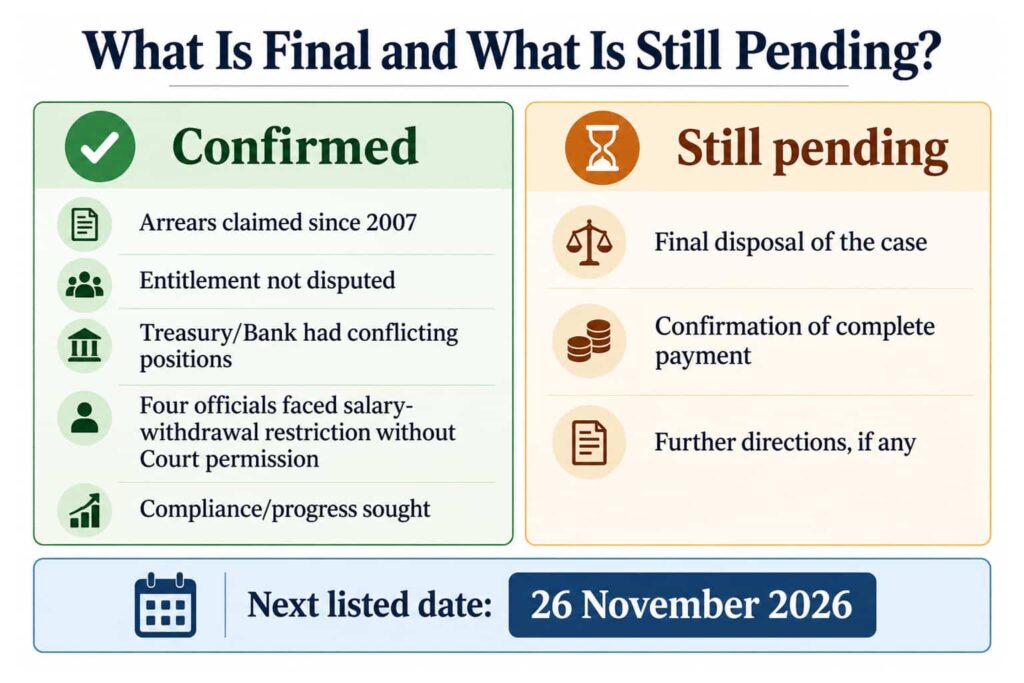
The pension arrears relating to Arora’s deceased wife, Sudarshan Kumari, were stated to have remained unpaid since 2007. The Punjab and Haryana High Court noted that the petitioner’s entitlement to the arrears was not disputed. Yet the money had still not reached him because different authorities continued to take conflicting positions over who was responsible for releasing it.
That transformed what could have been a routine pension-disbursement issue into something much larger: a test of administrative accountability when an admitted retirement benefit remains stuck for years.
On 18 September 2026, Justice Kuldeep Tiwari issued an interim direction under which four government and Bank of India officials were not to draw their salaries without prior permission of the High Court until effective collective steps were taken to resolve the arrears issue. The case is listed again for 26 November 2026.
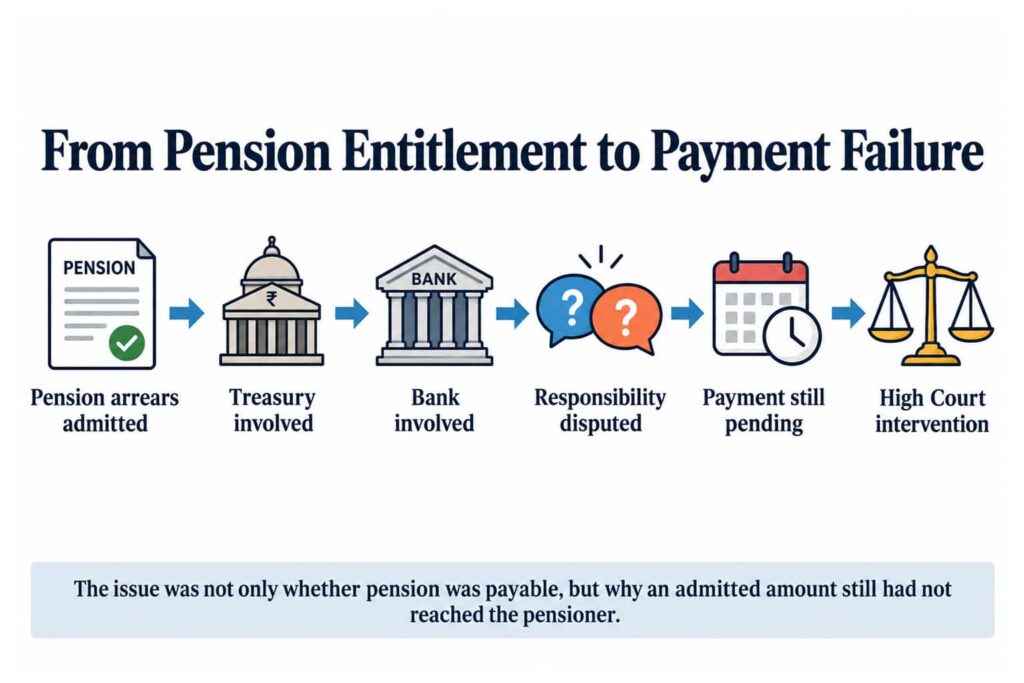
Why this case is different from an ordinary pension dispute?
Pension litigation often involves questions about qualifying service, pension calculation, family pension eligibility, pay fixation or interpretation of service rules.
Here, the reported position before the Court was different.
The arrears had reportedly remained unpaid since 2007, yet the petitioner’s entitlement itself was not being contested. The problem lay in execution.
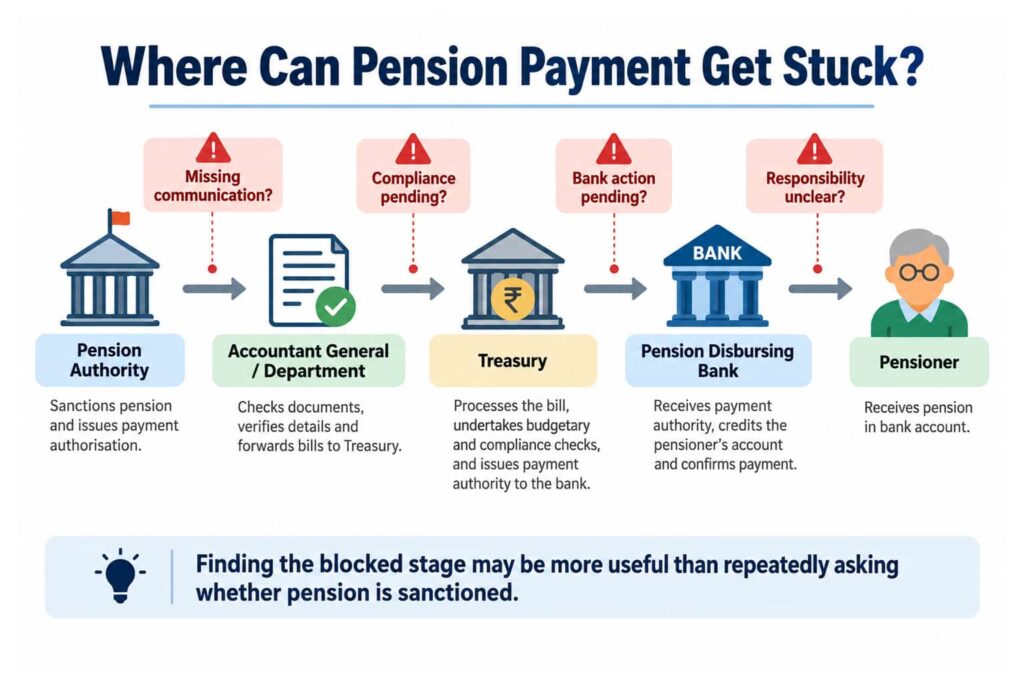
The State authorities told the Court that the Accountant General, Punjab had issued a communication dated 24 September 2012 to the District Treasury Officer, Gurdaspur. Their position was that Bank of India had not implemented it.
Bank of India, however, reportedly argued that it could not release the arrears because certain necessary compliance remained pending on the part of the District Treasury Officer.
In practical terms, the pensioner was caught between two institutional positions.
The Government side pointed towards the bank.
The bank pointed back towards the Treasury.
And the arrears remained unpaid.
The real story is the gap between sanction and actual payment
For pensioners, this distinction is critical.
A pension may be calculated correctly. An authority may even accept that arrears are payable. But unless the administrative chain reaches its final stage, an accepted entitlement can still remain only on paper.
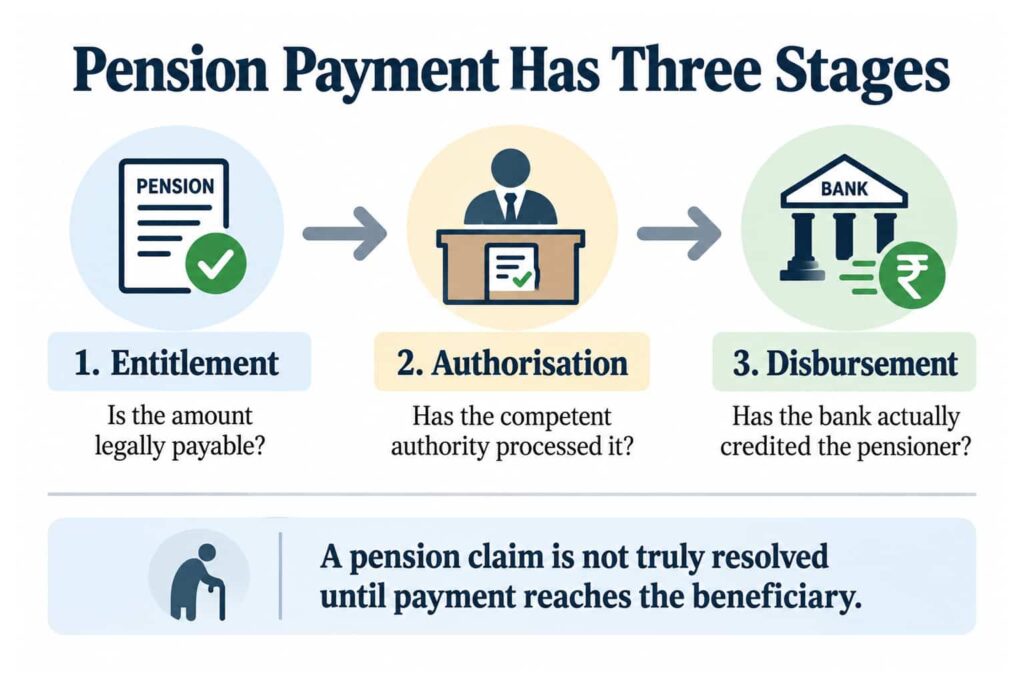
This case illustrates three separate stages:
Entitlement — Is the amount legally payable?
Authorisation — Has the competent authority processed or sanctioned it?
Disbursement — Has the money actually reached the pensioner?
The High Court proceedings became significant because, according to the reported record, the first issue was not really in dispute while the third remained unresolved for years.
Why did the High Court connect officials’ salaries with compliance?
The Court reportedly took note of the prolonged hardship faced by an elderly petitioner and the failure of the respondents to demonstrate any legal impediment preventing payment.
Justice Kuldeep Tiwari said the petitioner had been compelled to move between authorities for his rightful dues and attributed the continuing hardship to the manner in which the matter had been handled. The Court then said strict measures had become necessary because of the respondents’ collective failure to resolve the issue.
The resulting direction was unusual.
The Court directed that four identified officials should not draw their salaries without prior permission of the High Court until effective steps were collectively taken to resolve the pension-arrears issue.
But this needs to be reported accurately.
The Court did not permanently confiscate their salaries.
The direction is linked to the pending proceedings and compliance.
It is therefore better understood as an interim accountability mechanism, not as a final punishment or termination of salary entitlement.
Which officials are covered by the direction?
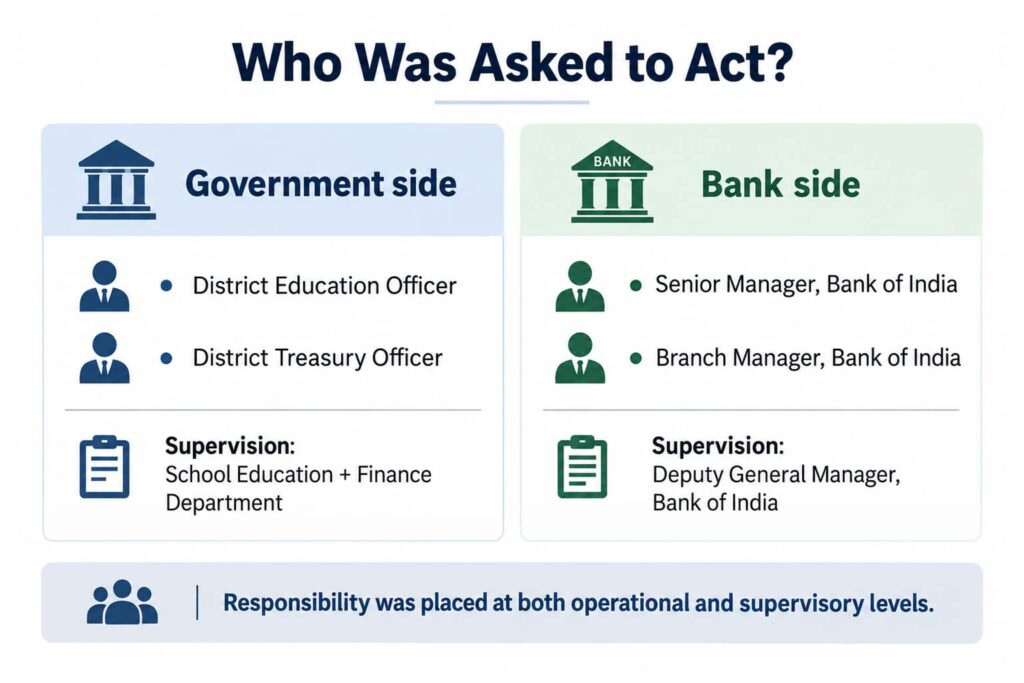
The reported order covers two officials from the Government side and two from Bank of India.
The Punjab School Education and Finance Department Secretaries were directed to ensure compliance regarding the District Education Officer (Elementary), Gurdaspur and the District Treasury Officer, Gurdaspur.
The Deputy General Manager of Bank of India was directed to ensure compliance regarding the Senior Manager, Bank of India, District Shopping Complex, Ranjit Avenue, Amritsar, and the Branch Manager, Bank of India, Gurdaspur.
The significance is not merely that four individuals came under the direction.
Higher authorities were also tasked with ensuring that the order was followed.
That moves the issue from individual correspondence into institutional responsibility.
What this order does not mean for every pension case?
This is where exaggerated headlines can create confusion.
The Punjab and Haryana High Court has not laid down a universal rule that whenever pension is delayed, the concerned officer’s salary must automatically be stopped.
The direction arose from the circumstances recorded in this particular pending case: arrears allegedly unpaid since 2007, an elderly petitioner, entitlement that was not disputed, conflicting stands between authorities and no demonstrated legal impediment to payment.
Another pension case may involve a genuine legal dispute about entitlement, missing records, contested service, pension calculation or an appeal.
So this order should be treated as a case-specific judicial response to prolonged non-resolution, not as an automatic formula applicable to every delayed pension claim.
Why the phrase “19 years without pension arrears” matters—but needs context?
The 19-year period makes the case striking, but it should not become the only focus.
A long delay becomes particularly serious when the claimant is not merely waiting for a court to decide whether he is entitled.
Here, the reported record suggests the arrears were accepted as payable, while the institutions involved remained divided over the mechanics of releasing them.
That is why this case is better viewed as:
“An admitted pension claim trapped in the payment system.”
This framing is more useful for pensioners because it helps identify where a case may actually be stuck.
How can a pensioner identify where the payment chain has broken?
For someone facing a similar delay, simply sending repeated representations to every department may not reveal the underlying problem.
A better approach is to reconstruct the payment trail.
The pensioner should ideally be able to identify the pension sanction or revised pension authority, Treasury communication, correspondence from the bank, any Accountant General letter, earlier representations, acknowledgement of those representations and any document showing why payment was withheld.
The objective is to answer one practical question:
Which authority had the file—or the ability to act—when the payment stopped moving?
That documentary sequence can become especially important if one authority later says responsibility belonged to another.
A broader High Court concern about delayed retirement benefits
This case does not exist in isolation.
In a separate August 2026 matter, the Punjab and Haryana High Court also addressed delays in pension and other retirement benefits and directed the Chief Secretaries of Punjab, Haryana and Chandigarh to ensure responsibility was fixed where prescribed procedures were not followed. That separate ruling focused on the responsibility of the Head of Office and the need to prevent retirees from repeatedly approaching courts for benefits that administrative rules already require authorities to process.
The two proceedings are legally separate and should not be merged.
But together they illustrate a recurring judicial concern: retirement benefits should not remain unresolved simply because responsibility is dispersed across departments.
Why this matters to Central Government employees and pensioners too?
The present case concerns Punjab authorities and Bank of India, so it should not be presented as a new Central Government pension rule.
Nevertheless, the administrative lesson travels much further.
Central Government employees and pensioners also deal with multiple entities during pension processing—Head of Office, Pay and Accounts Office, pension authorisation authorities, CPPCs, banks and other agencies depending on the pension system involved.
Whenever multiple institutions participate, there is a risk that an unresolved discrepancy gets passed from one desk to another.
For a pensioner, therefore, preserving written communication is not bureaucratic housekeeping.
It can establish:
who knew about the claim, when they knew it, what they were required to do, and where the process stopped.
What will happen on 26 November 2026?
The matter remains pending.
The case has been listed for 26 November 2026 to await further progress.
That means the September direction should not be described as the final disposal of the dispute.
The next hearing can examine whether effective steps were taken, whether the pension-arrears issue was resolved and whether further judicial directions are required.
Until then, the salary-related direction remains part of an ongoing proceeding rather than a final judgment settling every issue in the case.
The most important lesson for pensioners
The strongest lesson from the Jagdish Raj Arora case is not that courts will stop officers’ salaries whenever pension is delayed.
It is something more practical.
A pension case can continue for years even after the entitlement question has effectively been settled if nobody takes ownership of the final payment.
For pensioners, the distinction between “my pension has been sanctioned” and “my pension has actually been disbursed” can therefore be crucial.
For departments and pension-disbursing institutions, the case highlights another point: passing responsibility between authorities does not resolve a pension claim.
Ultimately, someone must complete the administrative chain.
And when an elderly pension claimant remains caught in that chain for years despite an admitted entitlement, judicial scrutiny can shift from the pension calculation itself to the accountability of the officials responsible for delivering the payment.
Sources
The Punjab and Haryana High Court official cause-list records Jagdish Raj Arora v. State of Punjab and Others, CWP-26393-2023, under the Gurdaspur retired School Education service category.
The detailed 18 September 2026 directions and reported facts are supported by The Tribune’s court report.




Leave a Reply