

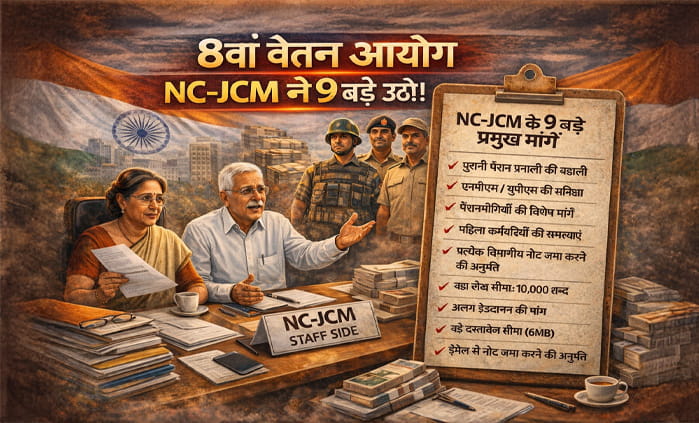
The 8th Pay Commission has moved into a more serious consultation phase, and that is exactly why the latest intervention by the NC-JCM Staff Side matters. The Commission formally opened its online memorandum process on 5 March 2026 and is accepting submissions till 30 April 2026 through its official portals, while the questionnaire phase itself was closed on 31 March 2026. In the middle of this transition, the staff side of the National Council, Joint Consultative Machinery has stepped forward with what has been reported as a nine-point representation aimed at widening and improving the way employee concerns are recorded before the Commission begins deeper examination.
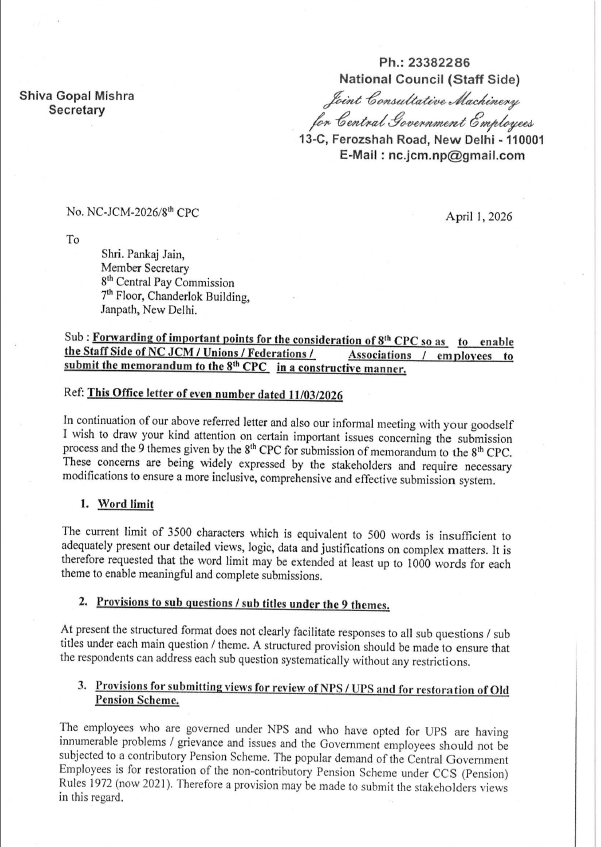
What makes this development important is that it is not just another routine employee memorandum. It is a direct attempt to influence the very structure of the consultation process. According to reports, the NC-JCM wrote on 1 April 2026 to 8th CPC Member-Secretary Pankaj Jain, arguing that several stakeholder concerns were not being adequately captured in the present format and that the system needed to become more inclusive, more detailed, and more workable before the joint memorandum of employee bodies is submitted.
At the heart of this representation is a simple but powerful argument: if the format is too narrow, the final recommendations may never fully reflect the real concerns of employees and pensioners. That is why the reported demands go beyond salary and fitment factor. They include a clearer space for pensioners’ issues, the right to submit views on NPS and UPS, the continuing demand for restoration of the Old Pension Scheme, a separate focus on women employees’ welfare, room for department-specific concerns, a higher word limit, better handling of sub-questions, a larger attachment-size limit, more than one mode of submission, and an extension of time for department-specific memoranda.
This is where the story becomes bigger than procedure. Pensioners’ issues, pension parity, commutation restoration, and retirement benefits are not side topics for central government staff. They are core issues that shape how employees view the credibility of the 8th Pay Commission itself. The same is true for NPS, UPS, and OPS. By asking for a dedicated space for these subjects, the staff side is effectively saying that the future of retirement security cannot be buried under a generic consultation format. In policy terms, that is a serious message.
The demand to include a separate section for women employees is equally significant. This is not being framed as a symbolic gesture. Reports say the proposal covers matters such as workplace safety, maternity support, menstrual health support, child care leave, and broader gender-equity concerns. In other words, employee bodies are trying to ensure that the 8th Pay Commission does not treat service conditions only as a pay issue, but as a larger workplace and welfare issue as well.
There is also a practical side to the dispute. The present online system has been criticised as too restrictive for meaningful submissions. Reported concerns include the existing character cap, lack of clarity on how to answer sub-questions properly, and a file-upload limit that unions say is too small for serious supporting documents. The staff side has therefore argued for a more flexible format, including bigger attachments and alternative submission modes such as email or hard copy. Even if the Commission does not accept every suggestion, the complaint itself reveals that many stakeholders do not want the consultation exercise to become a box-ticking process.
Timing also matters here. The NC-JCM drafting committee is set to meet on 13 April 2026 to review and likely finalise the common memorandum that will be sent to the Commission. That means the current phase is not about abstract debate anymore. It is about deciding which demands are carried into the formal record and how strongly they are argued before the 8th CPC. Once that stage passes, broad drafting room becomes narrower and the conversation shifts more toward evaluation and recommendation.
In that sense, the nine-point push is as much about participation as it is about policy. The staff side appears to be sending a clear signal that employees and pensioners do not want to be consulted in a limited or overly technical way. They want the process to reflect the complexity of service life, pension concerns, gender issues, and department-level realities. That makes this a politically important development, because the strength of the final 8th CPC debate will depend not only on what the Commission asks, but also on how effectively stakeholders manage to shape the conversation before recommendations are drafted.
The latest move by the NC-JCM Staff Side has turned a procedural stage of the 8th Pay Commission into a much more substantive story. What is at stake is not merely a list of demands, but the quality of representation itself. If employee bodies succeed in expanding the framework of consultation, the final 8th CPC process could become broader, sharper, and more responsive to real service concerns. If not, many fear that key issues such as pension reform, women employees’ welfare, and department-specific challenges may remain underrepresented. That is why this nine-point demand letter deserves close attention. It is not just about what employees want from the 8th Pay Commission. It is about whether the Commission’s process will be broad enough to hear them properly.

Leave a Reply