

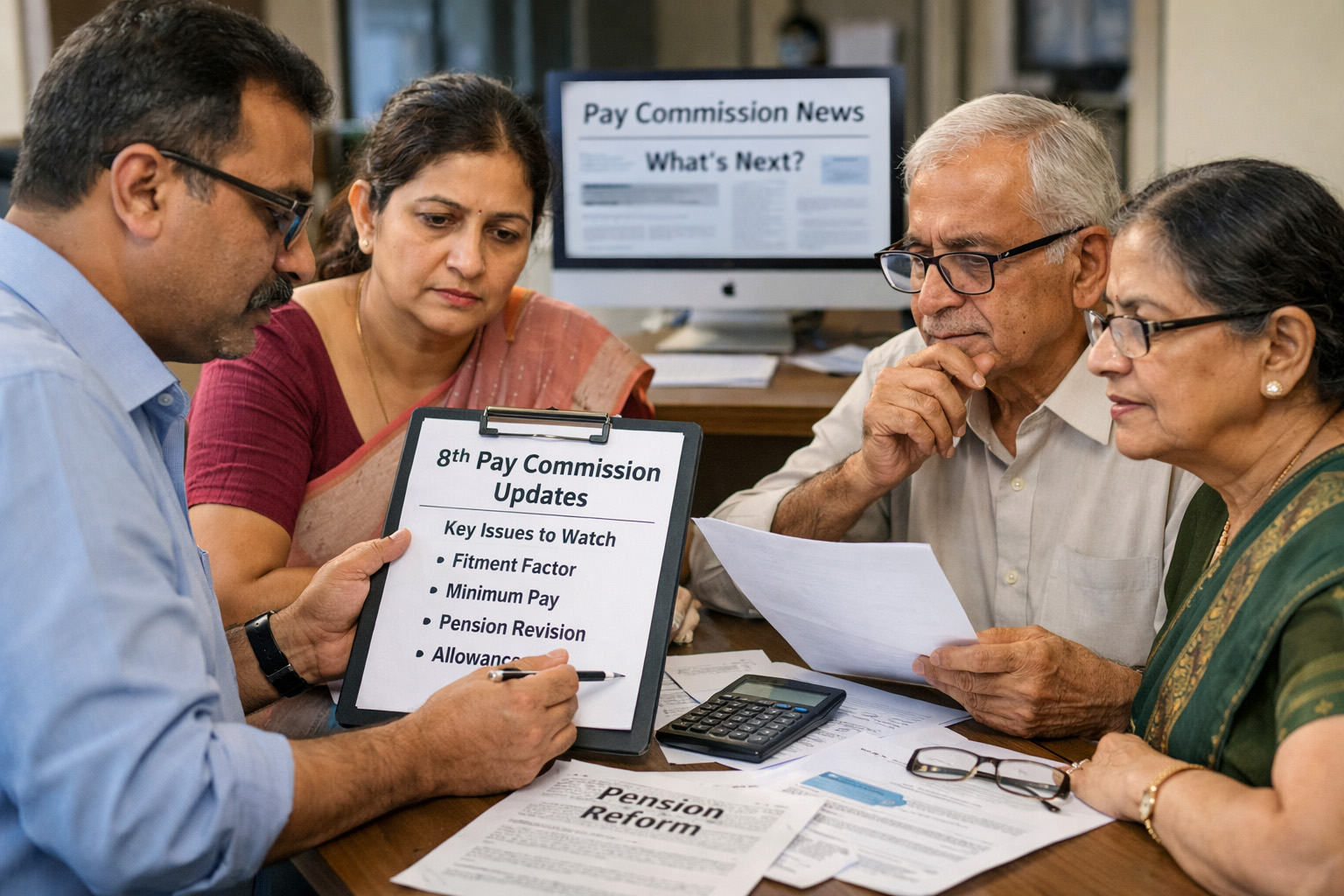
The discussion around the 8th Pay Commission has again become one of the biggest topics for central government employees, defence personnel, pensioners and family pensioners. The video highlights a strong public expectation that the new pay commission process should not be delayed for years and should move quickly once the government takes formal steps.
That expectation is understandable. For employees and pensioners, the 8th Pay Commission is not just another policy announcement. It is directly connected with salary, pension, allowances, fitment factor, pay matrix, minimum pay, Dearness Allowance, Dearness Relief, CGHS, defence-related benefits and long-pending anomalies.
The big question now is simple: can the 8th Pay Commission process move quickly, and if yes, what should employees and pensioners focus on at this stage?
The important point is that the 8th Central Pay Commission is now a formal reality. The official 8th CPC website states that the Commission was constituted by the Government of India through notification dated 3 November 2025. The Commission has been set up in New Delhi, which means the process has moved beyond only political discussion and entered the structured consultation stage.
As per the government resolution, the Commission is headed by Justice Ranjana Prakash Desai, with Prof. Pulak Ghosh as part-time member and Shri Pankaj Jain as Member-Secretary. The official resolution also says the Commission will examine and recommend changes related to pay, allowances, retirement benefits and other service conditions.
This is why the present phase is extremely important. Many people focus only on the final announcement, but the foundation of that announcement is built during the consultation and memorandum stage. What employee bodies, pensioners’ organisations, defence representatives and unions submit now can influence the issues that finally reach the Commission’s report.
At present, the 8th CPC has invited representations, memoranda and suggestions from a wide range of stakeholders, including central government employees, defence forces personnel, pensioners, service associations, unions, ministries, departments and other eligible groups. The submission window opened on 5 March 2026 and is scheduled to close on 30 April 2026.
This means the coming days are not just routine paperwork. They may decide how strongly different issues are placed before the Commission. For example, one employee may be concerned about minimum pay. Another may be worried about pension parity. A defence pensioner may focus on MSP, OROP linkage, disability pension, commutation recovery or family pension. A serving employee may want clarity on MACP, promotion hierarchy, HRA, transport allowance, risk allowance or working conditions.
The video’s larger message can be understood in this way: speed is important, but strong representation is even more important. A fast pay commission without properly documented demands can leave gaps. A well-documented representation can help ensure that real field-level problems are not lost in technical language.
Recent developments show that employee bodies are already pushing hard. Reports say the NC-JCM Staff Side has submitted a detailed memorandum to the 8th CPC with major demands, including a proposed minimum basic pay of ₹69,000, fitment factor of 3.83 and annual increment of 6%. These are demands, not approved decisions, but they show the scale of expectation among employees and pensioners.
Pension-related demands are also becoming central. Reports mention issues such as pension parity, commutation restoration, family pension, gratuity enhancement and better protection for retired employees. For pensioners, this matters because a Pay Commission does not affect only those currently in service. It also shapes the financial security of retired employees and their families for years.
This is where ordinary employees and pensioners must be careful. There is a major difference between a demand, a recommendation and a government approval. A union demand is the first step. A Commission recommendation is the second step. Final acceptance by the government is the third step. Until all these stages are complete, any figure related to fitment factor, minimum pay or final pension increase should be treated as a proposal, not a confirmed benefit.
Still, the momentum is visible. The official portal, the public consultation window, the Commission’s structure and the growing number of memoranda all indicate that the process is active. The next key task is to ensure that representations are specific, evidence-based and connected to real problems.
For example, a strong memorandum should not simply say “increase pension.” It should explain why pension needs revision, what gap exists, how inflation has affected retired employees, how medical expenses have increased and how the present system creates hardship. Similarly, a demand for higher minimum pay should be supported by household cost, family responsibility, education, housing, transport, healthcare and inflation data.
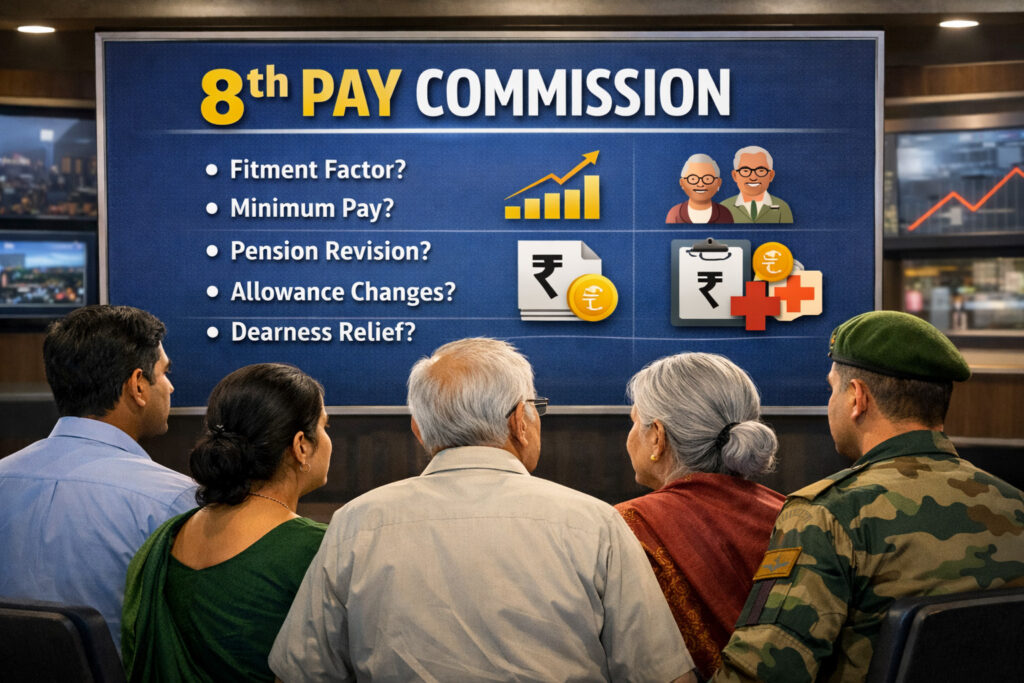
Defence personnel and veterans also need careful representation because their service conditions are different from civilian employees. Field postings, early retirement, disability-related issues, military service pay, risk conditions, family separation and post-retirement challenges require separate attention. If these issues are not explained properly, they may not receive the weight they deserve.
For central government employees, the 8th Pay Commission may also become a chance to review old anomalies from the 6th and 7th CPC periods. Many issues linked to pay levels, promotion gaps, grade pay transition, MACP, allowances and pension fixation have remained points of dissatisfaction. This is why the current submission phase should be seen as a rare opportunity, not a routine formality.
The most important takeaway is this: the 8th Pay Commission is not only about a future salary hike. It is about correcting structures that will affect employees and pensioners for the next decade. The final benefit will depend not only on political timing, but also on the strength of representations placed before the Commission.
Employees, pensioners, defence personnel and associations should therefore use the open window carefully. The deadline of 30 April 2026 makes this a time-sensitive stage. Those who want their issues to be considered should prepare clear points, attach relevant evidence wherever possible and avoid vague or emotional submissions.
The hope of quick implementation may create excitement, but the real work is happening now. The smarter approach is to track official updates, understand the difference between demand and approval, and participate in the process wherever eligible.
The 8th Pay Commission has entered a decisive phase. For employees and pensioners, this is not the time to only wait for the final headline. This is the time to make sure the right issues reach the right table.


Leave a Reply