

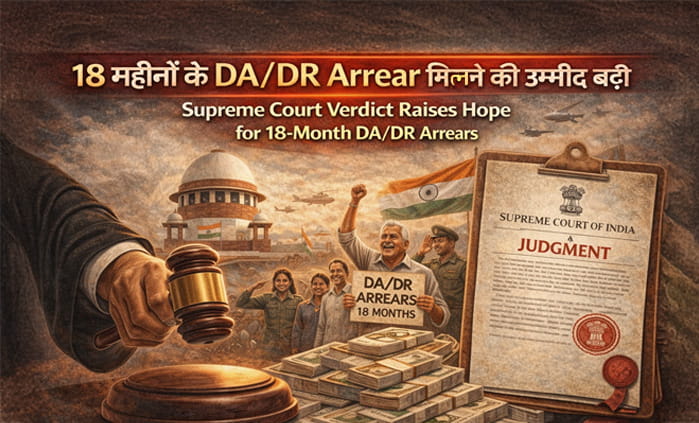
A fresh Supreme Court development has once again brought the issue of Dearness Allowance and Dearness Relief arrears into national discussion, especially among central government employees, pensioners, defence pensioners, and ex-servicemen. For lakhs of families, the real question is no longer only about past policy decisions. It is now about whether a stronger legal argument is finally emerging in support of the long-pending demand for the 18-month DA and DR arrears linked to the Covid-period freeze. The issue remains emotionally and financially important because inflation did not pause during that period, even though the release of DA and DR was held back.
What has made this development important is the legal principle highlighted in the discussion around the judgment. The central argument is that Dearness Allowance is not a favour extended by the government from time to time, but a service-linked entitlement meant to protect income against inflation. That distinction matters. Once DA and DR are understood as part of the compensation structure rather than a discretionary benefit, the entire debate changes. Employees and pensioners then begin to ask a sharper question: if inflation relief is a recognized entitlement, can it be denied for a long period without a fair and time-bound mechanism for restoration?
This is where the 18-month arrears issue becomes stronger in public debate. During the Covid period, the government froze DA and DR citing extraordinary financial pressure. That explanation was accepted at the time as part of a national emergency response. But the continuing grievance among employees and pensioners has always been about what happened after that phase passed. DA and DR were restored later, yet the arrears for the frozen period were not released. For many affected families, that created a sense that a temporary freeze had quietly turned into a permanent loss.
The importance of the Supreme Court-related reasoning lies in another crucial point as well. The idea that financial stress alone cannot become a blanket and indefinite excuse to deny a lawful service benefit has deep significance in employee matters. Governments can certainly take temporary fiscal decisions in difficult times, but if financial hardship is treated as a permanent justification, then many service-linked entitlements become vulnerable. That is why this legal direction is being seen as morally and strategically important. It does not automatically release the 18-month arrears, but it strengthens the argument that economic pressure cannot be used forever to close the issue.
There is also a practical lesson in the way arrears are being discussed. One of the strongest objections raised by the government side in such matters is usually fiscal burden. But if the legal reasoning supports entitlement, then complete denial is no longer the only policy option. A phased release mechanism, a time-bound schedule, or a structured compliance model can become part of the solution. This makes the conversation more realistic. Instead of framing the issue as an all-or-nothing demand, employees and pensioners can increasingly argue that if immediate full payment is difficult, then the government should at least announce a roadmap for staged release.
For pensioners, this issue is even more serious than it may look on paper. DR is not merely a technical percentage added to pension. It directly affects monthly survival against rising prices, especially in old age when medical bills, household expenses, and routine care costs rise steadily. For ex-servicemen and defence pensioners, the question also carries an emotional dimension, because many families feel that inflation protection is not a luxury but part of dignified post-service life. When arrears are withheld for a long period, the burden is felt most by those whose incomes are fixed but whose expenses are not.
At the same time, one important caution must remain clear. A legal principle supporting the nature of DA does not mean the 18-month arrears will automatically be credited immediately. That would be an incorrect conclusion. The current significance of the development lies in the fact that it adds strength to the legal and policy case. It gives employee unions, pensioners’ bodies, and associations a stronger foundation for future representations, negotiations, and possible legal strategies. In other words, this is a powerful supporting development, not the final end of the battle.
That is why the issue now moves beyond courtroom interpretation and into policy pressure. Employee organizations and pensioner associations can use this reasoning to ask for a formal review, a financial roadmap, and a fair settlement model. The longer the issue remains unresolved, the stronger the perception becomes that inflation protection was interrupted but never truly compensated. That is not just a financial concern. It is also a question of trust between the state and those who served under its rules.
The latest Supreme Court-linked development has given fresh momentum to the demand for 18-month DA and DR arrears, even though it does not by itself settle the matter. Its real importance lies in reinforcing a basic principle: Dearness Allowance is tied to inflation protection and service rights, not to administrative generosity. That principle gives employees and pensioners a stronger voice in pressing their case. Whether the government ultimately agrees to a phased release, a structured payment plan, or continues to resist the demand, one thing is clear: the issue is no longer fading away. Instead, it is returning with renewed legal weight, stronger moral force, and a wider public question about fairness for those who continue to wait for what they believe is rightfully theirs.
Watch the Full Video for Complete Details



Leave a Reply