

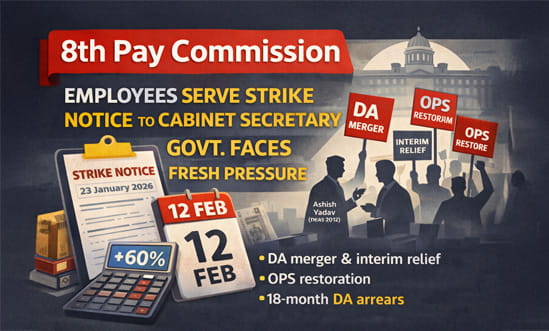
The 8th Pay Commission debate has taken a sharper turn after a formal strike notice was served to the Cabinet Secretary by the Confederation of Central Government Employees and Workers. The notice announced a one-day nationwide strike on 12 February 2026 and placed multiple demands before the government, many of them directly linked to the 8th CPC, pay revision, pension, and service conditions. This is significant because it shows that the 8th CPC discussion is no longer limited to expectations about future salary revision. It has now become a pressure point involving unions, pensioners, and serving employees across departments.
According to the published strike charter, Part A focuses mainly on employee and pension-related demands. These include a demand to modify the Terms of Reference of the 8th CPC, merge 50% DA/DR with basic pay and pension, grant 20% interim relief from 1 January 2026, restore OPS by scrapping NPS/UPS, avoid discrimination among pensioners, release the 18 months of frozen DA/DR arrears, and restore the commuted part of pension after 11 years instead of 15 years. The charter also raises issues such as compassionate appointment, filling sanctioned vacancies, stopping outsourcing and corporatisation, implementation of Board of Arbitration awards, and regularisation of casual, contingent, contractual and GDS employees.
The broader message behind this strike notice is simple. Employees are arguing that the 8th CPC process may take time, but financial stress is already being felt now. That is why two demands stand out more than the rest: DA merger and interim relief. A DA/DR merger at the 50% mark would raise the pay or pension base on which future revisions are calculated. Interim relief, meanwhile, is meant as temporary support until the Pay Commission’s final recommendations are implemented. Whether the government accepts either demand is a separate matter, but the strike notice clearly shows that employees want relief before the long 8th CPC cycle fully plays out.
This update also matters because it comes at a time when the official 8th CPC process is still in its consultation phase. The 8th Central Pay Commission was constituted on 3 November 2025, and its official website later opened routes for questionnaires, memoranda and stakeholder submissions. The website shows that responses to the questionnaire were extended up to 31 March 2026, while the separate online memorandum and representation window runs from 5 March 2026 to 30 April 2026. In other words, the Commission is working through formal inputs and documentation, but employees and pensioners are using union pressure to ensure their issues are not sidelined.
The government side has also continued with procedural movement. The 8th CPC website lists recent official updates such as the 24 April 2026 Dehradun visit notice, which shows that the Commission remains engaged in consultation rather than final recommendation-making. That is why this strike notice is politically and administratively important. It does not mean an 8th CPC decision has been taken. It means organised employee groups are trying to shape the agenda before the final report stage.
For Central Government employees, defence civilians, railway staff, CAPF personnel, postal employees and pensioners, the real takeaway is this: the 8th CPC story is now about pressure plus process. The process is the official consultation route through the Commission. The pressure is the employee side’s attempt to force attention on pay revision, pension fairness, OPS, DA arrears, commutation, and interim relief. Whether the government responds directly or not, the strike notice has already made one thing clear: the 8th Pay Commission will not be discussed only as a future salary formula. It will also be fought over as a present-day employee welfare issue.
For your website, this is the strongest news angle: the big twist is not that the 8th CPC has delivered relief, but that employees have raised the stakes and formally put the government under pressure before the Commission reaches its final recommendation stage.
Watch the full video for complete details!

Leave a Reply