

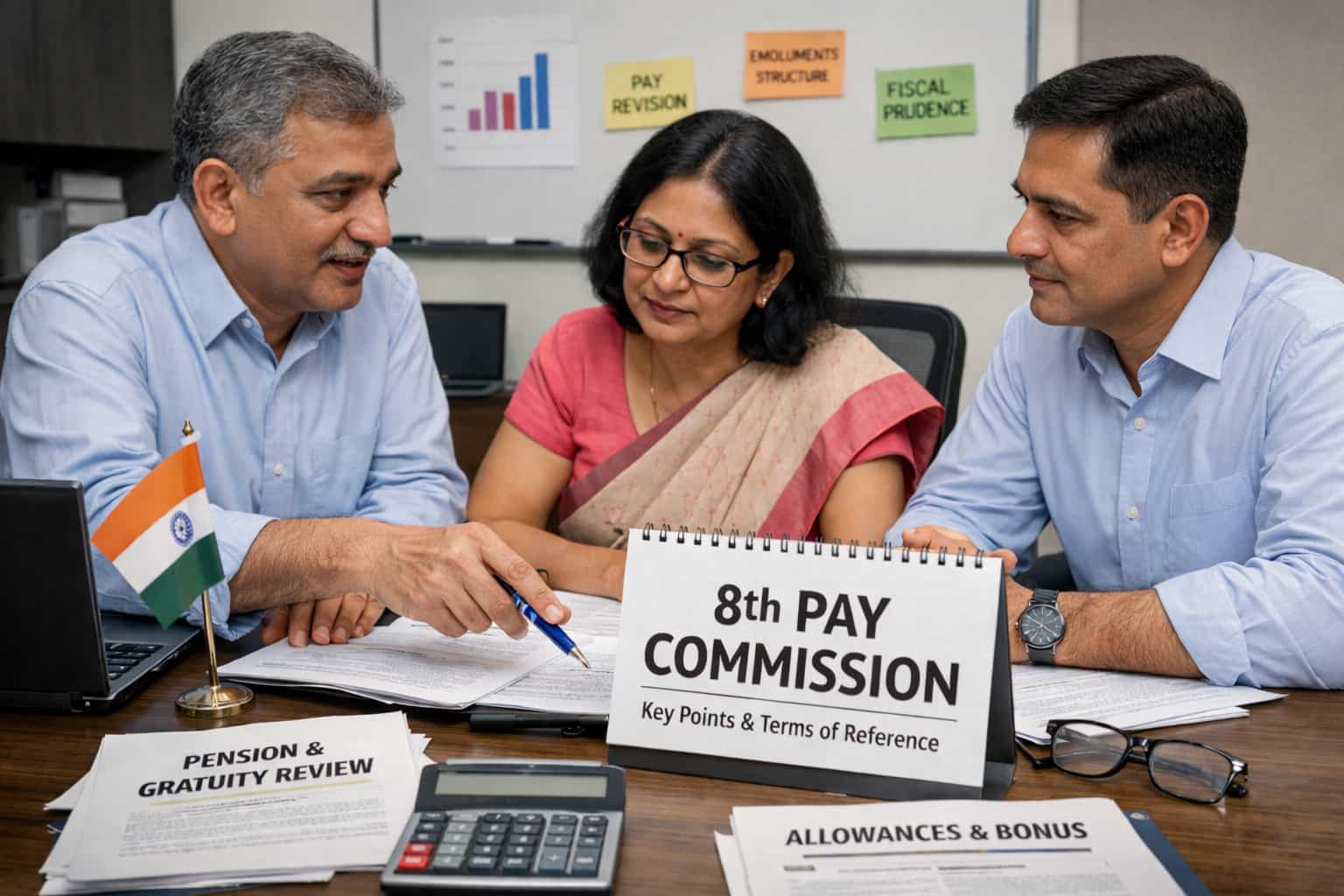
The release of the 8th Pay Commission resolution has brought a wave of fresh interest among central government employees, pensioners, and defence personnel. For many people, the biggest question was simple: what exactly has the government asked the Commission to examine? Now, with the official resolution spelling out the Terms of Reference, the picture has become much clearer.
For central government employees, defence personnel, pensioners, and several other affected groups, this is an important development. Why? Because the Terms of Reference decide what the Commission is actually allowed to examine and recommend. In other words, this document tells us the scope of the 8th Pay Commission, and that makes it one of the most important official papers released so far.
Who is in the 8th Pay Commission?
According to the official resolution, the 8th Central Pay Commission has been constituted with Justice Ranjana Prakash Desai as Chairperson, Prof. Pulak Ghosh as Member (Part-Time), and Shri Pankaj Jain as Member-Secretary. The resolution was issued by the Ministry of Finance, Department of Expenditure.
This matters because the formation of the Commission is no longer just a political announcement or media headline. It now stands backed by a formal government resolution published through the official record.
What the Terms of Reference include?
The Gazette resolution makes it clear that the Commission has been asked to examine and recommend changes in emoluments, which includes pay, allowances, and other facilities or benefits, whether in cash or kind. It is expected to look at these issues while keeping in mind rationalisation, modern functional requirements, and the specialised needs of different departments, agencies, and services.
The scope is quite wide. It covers central government employees, both industrial and non-industrial, officers of the All India Services, defence forces personnel, Union Territory staff, Indian Audit and Accounts Department employees, members of regulatory bodies other than the RBI, employees of the Supreme Court, certain High Court employees whose expenditure is borne by Union Territories, and judicial officers of subordinate courts in Union Territories.
This broad coverage shows that the 8th Pay Commission is not restricted to one narrow class of government employees. Its recommendations could influence multiple categories across the Union structure.
More than salary revision
One of the biggest takeaways from the resolution is that the Commission’s work is not limited to basic pay revision alone. It has also been asked to work out an emolument structure that can attract talent to government service and promote efficiency, accountability, and responsibility in work culture.
That means the conversation is not only about how much salary should rise, but also about how compensation structures can support better governance and stronger public service performance. This is a significant point because it connects pay reform with administrative outcomes.
The Commission has also been directed to review the existing bonus system and examine whether incentive-linked structures can be improved through better productivity and performance parameters. It has separately been tasked with reviewing allowances and the conditions under which they are granted, with a clear focus on rationalisation because of the large number of allowances currently in operation.
Pension and gratuity are clearly part of the picture
For pensioners, one of the most closely watched aspects of the Terms of Reference is the treatment of gratuity and pensions. The resolution specifically asks the Commission to review Death-cum-Retirement Gratuity for employees under the National Pension System, including the Unified Pension Scheme. It also asks the Commission to review gratuity and pensions of employees not under NPS, while linking that exercise to the broader financial considerations listed later in the resolution.
This is important because pension-related concerns had triggered substantial debate after the Terms of Reference were approved. Subsequent public reporting also highlighted that pensioner groups and employee bodies were closely watching whether pension revision had been adequately covered, and the Finance Ministry later clarified in Parliament that pension revision would indeed fall within the Commission’s scope.
So, while debate may continue over interpretation and future recommendations, the official framework does show that retirement-related issues are part of the Commission’s mandate.
The financial caution built into the mandate
The resolution also places clear limits on how the Commission must think. It has been told to keep in view the economic conditions in the country, the need for fiscal prudence, the need to preserve resources for developmental expenditure and welfare measures, the unfunded cost of non-contributory pension schemes, the likely impact on state finances, and the comparison with pay and working conditions in Central Public Sector Undertakings and the private sector.
This part is crucial. It means the 8th Pay Commission is not working in a vacuum. Its recommendations will have to balance employee expectations with budget realities. That may shape future debates on fitment factor, pension burden, allowances, and the overall affordability of recommendations.
Can the Commission take expert help?
Yes. The resolution states that the Commission can devise its own procedure and may appoint advisors, institutional consultants, and experts for specific purposes. It can also call for information, documents, and evidence as required, and all ministries and departments of the Government of India are expected to assist it. The government has also said it expects cooperation from state governments, service associations, and others concerned.
This suggests that the exercise ahead will not be a closed-door paperwork formality. It is designed to involve consultation, information gathering, and expert support wherever necessary.
Timeline and what comes next
The official resolution gives the Commission 18 months from the date of its constitution to make its recommendations. It also allows the Commission to submit interim reports on specific matters if needed before the final recommendations are completed. The Commission’s headquarters will be in Delhi.
That timeline is important because it sets expectations. The Gazette has clarified the structure and scope, but employees and pensioners should also understand that the process is not instantaneous. The terms define the road ahead, but recommendations, decisions, and eventual implementation are separate stages.
The 8th Pay Commission Gazette is a major document because it replaces speculation with structure. It confirms who is leading the Commission, identifies the employee categories under review, includes pay, allowances, bonus, pensions, and gratuity within its working framework, and sets out the economic and fiscal lens through which recommendations must be made.
For employees and pensioners, the biggest takeaway is simple: the Terms of Reference are broad, serious, and highly consequential. They do not guarantee any one outcome today, but they do make clear what the Commission is empowered to study and recommend. And in a process as important as pay and pension reform, that clarity is itself a big development.
Watch our full video for complete details!




Leave a Reply