

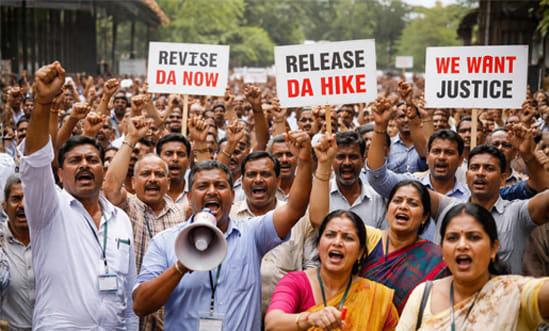
The delay in announcing the next Dearness Allowance and Dearness Relief revision has now become a major issue for central government employees and pensioners. What began as routine anticipation over the January 2026 DA/DR instalment has now turned into visible employee unrest, with a central government employee body calling for protest action over the pending decision.
According to a recent report, the Confederation of Central Govt. Employees & Workers has written to the Cabinet Secretary and announced that affiliated organisations would hold a lunch-hour demonstration on 16 April 2026 to press for the immediate release of the DA/DR instalment due from 1 January 2026. The issue is not simply about one percentage increase. For lakhs of employees and pensioners, the delay affects household budgeting, expectations around arrears, and confidence in the pace of decision-making.
At the heart of the matter is a simple question: where does the January 2026 DA/DR revision stand? As of 15 April 2026, the latest central government orders publicly visible on the Department of Expenditure’s DA circular page still point to the earlier notified rate, and the Pensioners’ Portal DR schedule also continues to reflect the last implemented revision rather than a fresh January 2026 order. In other words, the current controversy is being driven by a delay in formal announcement, not by an already-issued new notification.
The most recent confirmed central revision before this pending instalment was the increase that took DA and DR to 58 percent with effect from 1 July 2025. That revision was formally announced by the government and became the last clear benchmark for employees and pensioners. Since then, attention has shifted to the next instalment due from 1 January 2026, but an official notification for that stage is still awaited on the sources checked so far.
This distinction is important because news around DA often gets mixed up between estimates and official orders. Many reports and employee discussions are currently pointing toward a likely 2 percent increase, which would raise the DA/DR rate from 58 percent to 60 percent. That expectation is based on the standard calculation method linked to the average AICPI-IW data for the relevant period. However, until the government formally clears and notifies the revision, that number remains an expectation and not a legally operative rate.
The latest inflation data adds another layer to the discussion. Official CPI-IW figures released by the Labour Bureau show the all-India index at 148.6 in January 2026 and 148.5 in February 2026. These numbers are useful for tracking cost-of-living trends and future DA expectations, but they do not, by themselves, amount to a DA order. The actual payout depends on the government’s formal approval and notification process.
Ever since the beginning of the 7th Pay Commission on January 1, 2016, the government has never delayed the DA hike announcement so long. It was expected by many employees that the Centre would announce it ahead of or a few days after Holi which fell on March 4, 2026, but they are yet to receive it.
Which department will join the protest on April 16, 2026?
What makes this development more significant is the move from expectation to organised protest. The Economic Times report says the employee body expects participation from units in departments such as Income Tax, Postal, Agriculture, Botanical Survey of India, Geological Survey of India, and Survey of India. That gives the story a broader administrative and political dimension, because it suggests the issue is no longer confined to informal staff discussion or pensioner forums. It is now being framed as a coordinated demand for timely financial relief.
For employees, the delay matters because DA is not viewed as a bonus or optional benefit. It is designed as compensation against inflation. When inflation-linked relief is delayed, even if later paid with arrears, it still creates uncertainty in monthly financial planning. For pensioners, the same concern applies through Dearness Relief, especially at a time when medical costs, daily expenses, and household spending pressures remain high. The emotional impact of delay is often as important as the monetary value itself.
At the same time, it is important for readers to separate confirmed facts from speculation. The confirmed part is that an employee body has publicly raised the issue and linked it to a protest call. The last officially visible central DA/DR level remains 58 percent from 1 July 2025 on the government sources reviewed. The unconfirmed part is the final January 2026 rate, which is still being widely projected at 60 percent but has not yet appeared in a fresh central government notification on the official pages checked.
For now, the DA/DR story is less about a new hike being granted and more about a delay becoming a public flashpoint. If the government issues the order soon, the current protest mood may soften quickly. But until that happens, the issue is likely to remain in the spotlight for employees, pensioners, unions, and news platforms that closely track pay and pension developments.

Leave a Reply