

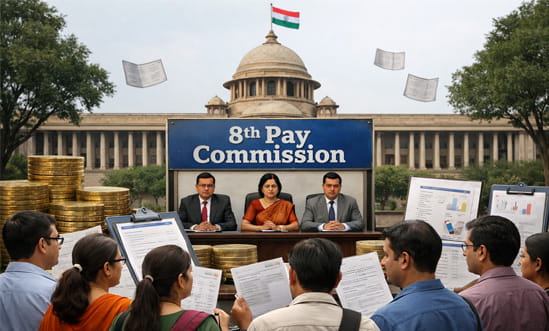
For lakhs of Central Government employees and pensioners, the 8th Pay Commission has never been just another policy topic. It has been a question tied directly to salary revision, pension expectations, inflation pressure, and long-term financial planning. That is why even a small update, a parliamentary reply, or a cabinet-related rumour can quickly become a major talking point.
At one stage, much of the discussion revolved around a simple but emotionally loaded question: would the government clear the 8th Pay Commission soon, and could cabinet approval come in the near term? That kind of speculation naturally gained attention because employees were already comparing rising living costs with the long wait for the next pay revision.
But the deeper lesson from that phase is important. In matters like a Pay Commission, the most critical difference is the one between expectation and official process.
For a long time, government replies in Parliament made it clear that there was no proposal under consideration to constitute the 8th Central Pay Commission. In July 2024, the government stated in Lok Sabha that although representations had been received, no such proposal was under consideration at that time. That reply disappointed many employees, but it also served as a reminder that viral claims and hopeful assumptions cannot be treated as policy decisions.
Then the situation changed.
In January 2025, the government officially announced the formation of the 8th Central Pay Commission. Later, on 28 October 2025, the Cabinet approved its Terms of Reference, and on 3 November 2025 the Commission was formally constituted. The official notification named Justice Ranjana Prakash Desai as Chairperson, Prof. Pulak Ghosh as Member, and Pankaj Jain as Member-Secretary. That sequence is important because it shows how major government decisions actually unfold: first political indication, then terms of reference, then formal constitution, and after that, the long administrative phase of consultations and submissions.
This is where the 8th Pay Commission story becomes more meaningful for readers.
The real issue was never just whether one cabinet meeting in one particular month would deliver instant relief. The real issue was whether the government had entered the formal process of reviewing pay, allowances, pensions, and related service conditions. Once the Commission was officially in place, the conversation shifted from “Will it happen?” to “How will it work, how long will it take, and what can employees realistically expect?”
That shift matters because pay commissions do not operate like one-day announcements. They require staffing, background papers, memoranda, stakeholder inputs, consultations, and eventually a report. The official 8th CPC website now shows exactly that kind of structured progress. It says the Commission was constituted on 3 November 2025, is functioning from Janpath in New Delhi, and has invited memoranda and representations from employees, pensioners, associations, ministries, and other stakeholders.
In other words, the early suspense around cabinet approval has now been replaced by something more serious: the institutional work of the Commission itself.
For employees and pensioners, that distinction is crucial. It is easy to get pulled into headline-driven hope, especially when every rumour is framed as a breakthrough. But a Pay Commission affects millions of people, and that is why its journey is usually gradual, document-driven, and heavily procedural. The final outcome will depend not only on public expectations, but also on the Commission’s recommendations, fiscal considerations, and the government’s eventual acceptance of those recommendations.
That is also why government replies in Lok Sabha matter so much. They do not always provide the answer employees want to hear, but they often reveal where the issue truly stands. At one point, the reply signalled there was no proposal. Later, official actions showed that the government had moved ahead. Together, those stages tell a larger story: policy does not move in a straight line, but when it does move, the official record matters more than noise.
For readers today, the best takeaway is this: the 8th Pay Commission should be understood not as a chain of rumours, but as a process. The journey from speculation to official constitution shows why patience, documentation, and verified updates matter so much in government matters. Employees and pensioners have every reason to watch the Commission closely, but they also have every reason to judge it by official notifications and concrete milestones, not by excitement alone.
That is the real story behind the old cabinet-approval debate. It was never only about one month or one reply. It was about how a long-awaited demand slowly moved from public pressure to official reality.


Leave a Reply