


The real story is not just the final recommendation
Whenever the 8th Pay Commission is discussed, most attention quickly shifts to one question: how much could salaries and pensions rise? It is a natural question, because for central government employees and pensioners, the Commission is directly linked to financial stability, household planning, and future expectations.
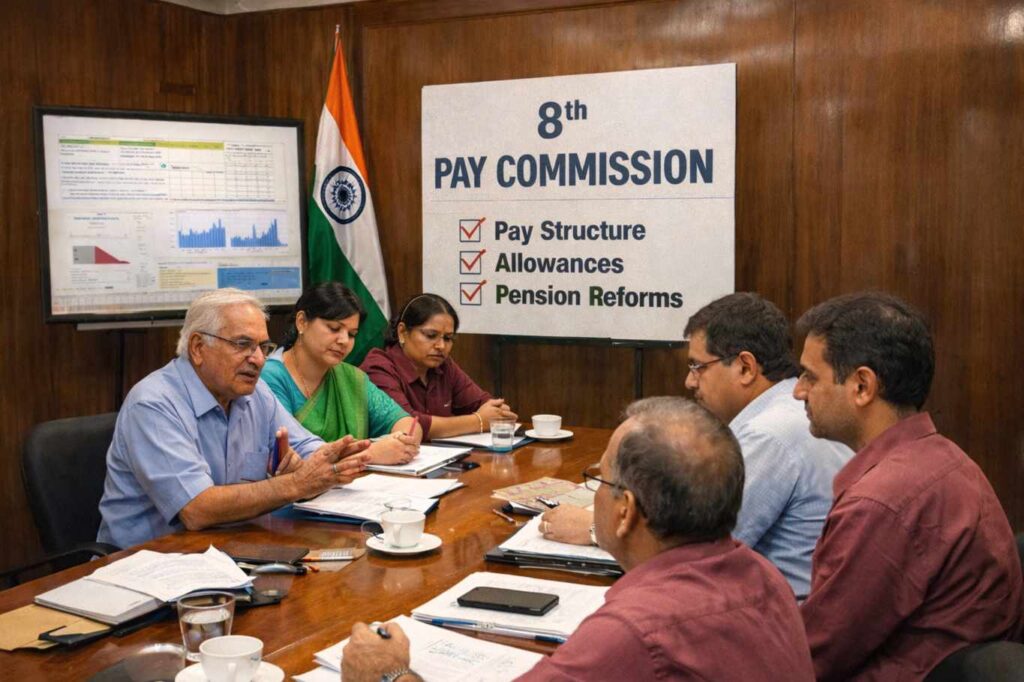
But there is another side to this process that deserves just as much attention.
Before any final recommendation is announced, a long policy-building stage takes place behind the scenes. That stage includes consultation, issue mapping, stakeholder inputs, and detailed examination of concerns related to pay, pension, allowances, and service conditions. This is where the foundation is laid. If the foundation is weak, even a promising final report can leave room for fresh anomalies and long-term dissatisfaction.
That is why the current phase of the 8th Pay Commission matters so much.
Why this stage deserves serious attention?
In large policy exercises, the final outcome is only as good as the material that goes into it. A Pay Commission does not create recommendations in a vacuum. It studies records, receives submissions, compares demands, evaluates financial impact, and tries to understand where the current system is working and where it is failing.
For employees and pensioners, this means one important thing: the present stage is not passive. It is participatory.
This is the point where concerns can be framed properly. It is where long-pending issues can be documented. It is also the stage where practical, evidence-backed arguments can be made before the structure becomes harder to influence.
In simple terms, if the wrong issues dominate now, the wrong issues may dominate later too.
Why employees are looking beyond just basic pay?
Salary revision is always the headline issue, but employees know the full picture is much wider than basic pay alone. The value of any Pay Commission depends not just on the revision figure, but on how the entire compensation structure is treated.
That includes:
- pay matrix design
- fitment logic
- annual increment structure
- career progression issues such as MACP
- risk and hardship-related allowances
- housing-related support like HRA
- treatment of field, technical, and specialised roles
This is why many employees are watching the process more carefully this time. There is a strong view that the system should not only revise pay, but also address structural gaps that continue to affect fairness across categories.
the growing concern over broad treatment of allowances
One of the biggest policy concerns emerging in this phase relates to allowances.
On paper, grouping allowances into broad categories may seem efficient. It may simplify review and make the process look more manageable. But in practice, this can create a serious problem. Different allowances exist for different reasons, and those reasons are often tied to the actual reality of service conditions.
An employee working in a difficult terrain, hazardous environment, remote posting, technical role, or intensive operational setting does not experience service in the same way as someone in a standard office assignment. The challenge, pressure, and nature of duty are different.
If all of this is flattened into a broad administrative category, the final recommendation may fail to capture those distinctions. That is why many stakeholders are arguing that allowances should be examined with more depth, not less.
Why pensioners have a strong stake in this process?
For pensioners, the Pay Commission is not simply a policy discussion. It is deeply personal.
Retirement income is fixed or semi-fixed in nature. As the cost of living rises, even a modest gap in pension fairness can significantly affect everyday financial security. This is why pension-related issues continue to remain central in every Pay Commission discussion.
Key concerns usually include:
- pension revision fairness
- parity concerns across groups
- treatment of retirement benefits
- commutation-related logic
- post-retirement financial sustainability
Pensioners often feel that public debate focuses more on serving employees and less on those who have already completed service. But the impact of Commission recommendations on retired personnel can be just as significant, especially when it comes to long-term benefit design.
That is why this stage is important for them too. It gives space to place retirement-related concerns on record before priorities are finalised.
Why evidence matters more than emotion?
In matters like pay and pension, emotion is understandable. People are discussing livelihood, family budgets, retirement dignity, and long-term financial security. But for policy purposes, emotion alone is rarely enough.
What strengthens a demand is evidence.
A well-supported point can include:
- comparison with existing anomalies
- examples of category-specific hardship
- pay impact calculations
- references to official orders or circulars
- pension and commutation illustrations
- practical explanation of how a rule affects service or retirement life
This kind of material makes it easier for policy reviewers to understand not just what the grievance is, but why it deserves attention.
A vague complaint may be noticed. A clear, structured, documented point is far more likely to be taken seriously.
Why the current process must not become a rushed exercise?
One recurring concern in such phases is whether the process allows enough space and time for meaningful input. If stakeholders are expected to summarise serious issues in limited formats or under tight deadlines, the result may be incomplete representation.
That would be a costly mistake.
A rushed process often produces shallow submissions. Shallow submissions lead to shallow understanding. And once that happens, even genuine concerns may appear less important than they really are.
This is especially true for technical matters such as allowances, pay anomalies, pension logic, or category-specific service conditions. These issues require explanation, examples, and supporting documents. They cannot always be captured properly in a hurried note.
That is why process quality matters almost as much as policy quality.
What employees and pensioners should keep in mind?
At this stage, the most sensible approach is neither blind optimism nor unnecessary panic. It is informed participation.
Employees and pensioners should focus on three things.
First, understand the issue clearly. Before raising any demand, it is important to define what the actual problem is.
Second, support the issue with facts. Documents, examples, calculations, and structured comparisons make the argument stronger.
Third, think in solution terms. A submission becomes more effective when it not only points out the problem but also suggests a practical remedy.
This approach improves both the quality of participation and the chances of meaningful consideration.
Why this phase may matter more than the final headlines?
Final recommendations always attract the most public attention. Headlines will focus on salary revision, fitment factor, pension impact, and implementation dates. But by the time those headlines arrive, much of the underlying direction has already been shaped.
That is why the present phase is so important.
It is where employee realities, pensioner concerns, and category-specific issues enter the policy conversation. It is where the system gets the opportunity to understand what needs correction before the final framework is locked in.
In that sense, this stage is not secondary to the final report. It is what helps create the final report.
The 8th Pay Commission is not just a future announcement waiting to happen. It is an evolving process, and every serious stage of that process matters.
Right now, the focus should not only be on what the final recommendation might deliver. It should also be on whether the process is receiving the right inputs, the right evidence, and the right representation from those who will be affected most.
For central government employees and pensioners, this is a crucial moment. It is the stage where concerns can still be shaped into policy language, where real-world problems can still be documented properly, and where future outcomes can still be influenced.
Because in a process as important as the Pay Commission, what gets recorded today often decides what gets resolved tomorrow.


Leave a Reply