

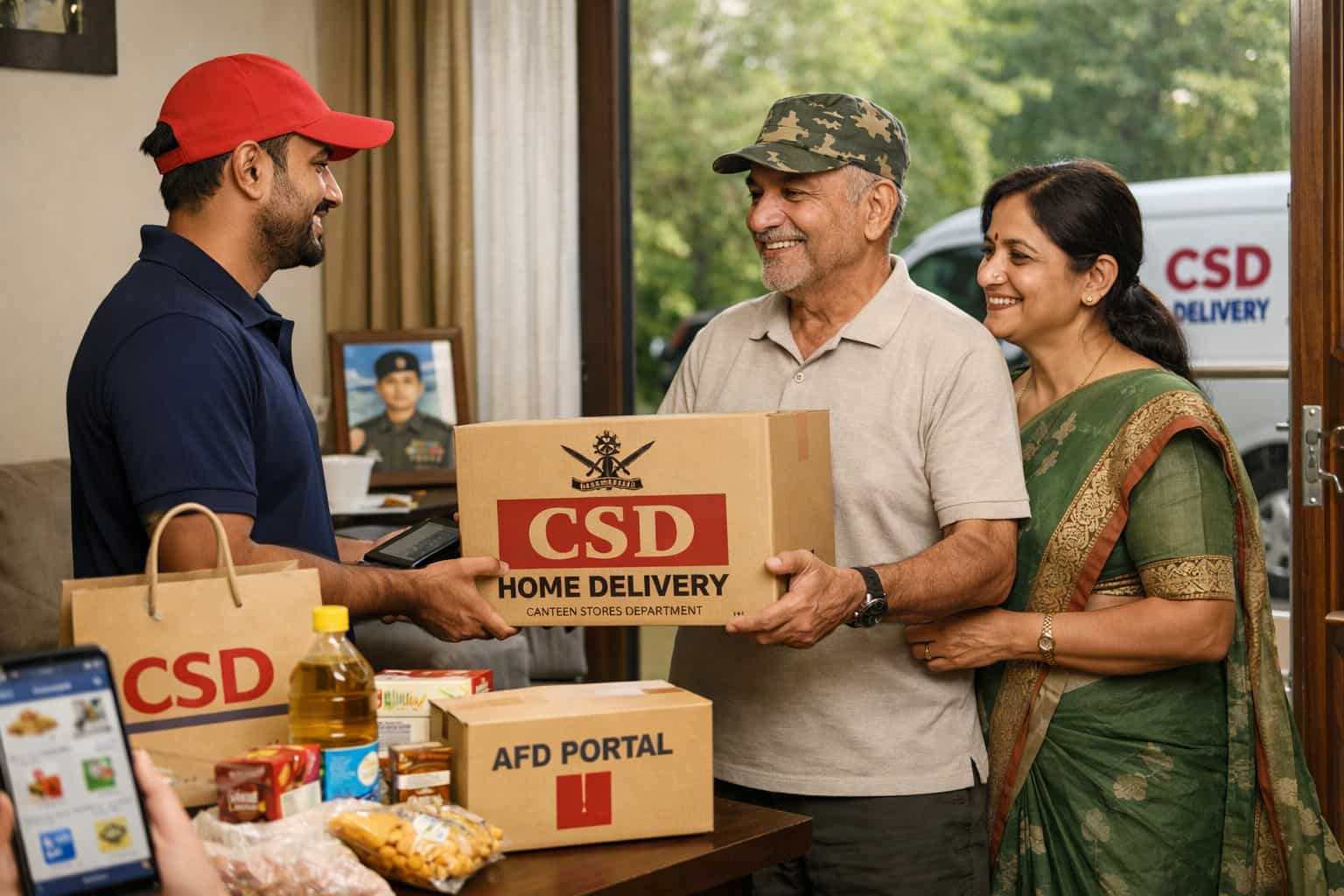
For lakhs of defence families across India, the CSD canteen is not just a place to buy monthly household items. It is a trusted welfare facility that has supported serving soldiers, ex-servicemen, defence pensioners, Veer Naris and their families for decades. From groceries and daily-use products to selected high-value items through official channels, the CSD system has helped the fauji community manage household expenses with dignity and relief.
Now, a new discussion has created strong interest among beneficiaries. As per public-domain reports, the Ministry of Defence is exploring the possibility of a CSD e-commerce model where eligible users may be able to order canteen items online and receive them at home. In simple words, many defence families are asking one question: can CSD shopping become as easy as ordering from an online platform?
The idea is exciting, but it also needs caution. At present, beneficiaries should understand that the final rules, launch date, delivery model, list of products, authentication method and payment process will become clear only after an official announcement from MoD or CSD. Until then, this should be treated as a developing update, not a confirmed service available for use.
Why this update matters for the fauji community?
CSD is deeply connected with the everyday life of defence families. A serving soldier posted far from home may depend on family members to manage household purchases. A retired Subedar living in a small town may need to travel a long distance to reach the nearest Unit Run Canteen. A Veer Nari may have to depend on others for monthly canteen visits. Senior veterans may find it difficult to stand in queues, carry heavy bags or travel repeatedly for basic household items.
This is why the idea of CSD home delivery has become important. If implemented properly, it can reduce travel, save time and make canteen access easier for those who need support the most. For many families, it may not be just a digital convenience. It may become a real welfare improvement.
In cities, beneficiaries often face traffic, parking issues and long waiting time at canteens. In smaller towns and remote areas, distance becomes the biggest challenge. Many users also face stock-related uncertainty. They may travel to the canteen only to find that some items are not available. A well-designed online system can reduce this problem by showing stock availability before purchase.
A possible next step after the AFD portal
CSD already has an official digital system for certain categories. The AFD portal is used by eligible beneficiaries for Against Firm Demand Category-1 items such as cars, two-wheelers, televisions, refrigerators and other selected products. This has already made high-value purchases more structured and transparent for many users.
If a grocery and household delivery model is introduced in the future, it may become the next big digital step for CSD. The main difference is that daily-use items involve regular demand, wider stock movement and faster delivery expectations. So the system will need stronger logistics, accurate inventory updates and proper customer support.
A portal alone will not solve everything. The real success will depend on how smoothly the system works on the ground.
What beneficiaries should not assume yet?
The biggest mistake right now would be to assume that every CSD item will become available for doorstep delivery. Product scope will be one of the most important questions.
Will the service include only grocery and household essentials? Will toiletries, packaged food, cleaning products and other routine items be included? Will controlled items be added later? If liquor is ever included in any form, it will require strict compliance with entitlement, quota, state rules and local restrictions. Beneficiaries should wait for the official product list instead of depending on forwarded messages or unofficial claims.
The second important question is launch timeline. The system may start as a pilot project in selected locations before any wider rollout. This would be practical because delivery operations, payment systems, identity verification and stock management need testing.
The third question is delivery cost. CSD prices are generally attractive for beneficiaries, but delivery charges can influence the final benefit. A fixed delivery fee may be easier for families to understand, while distance-based charges may affect users living far from canteen locations. Still, many veterans and families may accept a reasonable delivery charge if it saves travel cost, physical strain and time.

Security and fraud prevention will be critical
Any digital welfare service must be protected from misuse. CSD benefits are entitlement-based, which means only genuine beneficiaries should be able to use the service. For this, a future system may require secure login, registered mobile number verification, OTP authentication, smart card details and proper user validation.
This is also where beneficiaries need to be very careful. No one should share OTP, CSD smart card details, Aadhaar copies, login password or payment information with unknown people. Fake agents, fake websites and fake apps often appear when a welfare service becomes popular. Such fraud can target elderly veterans and family members who are not comfortable with digital systems.
CSD has already advised beneficiaries to avoid agents and middlemen and to use only official channels. If a new CSD delivery portal or app is announced, users should verify it only through the official CSD website, official MoD communication, PIB updates or trusted government sources.
Forwarded WhatsApp links should not be trusted blindly. Even if a message looks attractive, beneficiaries should first check whether the information is officially confirmed.
What a successful CSD delivery system will need?
For CSD home delivery to become useful, it must be simple, secure and reliable. Beneficiaries will expect updated stock details, proper billing, transparent payment, delivery tracking and clear complaint support. If a product is damaged, expired, missing or wrongly delivered, there must be a proper return or replacement system.
The user interface should also be easy for senior citizens. Many elderly veterans may not be comfortable with complicated apps. A clean portal, simple language, helpline support and step-by-step guidance can make the system more inclusive.
Another key requirement will be coordination between canteens, depots, delivery partners and beneficiary records. If the system is not properly connected with stock and entitlement data, users may face order cancellations or delays. That is why a phased rollout may be more realistic than an immediate nationwide launch.
What CSD users should do now?
At this stage, beneficiaries should take three practical steps.
First, keep CSD card details and registered mobile numbers updated. If digital verification becomes part of the process, updated records will be important.
Second, follow only official CSD and MoD communication. Do not depend on random social media posts for final rules.
Third, avoid sharing unverified links in WhatsApp groups. Many defence families trust community messages, but digital fraud often spreads through the same route.
A hopeful reform, but official clarity is essential
If CSD home delivery becomes a reality, it can be one of the most useful welfare upgrades for the defence community. It can help serving families, retired personnel, Veer Naris, senior veterans and beneficiaries living far from canteen facilities. It can reduce queues, save time and make monthly shopping more convenient.
But the system must protect entitlement rules, pricing transparency and beneficiary security. CSD is not an ordinary shopping platform. It is a welfare facility linked with trust, eligibility and service identity.
For now, the idea is promising, but the final picture will become clear only after official notification. Until then, defence families should stay alert, stay informed and use only verified channels.
If implemented with care, CSD doorstep delivery can make one simple but powerful change: canteen benefits may become easier to access without compromising security, rules or transparency.


Leave a Reply