


For Central Government employees and pensioners, CPI-IW is not just a monthly statistic released by the Labour Bureau. It is one of the most important numbers in the entire pay and pension system because it directly shapes Dearness Allowance and Dearness Relief. That is exactly why the March 2026 AICPIN update has created so much fresh interest.
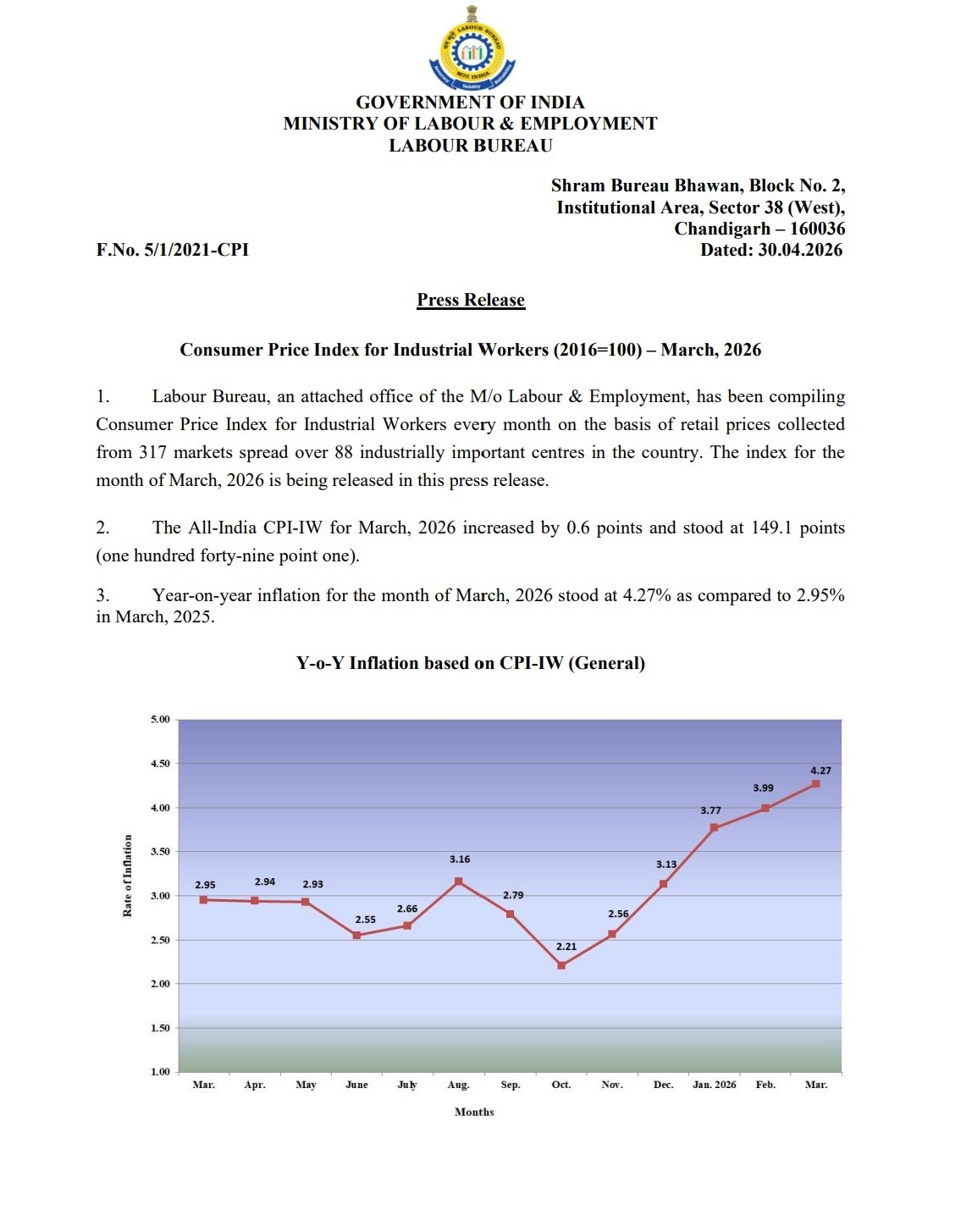
The latest data shows that the All-India CPI-IW for March 2026 has increased to 149.1, up from 148.5 in February 2026. On paper, that is a rise of 0.6 points. It may sound small, but in the world of DA and DR calculation, even a small monthly increase can become important when it enters the rolling average used for the next revision.
This is the real reason why employees and pensioners are paying close attention to March.
The July 2026 DA/DR revision is not decided by one month alone. It depends on the broader CPI-IW trend up to June 2026. That means January, February, March, April, May, and June all play a role in shaping the final outcome. Since three of those months are now available, the early picture is beginning to take shape, and right now that picture looks stronger than it did before.
This is where the discussion becomes more interesting.
Based on current calculator trends, the July 2026 DA/DR projection has moved to around 61.93%. That does not mean the government has finalized 61.93% as the next DA or DR rate. It simply means the present trend is moving in that direction based on the available data so far. The final figure will only become clear after the CPI-IW numbers for April, May, and June 2026 are released.
That distinction is important because many people confuse a trend with a confirmed announcement. They are not the same thing.
Still, March has made a difference. It has improved the mood around the July revision because the index has moved upward at a time when every decimal matters. When the CPI-IW rises in the months leading to a DA revision, the calculation becomes stronger. And when the calculation becomes stronger, employees and pensioners begin to see a more encouraging possibility for the next round of inflation compensation.
Another reason this update matters is the wider inflation picture. The year-on-year inflation rate for industrial workers in March 2026 stood at 4.27%, compared with 2.95% in March 2025. In simple terms, this means cost pressure is higher than it was a year ago. For families dependent on salary or pension, this is not just a technical comparison. It reflects the reality of rising household expenses, transport costs, food prices, medical spending, and day-to-day living pressure.
That is why DA and DR matter so much.
For serving employees, DA acts as a cushion against inflation. For pensioners, DR serves the same purpose. It helps protect monthly income from losing value as prices rise. This is especially important for retired employees and senior citizens, many of whom face increasing medical and household expenses every year. Even a modest upward movement in DR can bring some relief.
The March 2026 CPI-IW update also matters in another way. It adds weight to the larger conversation around the 8th Pay Commission.
The 8th CPC will deal with broader questions such as pay structure, pension revision, allowances, and overall cost-of-living adjustment. Inflation data like CPI-IW becomes important in that discussion because it shows why employees and pensioners keep demanding realistic revision instead of symbolic adjustment. When inflation stays active and household pressure rises, the case for fair salary correction and pension protection becomes stronger.
This is why the current CPI-IW movement is not being seen in isolation. It is being read alongside the 8th CPC debate, fitment factor expectations, and long-term pension concerns. Employees want to know whether their income is keeping pace with the cost of living. Pensioners want to know whether DR and future pension revision will offer real protection. And unions want data points that support their case before the Commission.
At the same time, it is important to stay practical.
One strong month does not decide the final DA/DR rate. March has improved the trend, but the story is still incomplete. If the CPI-IW remains stable or moves higher in April, May, and June, the July 2026 outcome could become firmer. If the index softens, the final number could change. That is why it would be wrong to present 61.93% as a final result at this stage.
The better way to understand the current position is this: March 2026 has given a positive push, but the last word has not yet been written.
For readers, the biggest takeaway is simple. The March CPI-IW rise to 149.1 has made the July 2026 DA/DR discussion more serious and more hopeful. It has strengthened the early trend and given employees and pensioners a reason to track the next three CPI-IW releases very closely. It has also added fresh energy to the wider 8th Pay Commission conversation, where inflation, salary revision, pension security, and cost-of-living protection are all becoming more important.
So while the final DA/DR rate is still some distance away, March 2026 has clearly shifted the momentum in a positive direction.




Leave a Reply