

Ex-servicemen can build second careers beyond security by using their military experience in operations, logistics, facility management, ESG, e-waste, CSR, GeM procurement and green jobs. Here is a practical roadmap for veterans.
For many ex-servicemen, retirement creates one difficult question:
What next?
The uniform gives identity, routine, respect and purpose. After retirement, many veterans are pushed towards one familiar path: security work. Security is a respectable field, but it should not be the only option for a person who has spent years managing people, equipment, stores, movement, discipline and responsibility.
A veteran does not leave the service empty-handed.
He carries leadership, punctuality, pressure-handling, documentation discipline, logistics sense and the ability to complete tasks without excuses. These skills are valuable in today’s civilian job market, especially in operations, facility management, procurement, sustainability and green-sector roles.
Why veterans should think beyond traditional jobs?
Many ex-servicemen underestimate their own experience because they describe it only in military language.
A civilian employer may not immediately understand appointment titles from service life. But the same experience becomes powerful when translated correctly.
Handling men becomes team management.
Maintaining stores becomes inventory control.
Movement planning becomes logistics coordination.
Training juniors becomes workforce development.
Unit administration becomes facility operations.
Record checking becomes compliance discipline.
The skill already exists. The language needs to change.
This is where second-career planning becomes important.
Why green jobs are becoming relevant?
India’s economy is changing. Companies are paying more attention to sustainability, waste management, recycling, ESG reporting, responsible procurement and environmental compliance.
This opens new doors for veterans.
Green jobs are not only for scientists or environmental experts. Many green-sector activities need disciplined supervisors, warehouse controllers, material handlers, operations managers, training coordinators, project monitors and compliance assistants.
These are practical roles where ex-servicemen can fit well after short upskilling.
E-waste sector: Why it matches military skills
E-waste management is one of the strongest emerging areas for veteran employment.
Old computers, mobile phones, batteries, servers, wires, circuit boards and electronic equipment must be collected, sorted, recorded, dismantled, recycled or disposed of safely.
This process needs structure.
Every item must be tracked. Every movement must be documented. Safety rules must be followed. Material value must be protected. Compliance records must remain clean.
This is very close to the military habit of accountability.
A veteran who has handled stores, equipment, transport, technical teams or documentation can understand e-waste operations faster than many fresh civilian workers.
With focused training, he can work in e-waste collection centres, recycling units, asset recovery operations, corporate sustainability teams, warehouse control, ESG support or compliance monitoring.
Why ESG and CSR can become useful career paths?
Companies are now expected to show responsibility beyond profit. ESG and CSR work has become more organised.
ESG deals with environment, social responsibility and governance. CSR deals with company-funded social projects. Both areas need people who can plan, monitor, verify and execute projects on the ground.
This is where veterans can add value.
They understand field execution. They know how to manage teams. They can handle reports, deadlines, vendors and ground-level discipline.
A veteran may not become an ESG expert on day one, but he can begin with support roles and grow through short courses and practical exposure.
GeM procurement: A useful skill for veterans
The Government e-Marketplace, or GeM, is another area worth learning.
Many government-linked purchases and institutional procurements now move through digital systems. Veterans with administrative, store, purchase or supply-chain experience can benefit by learning GeM basics.
A short GeM procurement course can help retired personnel explore roles in purchase departments, tender support, vendor coordination, institutional procurement and office administration.
This is especially useful for JCOs, clerks, store handlers, logistics personnel and officers with administrative exposure.
Planning should start before retirement
The biggest mistake is waiting until the last month of service.
A second career should be planned at least two to three years before retirement.
A retiring soldier should ask:
Which civilian field suits my experience?
Do I want operations, logistics, training, administration or sustainability?
What course can improve my profile?
Can I learn computer basics, GeM, ESG, CSR or warehouse systems?
Do I have a civilian-style resume?
Can I explain my service experience in corporate language?
Early preparation gives confidence.
Late preparation creates pressure.
Role of DGR and verified channels
Ex-servicemen should use official resettlement platforms wherever possible.
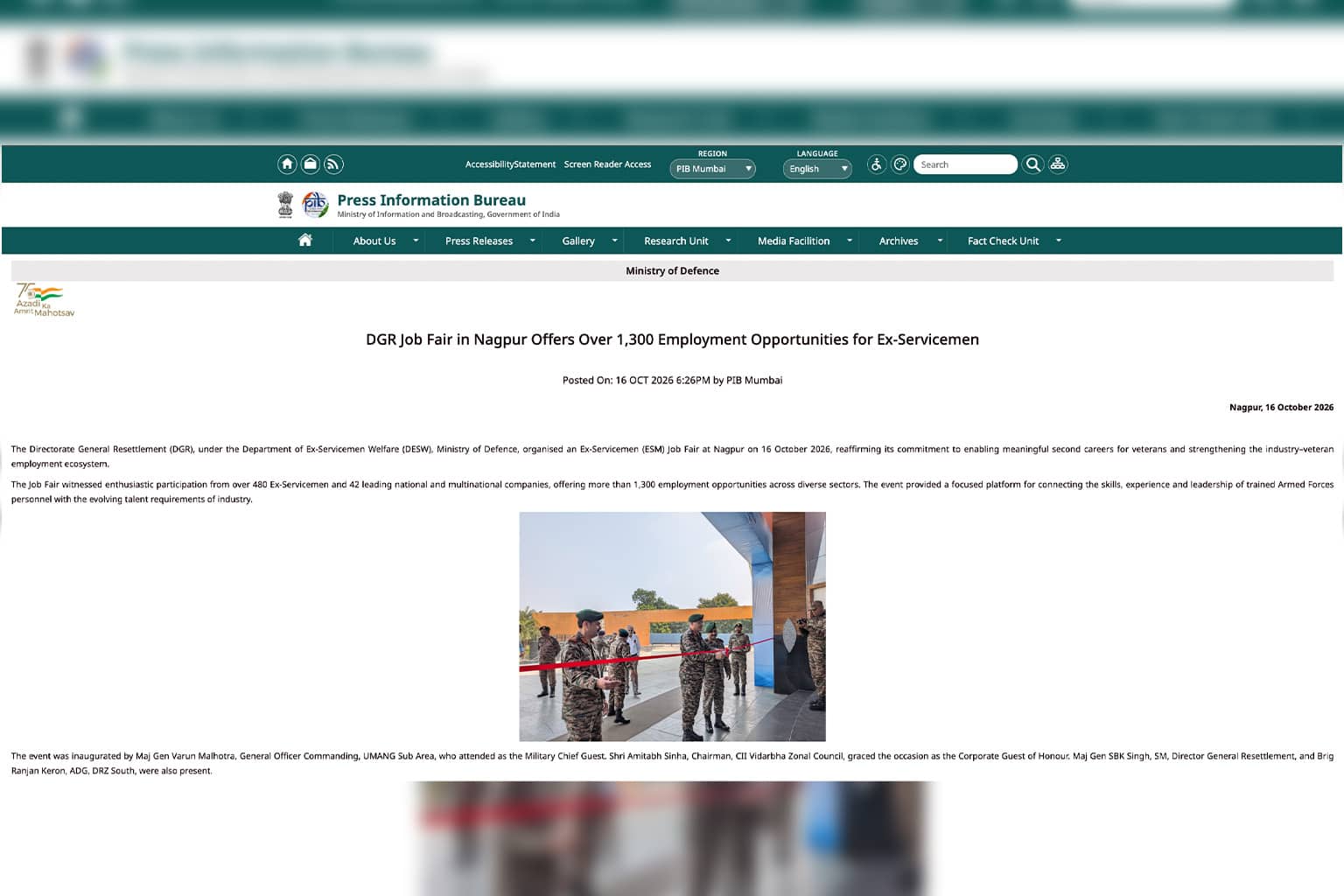
The Directorate General Resettlement supports retiring and retired defence personnel through training, job assistance, employment support and job fairs. DGR has also reported large-scale ESM participation through employment and self-employment pathways, which shows the importance of organised resettlement channels.
Veterans should avoid random agents and unverified job promises.
A serious second career should be built through verified training, proper documentation, official platforms, industry networking and realistic expectations.
What officers, JCOs and ORs can explore?
Every rank carries useful civilian value.
Officers can explore operations leadership, administration, facility management, compliance, education management, consulting, CSR and corporate roles.
JCOs can do well in logistics supervision, training coordination, warehouse management, institutional administration, security technology, transport operations and facility control.
ORs can move into technical services, repair support, e-waste handling, storekeeping, field supervision, transport coordination, maintenance roles and operations support.
The important point is not rank comparison. The important point is skill mapping.
A veteran should identify what he has actually done in service and connect it with a civilian need.
Comment
Ex-servicemen should not see retirement as a sudden fall from service life to uncertainty.
The country still needs their discipline and experience. The private sector needs reliable managers. Schools need administrators. Companies need compliance-minded people. Green businesses need organised supervisors. Recycling units need accountability. CSR projects need field execution.
A soldier may remove the uniform, but the habits of the uniform continue.
The next step is to learn the language of the civilian workplace and enter it with confidence.
Final takeaway
The second career of ex-servicemen should not be limited to security alone.
Security remains one option, but modern India is creating new opportunities in operations, logistics, e-waste, ESG, CSR, GeM procurement, facility management and training.
Veterans already have discipline, leadership, punctuality, people management and mission focus. With short upskilling and proper career mapping, these strengths can become strong civilian employment assets.
The message is simple: retirement is not the end of contribution.
It is the start of a new assignment.
Sources:-
E[co]work profile page mentioning Lt Col Ashok Kumar Singh:
https://www.ecowork.international/team
Directorate General Resettlement official website:
https://dgrindia.gov.in/
DGR job fair page:
https://dgrindia.gov.in/Content1/job-fair
PIB: Welfare and rehabilitation of ex-servicemen:
https://www.pib.gov.in/PressReleasePage.aspx?PRID=2204111
Skill Council for Green Jobs:
https://sscgj.in/


Leave a Reply