


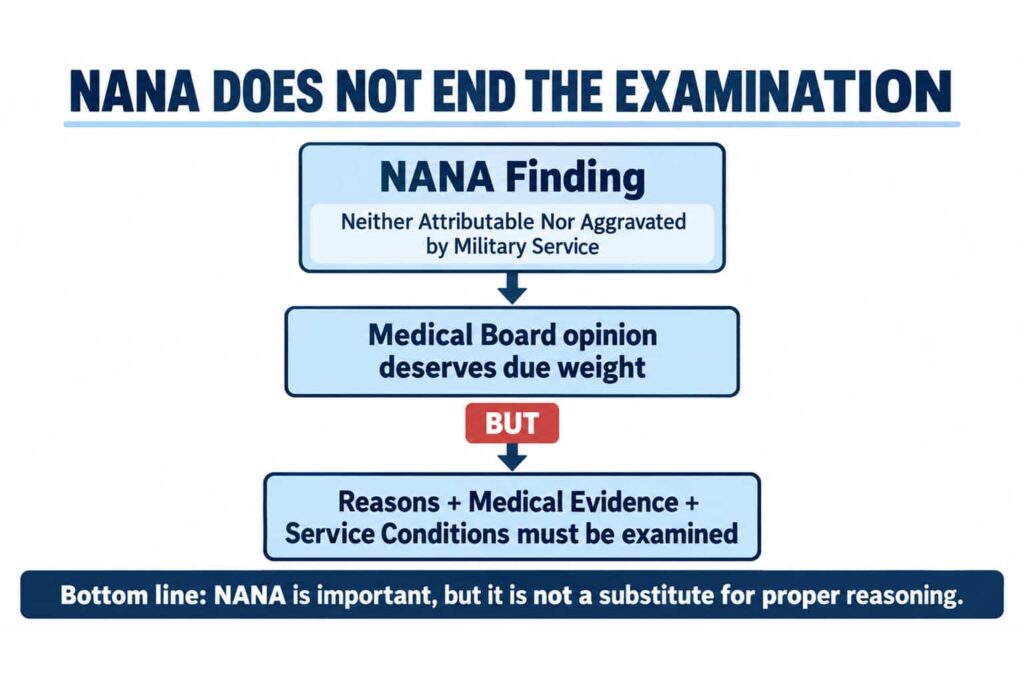
For an ex-serviceman fighting a disability-pension case, one expression can often become the turning point: NANA — Neither Attributable Nor Aggravated by Military Service.
For years, many disability-pension disputes have revolved around this Medical Board finding. If the Board says that a disease or disability was neither caused nor aggravated by military service, does that end the claim? Can a Tribunal disregard the Medical Board? What happens when a veteran raises the dispute many years after retirement?
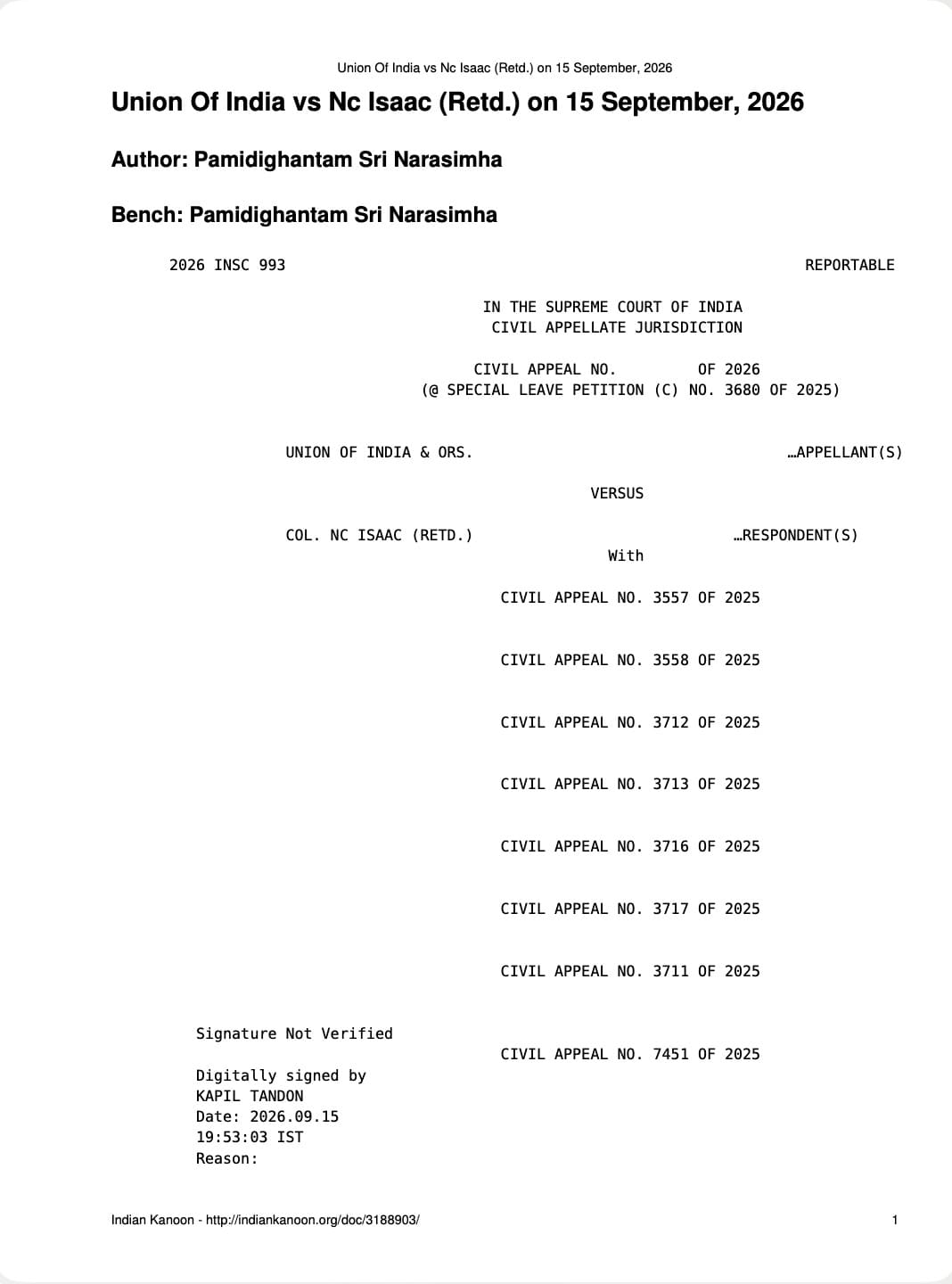
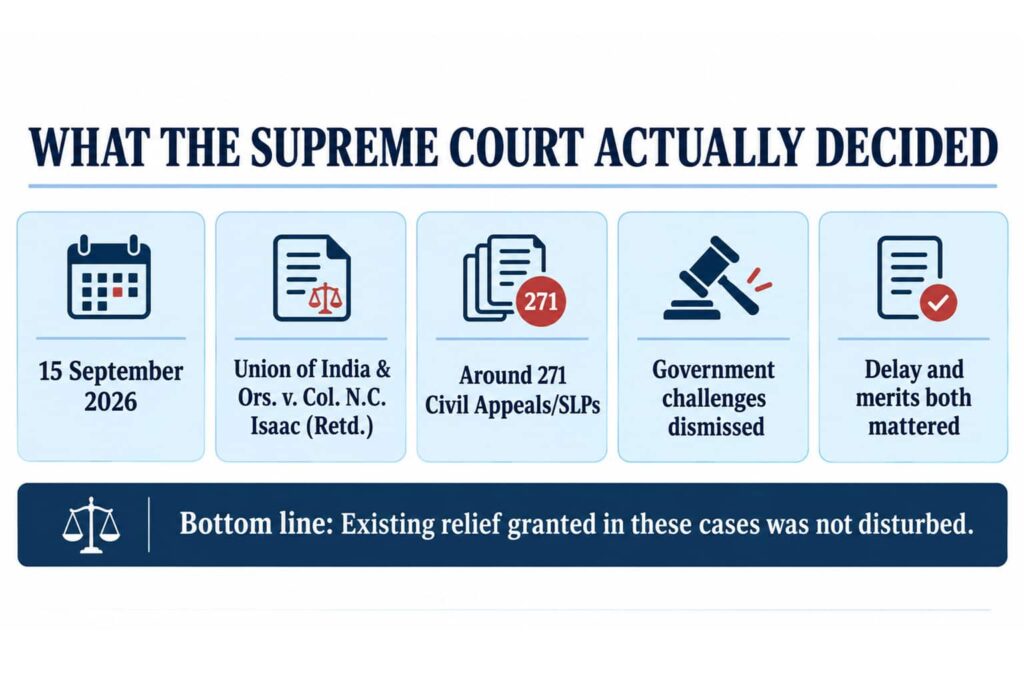
The Supreme Court has now dealt with these questions in Union of India & Ors. v. Col. N.C. Isaac (Retd.) and connected matters, decided on 15 September 2026.
The judgment is important, but it needs to be read carefully.
It does not mean that every veteran whose disability was declared NANA will automatically receive disability pension. At the same time, it also makes clear that disability-pension cases cannot be disposed of mechanically merely by repeating a NANA conclusion.
The real significance of the ruling lies somewhere between these two extremes.
Start with the most important point: this is not a blanket disability-pension order
The Supreme Court was dealing with a large group of cases in which retired Armed Forces personnel had already received relief from the Armed Forces Tribunal or different High Courts.
Their Release Medical Boards had generally classified the relevant disabilities as NANA. Based on those opinions, departmental disability-pension claims had been rejected.
The veterans subsequently challenged those decisions and secured relief before judicial forums. The Union of India then approached the Supreme Court.
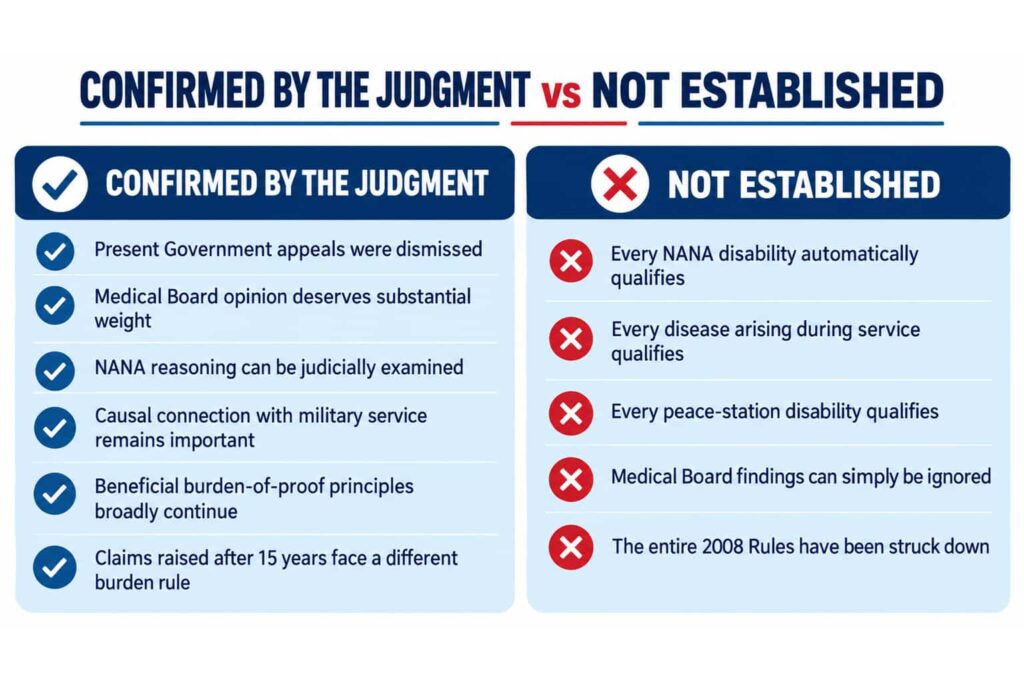
In the present batch, the Supreme Court found no sufficient ground to interfere and dismissed the Government’s appeals and petitions on delay as well as merits. The judgment records a batch of roughly 271 matters, many of which were also affected by limitation.
That outcome is significant for the veterans involved in those cases.
But it should not be converted into a general statement that:
“Supreme Court has ordered disability pension in every NANA case.”
That would be an incorrect reading of the judgment.
A NANA finding matters — but the reasoning behind it matters even more
This is perhaps the most practical takeaway for veterans.
A properly constituted Medical Board is an expert body. Questions such as whether hypertension, a cardiac condition, hearing loss, diabetes, an orthopaedic disability or another medical condition has a connection with military service often require professional medical assessment.
The Supreme Court therefore emphasised that the Medical Board’s opinion deserves due weight.
A Tribunal should not discard that opinion merely because another possible medical view exists.
But “due weight” does not mean “automatic acceptance”.
The real question becomes:
Has the Medical Board explained why the disability is NANA?
A Tribunal examining such a case may look at the Board’s reasoning, medical history, nature of the disease, service circumstances and whether the conclusion is supported by the material available.
In simple terms:
Medical expertise must be respected, but an unexplained conclusion is not beyond scrutiny.
Why the 2008 Rules became central to the case?
One of the Government’s important arguments concerned the difference between the older Entitlement Rules, 1982 and the Entitlement Rules for Casualty Pensionary Awards, 2008.
Earlier disability-pension jurisprudence, particularly the principles associated with Dharamvir Singh, provided significant protection to Armed Forces personnel in determining attributability and aggravation.
The Union argued that the position had materially changed under the 2008 framework.
The Supreme Court accepted one important distinction.
Merely showing that an illness developed while a person was serving in the Armed Forces does not by itself establish that military service caused or aggravated that illness.
There must still be an examination of the causal relationship between the disability and military service.
However, the Court did not accept the proposition that the 2008 Rules completely removed the protective character of the earlier entitlement framework.
Important principles relating to burden of proof, attributability, aggravation and reasonable doubt continue to have relevance.
That distinction is critical.
A veteran cannot simply say:
“The disease started during service, therefore disability pension must follow.”
Equally, the establishment cannot treat every disability as disconnected from military service without properly addressing the evidence and applicable entitlement principles.
The 15-year rule is being widely misunderstood
Among all parts of this judgment, the reference to 15 years has the greatest potential to create confusion.
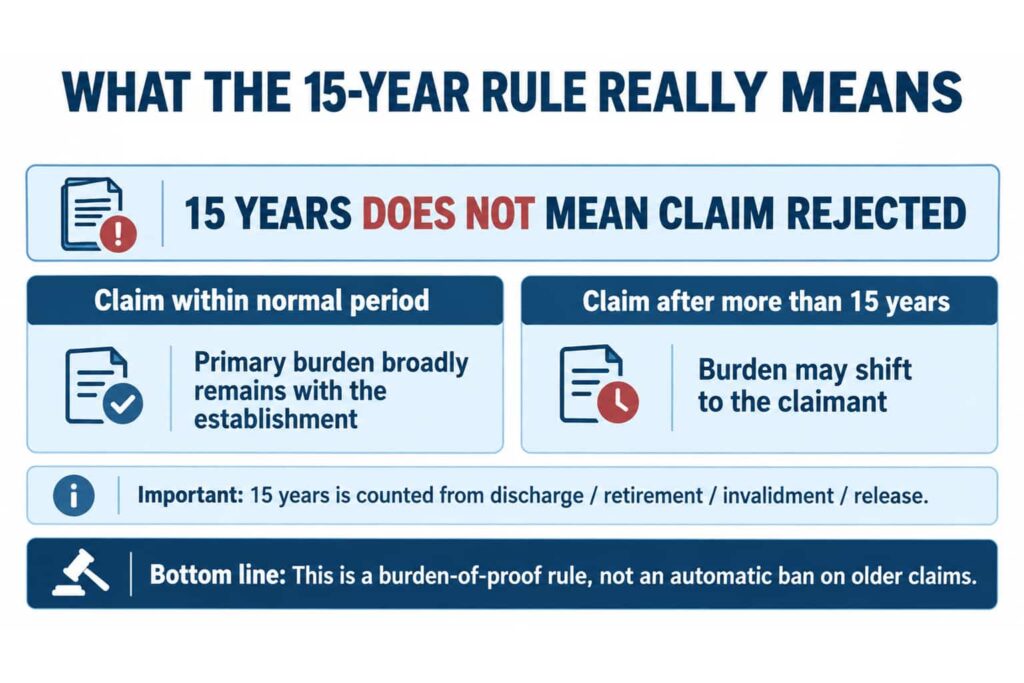
The Supreme Court has not imposed a rule saying that disability-pension claims become invalid after 15 years.
The issue relates to the burden of proof.
Under the 2008 Entitlement Rules, the ordinary framework places the primary burden broadly on the establishment rather than requiring the claimant to prove every condition of entitlement.
But the proviso to Rule 7 creates an important exception for delayed claims.
Where the relevant claim is raised more than 15 years after discharge, retirement, invalidment or release, the evidentiary burden can shift to the claimant.
That means an old claim is not automatically dead.
It means the veteran may have to produce sufficient material to establish the basis of entitlement.
Why old disability-pension cases may become more document-dependent?
The 15-year distinction has an obvious practical consequence.
A veteran approaching the authorities or Tribunal after a long period may face difficulty because medical records, service documents and other contemporaneous evidence can become harder to retrieve.
For an older claim, documentation may therefore become especially important.
Relevant material can include:
- Release Medical Board proceedings
- Service medical records
- disability assessment and percentage
- reasons recorded for the NANA finding
- posting and service history
- First Appeal and Second Appeal decisions
- previous representations
- hospital or specialist records
- date on which the pension claim or challenge was first raised
For anyone dealing with a pending dispute, simply possessing the final Medical Board result may no longer be enough. The reasoning and underlying documents could become equally important.
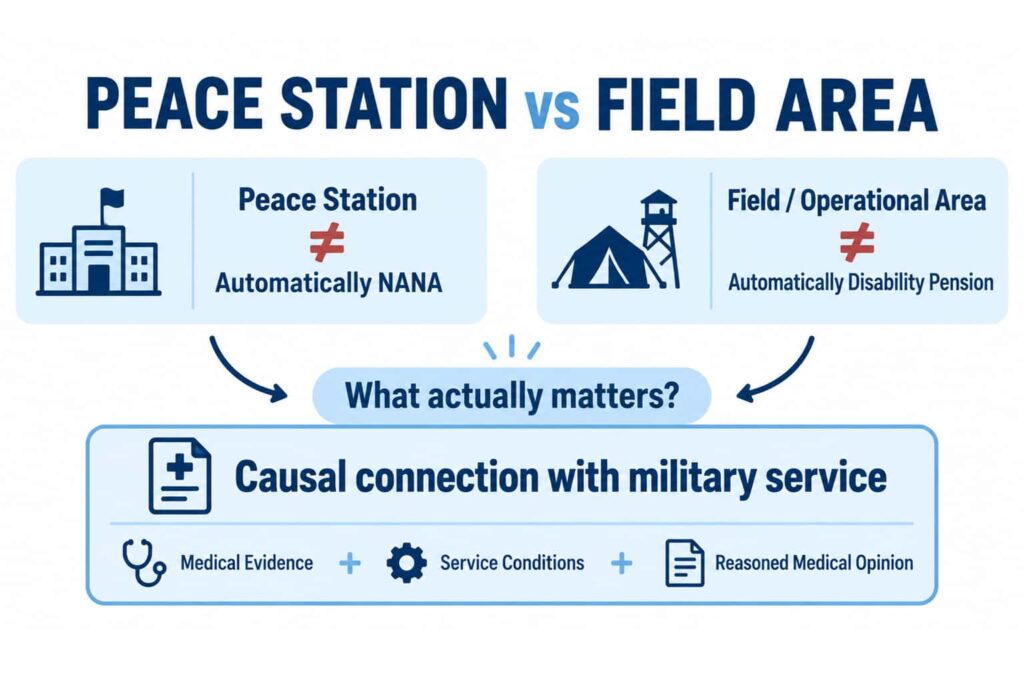
Does serving in a peace station weaken a disability claim automatically?
No such universal rule emerges from the judgment.
A disease diagnosed while an individual is serving at a peace station does not automatically become NANA.
Likewise, service in a field or operational area does not automatically establish entitlement to disability pension.
The central question remains whether there is an identifiable connection between military service conditions and the disability or its aggravation.
This becomes particularly important in cases involving conditions such as hypertension, cardiac disease or other illnesses where several medical and lifestyle factors may be relevant.
Every case therefore has to be examined against its own medical history and service circumstances.
Medical Board versus Tribunal: neither gets an automatic free hand
The judgment also creates an important balance between medical expertise and judicial scrutiny.
A Tribunal is not itself a Medical Board.
It should therefore be cautious about replacing a professional medical conclusion merely because it prefers another interpretation.
At the same time, a Medical Board decision cannot become immune from examination simply because medical terminology has been used.
A well-reasoned Medical Board opinion can carry substantial weight.
A poorly explained conclusion may be questioned.
That is a much more nuanced position than saying either:
“Medical Board opinion is final”
or
“Tribunal can simply ignore the Medical Board.”
Neither statement properly captures the judgment.
The Supreme Court also raised a larger question about the 2008 Entitlement Rules
There is another aspect of the judgment that may prove important beyond these individual cases.
The Supreme Court examined uncertainty surrounding the source and manner in which the 2008 Entitlement Rules came into operation while replacing the earlier framework.
The Court also referred to concerns earlier examined by the Raksha Mantri’s Committee of Experts, 2015.
This should not be reported as if the Supreme Court has simply struck down the entire 2008 Rules.
It has not.
But the judgment does highlight the need for pension regulations affecting a large class of serving and retired Armed Forces personnel to have clarity, certainty and proper authority behind them.
That aspect deserves close attention in the months ahead.
Why the Court’s comments on repeated Government litigation matter?
This judgment is also about something larger than NANA.
The Supreme Court took note of the history of disability-pension litigation and the recommendations of the 2015 Raksha Mantri’s Committee of Experts, which had recommended withdrawal of certain categories of appeals involving disabled personnel.
The judgment records that a large number of Government challenges nevertheless continued.
It also referred to data showing how few disability-pension appeals succeeded at departmental appellate levels compared with the number rejected.
According to the figures recorded in the material considered by the Court:
| Appeal stage | Total | Rejected | Accepted |
|---|---|---|---|
| First Appellate Authority | 2,997 | 2,855 | 142 |
| Second Appellate Authority | 456 | 439 | 17 |
These figures formed part of the Court’s consideration of the broader litigation problem surrounding disability-pension claims.
The concern is therefore not only about how an individual claim is decided, but also about whether avoidable pension litigation is being carried forward despite earlier policy-level recommendations.
So what has actually changed for a veteran with a pending case?
The biggest change may not be a new pension entitlement.
It is greater clarity about how the claim should be examined.
A pending disability-pension case should no longer be viewed simply as:
Veteran says service caused disability vs Medical Board says NANA.
A more complete examination would involve:
What condition was diagnosed?
When did it arise?
What were the service circumstances?
What did the Medical Board record?
Why did it arrive at NANA?
What medical evidence supports or contradicts that conclusion?
When was the claim first raised?
Which entitlement rules apply?
That is where the real impact of the Supreme Court judgment lies.
What this judgment does not do?
Veterans and families should be cautious about social-media messages claiming that the judgment has opened disability pension automatically to everyone whose claim was earlier rejected.
It has not.
Similarly, a NANA classification should not automatically be treated as meaningless after this ruling.
It remains an important expert opinion.
The judgment instead reinforces a middle path:
medical evidence matters, expert opinion matters, reasons matter, service conditions matter and applicable legal rules matter.
Each claim ultimately turns on its own factual and medical record.
Sources:-
- Supreme Court of India — Official Judgment
Union of India vs. NC Isaac (Retd.), C.A. No. 12885/2026, decided on 15 September 2026, Neutral Citation 2026 INSC 993. The case is listed on the Supreme Court’s official judgment page.
Open Supreme Court of India judgment page - Sainik Welfare News — Detailed Explainer
Covers the dismissal of Government appeals, NANA findings, Medical Board role, 15-year rule, and disability-pension implications.
Read Sainik Welfare News article - Legal Analysis — LawChakra
Detailed analysis of the 2008 Entitlement Rules, Medical Board findings, Rule 7 burden of proof, and the 15-year exception.
Read LawChakra legal analysis




Leave a Reply