


For an ECHS beneficiary living in a hill district, the empanelment status of a nearby hospital is not merely an administrative detail. It can determine whether specialised treatment is available close to home or whether an elderly veteran, war widow or dependant has to travel to another district for care.
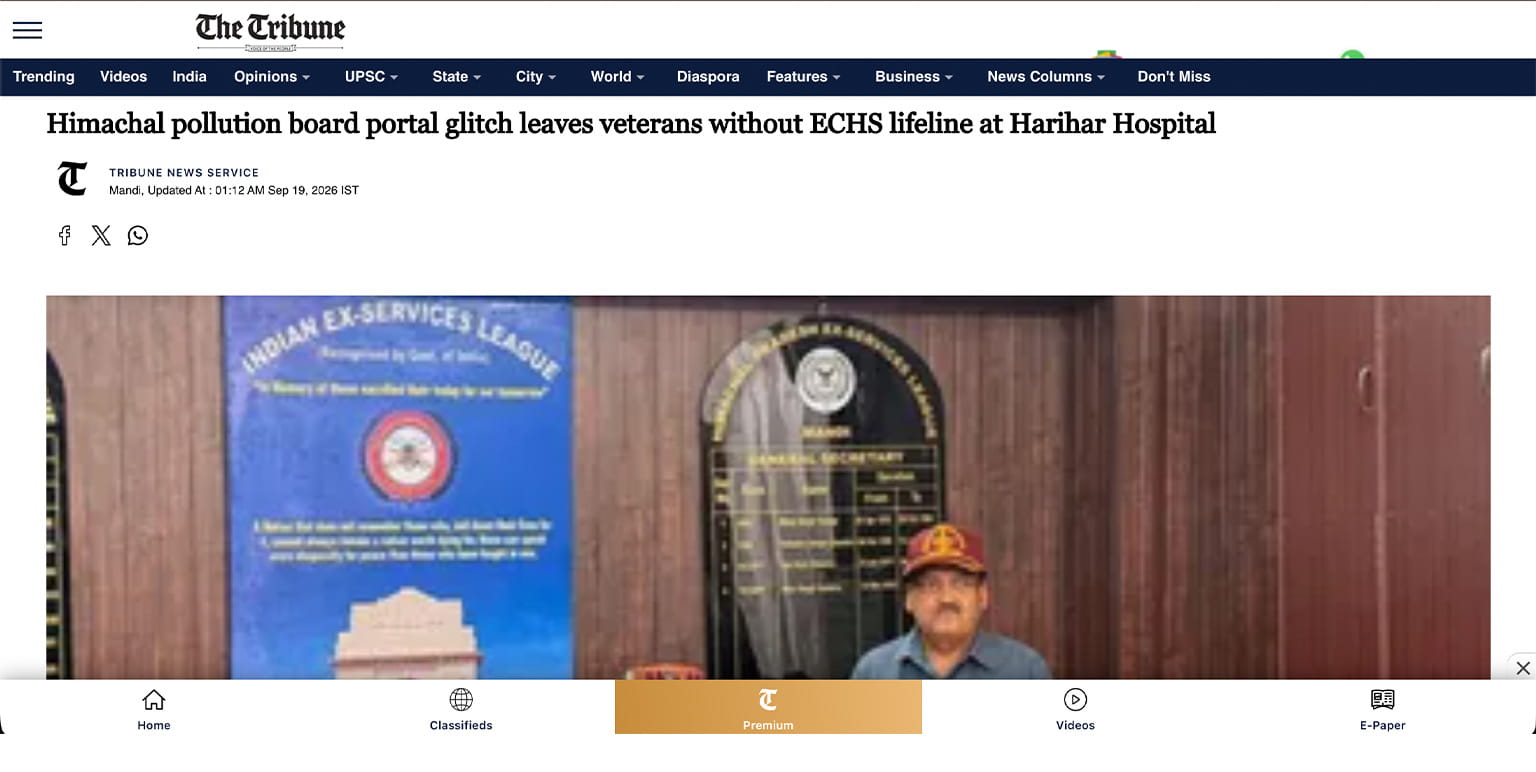
That concern has emerged in Mandi, Himachal Pradesh, where the renewal of Harihar Hospital at Gutkar under the Ex-Servicemen Contributory Health Scheme (ECHS) has reportedly been delayed because a pollution-related statutory clearance could not be completed.
According to information reported by the Mandi ex-servicemen community, the hospital’s ECHS Memorandum of Agreement reportedly expired on 9 September 2026. Veterans have subsequently sought a temporary arrangement while the pending compliance issue is resolved.
The important distinction, however, is that a request for temporary continuation is not the same as an approved ECHS extension.
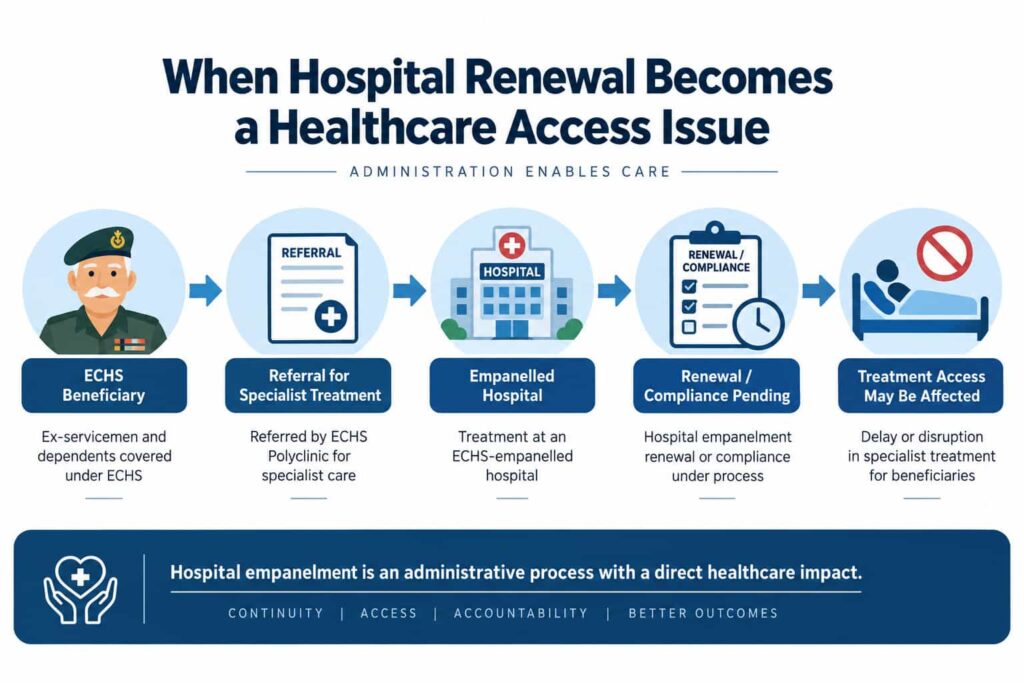
Why does Harihar Hospital’s ECHS status matter?
Harihar Hospital is reported to cater to ECHS beneficiaries from several parts of Himachal Pradesh, including Mandi, Kullu, Lahaul-Spiti, Bilaspur and Hamirpur.
For beneficiaries in hill areas, the practical significance is obvious.
Specialist or tertiary treatment may already involve considerable travel. If an established empanelled facility becomes temporarily unavailable under the ECHS network, patients may need to identify another authorised hospital and coordinate their referral or treatment route accordingly.
The issue is therefore larger than a contract-renewal date.
It is about the relationship between:
hospital compliance
and
continuity of healthcare for veterans and their families.
What exactly is holding up the renewal?
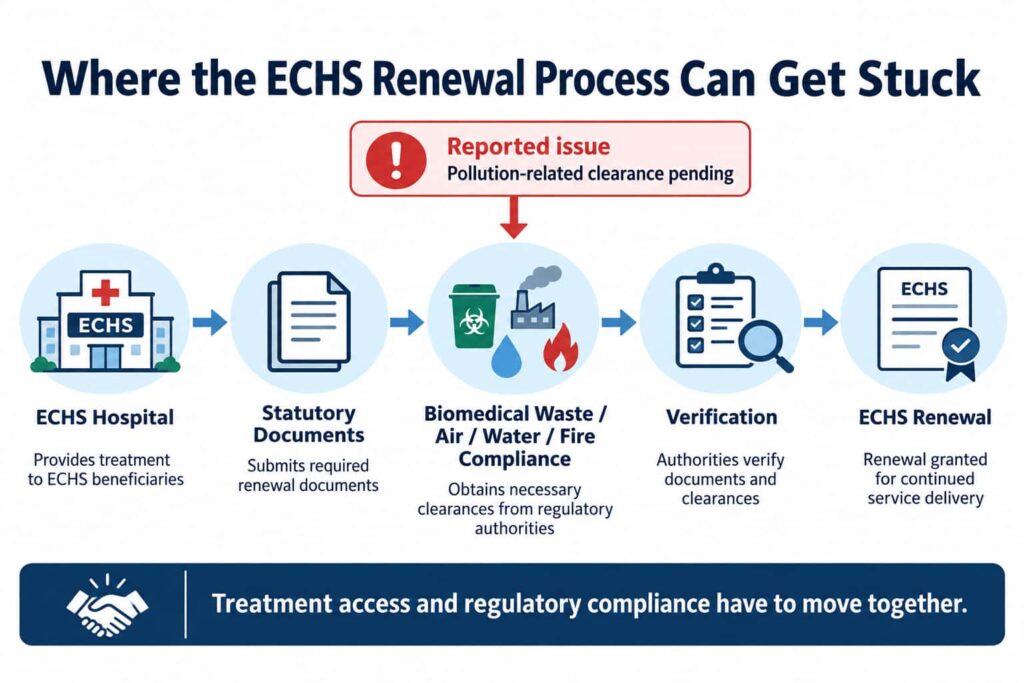
The Mandi Ex-Servicemen League has said that a required clearance connected with the Himachal Pradesh State Pollution Control Board remained pending.
That claim is consistent with the broader ECHS empanelment framework.
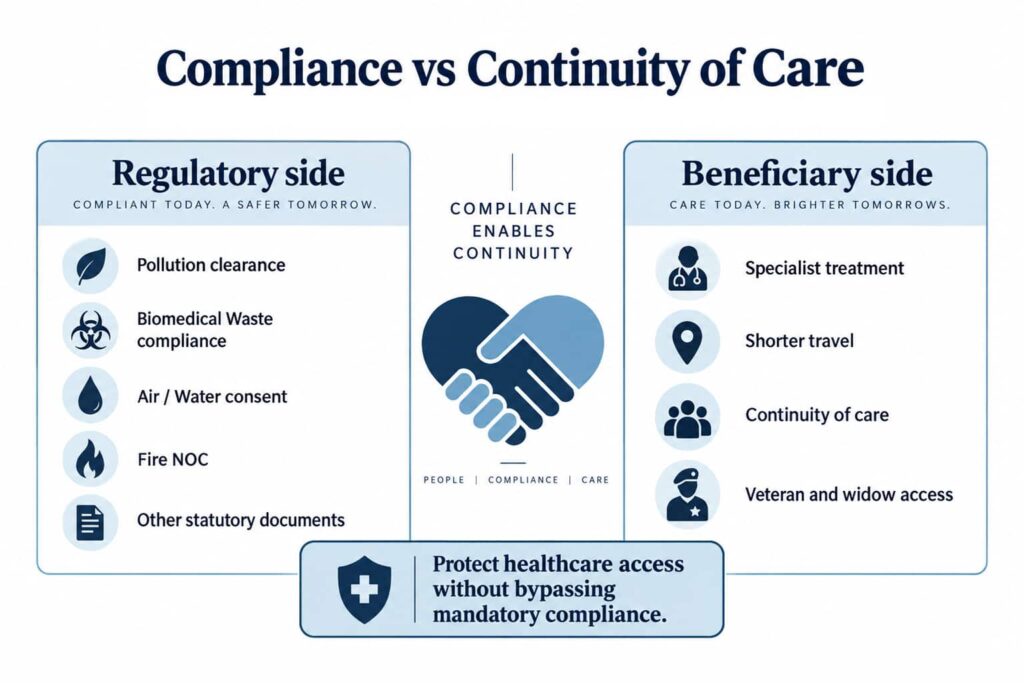
Official ECHS guidelines require healthcare organisations, where applicable, to submit statutory documents including:
- Biomedical Waste disposal/management compliance;
- Air consent or clearance;
- Water consent or clearance;
- Fire clearance;
- applicable drug licences; and
- other statutory approvals.
This means pollution-related documentation is not merely optional paperwork that can automatically be ignored in the interest of quicker renewal.
It forms part of the compliance mechanism used while empanelling hospitals.
The portal issue needs careful wording
The veterans’ body has reportedly stated that the Pollution Control Board’s online portal had not been functioning from 1 August 2026, preventing required documents from being uploaded.
This is one area where reporting needs to remain cautious.
The available material attributes the portal problem to the Ex-Servicemen League’s account. A separate official public notice independently establishing a continuous statewide shutdown from 1 August was not identified in the material reviewed.
Therefore, the appropriate description is:
a reported online or technical processing problem
rather than:
a confirmed statewide portal shutdown.
That distinction is important because the reason for a delayed statutory clearance and the legal requirement for the clearance are two different questions.
What relief are veterans asking for?
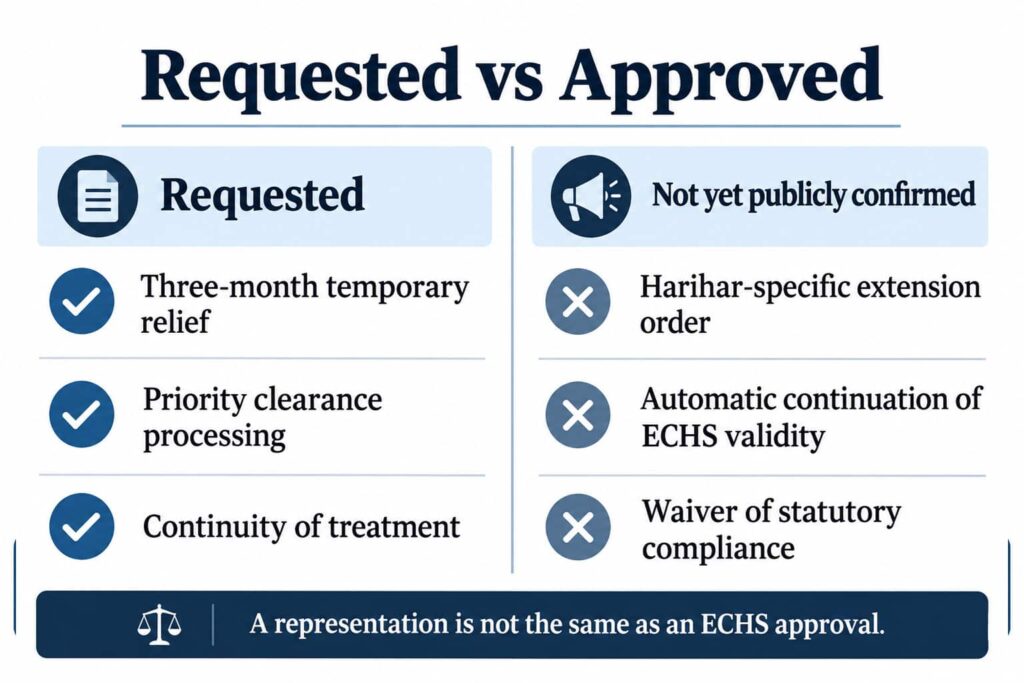
The ex-servicemen body has sought a one-time temporary relaxation or approximately three-month extension for Harihar Hospital.
The apparent objective is to prevent an interruption in ECHS treatment while the hospital completes the remaining statutory documentation.
The veterans have also sought priority processing of the pollution-clearance application and, if required, an alternative route for completing the process while the reported online issue persists.
From the beneficiaries’ point of view, the argument is understandable:
If the hospital is otherwise functioning and a renewal is delayed because one administrative clearance is pending, can a temporary arrangement protect patients from disruption?
But that question ultimately has to be answered by the competent authorities.
Has a three-month extension actually been approved?
As of the material reviewed, no public ECHS order granting Harihar Hospital the requested three-month temporary extension has been identified.
This is the single most important caution for beneficiaries.
What has been requested?
Temporary continuation / three-month relaxation
What has been publicly confirmed?
No Harihar-specific approval identified yet
Therefore, beneficiaries should not assume that the hospital remains automatically covered by ECHS simply because a veterans’ organisation has sought relief.
Why can’t ECHS simply overlook the missing document?
There are two legitimate interests involved.
On one side are veterans and dependants who need uninterrupted access to treatment.
On the other is the requirement that hospitals within a Government healthcare network meet prescribed statutory and safety conditions.
ECHS itself operates through a combination of polyclinics and empanelled civil healthcare facilities. The official ECHS framework states that it has 30 Regional Centres and 448 polyclinics, while private/civil healthcare organisations supplement the system through empanelment.
For that system to remain credible, empanelment cannot depend only on whether a hospital is geographically useful.
Regulatory eligibility also matters.
The real policy challenge, therefore, is not:
compliance OR treatment access
but:
How to maintain treatment continuity without weakening mandatory compliance.
What about the 30 September 2026 deadline mentioned in the ECHS process?
A separate ECHS development has created some possible confusion.
The Department of Ex-Servicemen Welfare had provided a broader timeline connected with revised MoA arrangements and revised CGHS-rate implementation, with time available up to 30 September 2026 in that wider process. The Harihar report notes this distinction.
That general timeline should not automatically be read as:
“Harihar Hospital is definitely empanelled until 30 September.”
An individual hospital’s renewal can depend on its own agreement, compliance status and required documents.
No publicly identified Harihar-specific order was found clarifying that the broader timeline automatically extends this particular hospital’s validity.
Why this matters more in hill districts?
Healthcare access has a geographic dimension.
In a large city, a beneficiary may have several empanelled hospitals within a relatively small radius.
That may not be the reality across parts of Himachal Pradesh.
If an elderly pensioner has to move from one district to another for cardiology, oncology, surgery or another specialised service, the consequences can include:
longer travel
additional expense
greater physical strain
more coordination with attendants
and, in some cases,
delay in planned treatment.
That is why hospital renewal disputes deserve quick administrative resolution even when authorities must continue to enforce compliance requirements.
What should ECHS beneficiaries do right now?
A beneficiary planning treatment at Harihar Hospital should not rely only on earlier empanelment history.
The sensible approach is to verify the hospital’s current ECHS status before a planned admission or procedure.
The official ECHS portal provides access to empanelled-hospital information and hospital application status. ECHS also lists its national toll-free helpline as 1800-114-115.
Where there is uncertainty, beneficiaries can also approach the concerned ECHS polyclinic or Regional Centre for guidance about the authorised treatment route.
The ECHS website itself states that issues involving empanelled hospitals can be raised with the relevant Director Regional Centre.
What happens next?
Three developments now matter.
First, whether the pending pollution-related clearance is completed.
Second, whether ECHS authorities formally renew Harihar Hospital’s empanelment.
Third, whether any temporary relaxation is granted to protect beneficiaries during the intervening period.
Until one of these developments is formally confirmed, it is safer to treat the reported three-month relief as a demand rather than an approved extension.
The larger lesson from the Harihar Hospital case
The Harihar Hospital situation highlights a problem that can arise whenever a healthcare facility’s regulatory renewal and a beneficiary’s treatment needs move on different timelines.
For Government healthcare schemes, both objectives matter.
A statutory clearance cannot automatically be discarded simply because the hospital is useful to patients.
At the same time, administrative delays can have real consequences when the people affected are elderly pensioners, ex-servicemen, war widows and dependants living far from alternative specialist facilities.
The most effective solution is therefore a quick, transparent compliance process accompanied by clear communication from ECHS authorities about the hospital’s current status.
For beneficiaries, the position should remain simple:
Do not assume that Harihar Hospital’s ECHS extension has been approved. Verify its current empanelment before planned treatment and watch for an official renewal or temporary-relief order.
Sources
Ex-Servicemen Contributory Health Scheme — Official Guidelines/SOP
Official ECHS documentation listing statutory requirements including Biomedical Waste, Air and Water consent and other clearances for healthcare organisations.
ECHS official website
ECHS — Official beneficiary and hospital information
Includes hospital empanelment resources, Regional Centre information and the national helpline 1800-114-115.




Leave a Reply