


For many serving Central Government employees, the 17 September 2026 CGHS order creates something that did not exist earlier in the same form: a healthcare choice that is no longer decided simply by how far they live or work from a CGHS Wellness Centre.
But wider eligibility does not automatically mean that every eligible employee should immediately switch to CGHS.
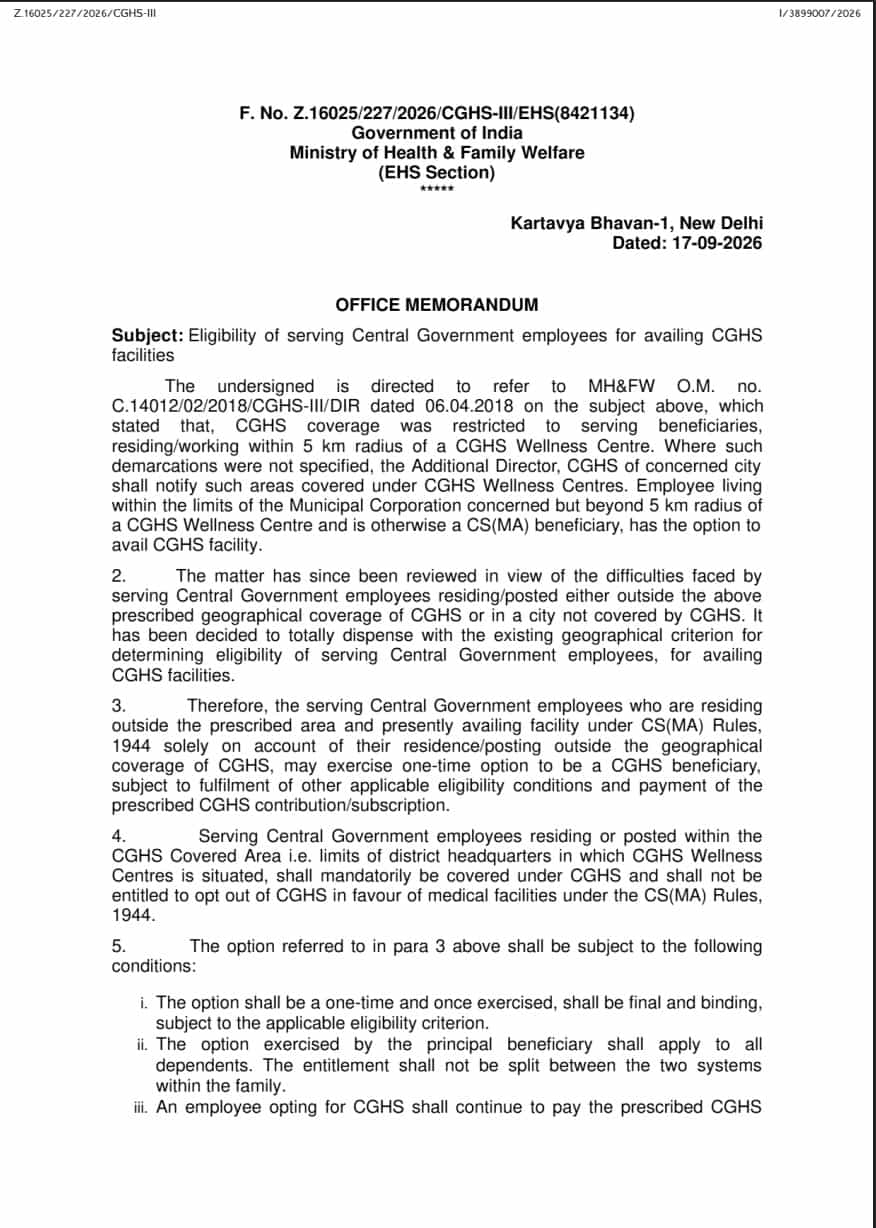
The Ministry of Health & Family Welfare has removed the existing geographical criterion used for determining CGHS eligibility of serving Central Government employees. Employees who were under the Central Services (Medical Attendance) Rules, 1944 — CS(MA) solely because they lived or were posted outside CGHS geographical coverage can now exercise a one-time option to join CGHS, subject to other eligibility conditions and payment of the prescribed contribution.
The key words are “one-time” and “final and binding.”
That makes this more than an eligibility amendment. For the employees covered by the option, it is also a long-term healthcare decision for themselves and their eligible dependants.
What exactly changed on 17 September 2026?
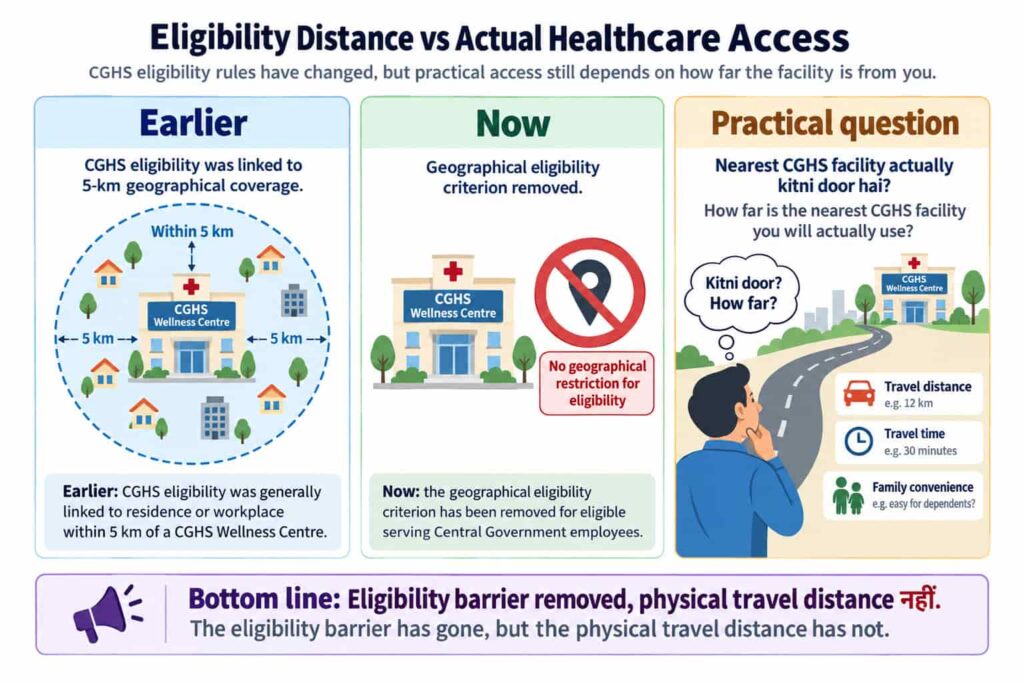
The new Office Memorandum refers back to the Ministry’s 6 April 2018 policy, under which CGHS coverage for serving employees was linked to residence or workplace within a 5-km radius of a CGHS Wellness Centre, subject to certain local arrangements and exceptions.
The Government has now decided to “totally dispense with” the existing geographical criterion for determining CGHS eligibility of serving Central Government employees.
This means physical distance from the Wellness Centre will no longer, by itself, prevent an otherwise eligible serving employee from coming under CGHS.
But there are two very different employee situations under the new framework.
One category gets a choice.
Another remains mandatorily covered by CGHS.
Understanding which category an employee falls into should be the first step before filling out any form.
Who actually gets the new one-time option?
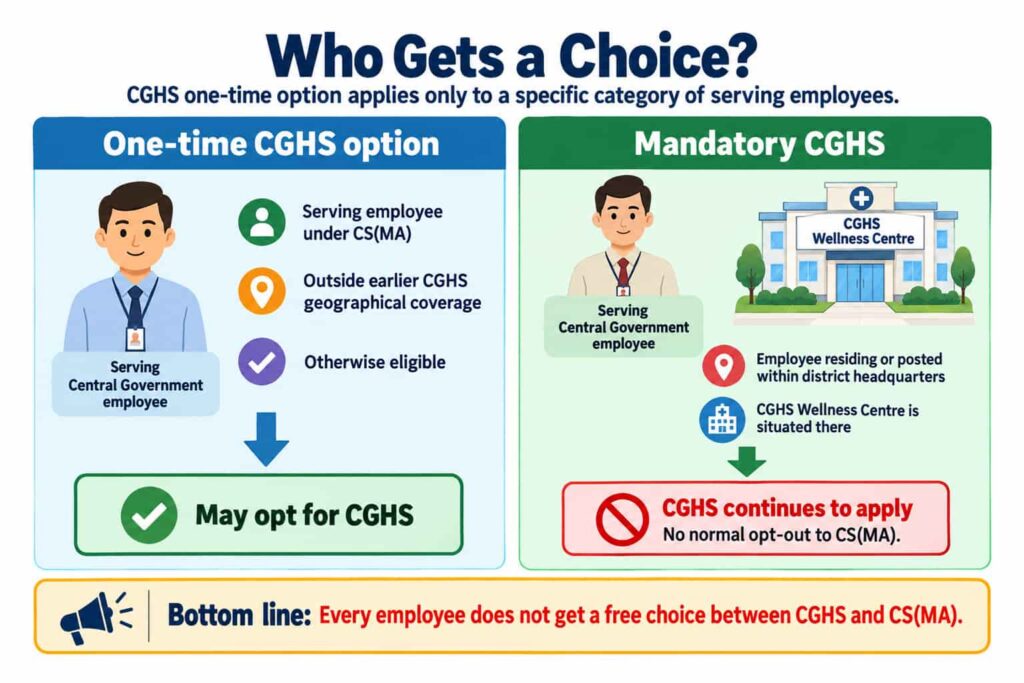
The one-time option is relevant to serving Central Government employees who:
- are presently covered under CS(MA) Rules, 1944;
- are under CS(MA) solely because their residence or posting is outside CGHS geographical coverage; and
- otherwise satisfy applicable CGHS eligibility requirements.
Such employees can choose to switch from CS(MA) to CGHS after paying the prescribed CGHS subscription or contribution.
This should not be interpreted as automatic CGHS enrolment.
If an employee in this category does not exercise the option, the OM says that the employee will continue under CS(MA), as applicable.
Who cannot use the new order simply to leave CGHS?
This is one of the most important parts of the OM.
Serving Central Government employees residing or posted within the CGHS-covered area — defined in the order as the limits of the district headquarters in which a CGHS Wellness Centre is situated — remain mandatorily covered under CGHS.
They cannot use this order to opt out of CGHS and move to CS(MA).
So the policy does not create a universal choice between the two healthcare systems for every Central Government employee.
It primarily expands CGHS access for a specified category that previously remained under CS(MA) because of geography.
Why employees should not treat this as a routine formality?
An employee may initially see the new policy as simple:
CGHS has become available → choose CGHS.
But the order itself makes the decision more consequential than that.
Once the option is exercised, it is described as:
One-time, final and binding.
That means the employee should consider not only whether CGHS appears attractive today, but how practical the system will be for the family over time.
This matters particularly for employees living in cities where CGHS infrastructure is not close by.
One employee’s choice affects the eligible family
The option is not restricted to the principal beneficiary alone.
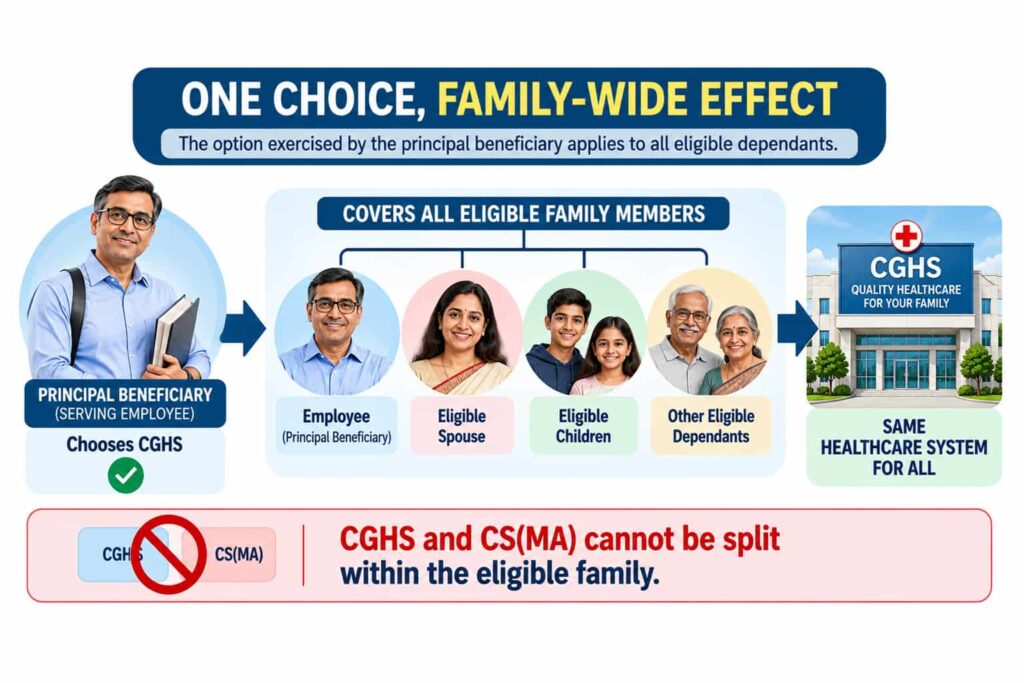
The OM states that the choice exercised by the principal beneficiary will apply to all eligible dependants.
Entitlement cannot be split between CGHS and CS(MA) within the same family.
For example, an employee cannot ordinarily decide:
CGHS for myself
but
CS(MA) for my eligible spouse and children.
The family moves under the healthcare arrangement resulting from the principal beneficiary’s valid option.
That makes family circumstances especially relevant before switching.
The biggest practical issue: eligibility is not the same as accessibility
This may be the most important implication of the entire order.
An employee may now legally qualify to choose CGHS even if the employee is located outside the old geographical coverage.
But that does not mean a new Wellness Centre will suddenly appear nearby.
The employee may still have to travel to obtain:
- consultation;
- medicines;
- investigations;
- specialist treatment; or
- other CGHS services.
And the 17 September OM specifically states that no TA/DA will be admissible for travelling to avail CGHS treatment or procure medicines.
This creates an important distinction:
Eligibility has been liberalised. Physical access has not automatically changed.
An employee living far from the nearest practical CGHS facility should therefore consider travel requirements before making an irreversible choice.
Six questions an employee should ask before opting for CGHS
This is where the decision becomes personal.
Before exercising the one-time option, an employee should ideally examine:
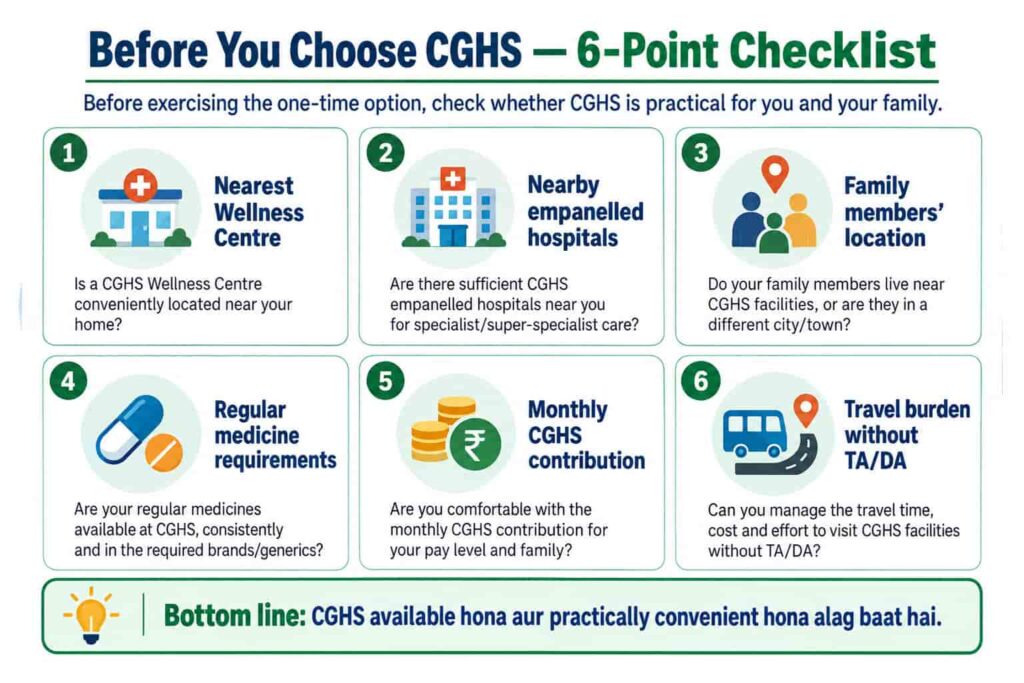
Can an employee use CGHS for some expenses and CS(MA) for others?
No.
The OM specifically prohibits simultaneous benefits under the two systems after the employee comes under CGHS.
The undertaking requires the employee to declare that neither the employee nor any eligible family member will simultaneously claim medical facilities or reimbursement under CS(MA).
Any inadmissible dual benefit can be recovered.
The Government has also warned that false, suppressed, misleading or incorrect information may lead to recovery as well as disciplinary action under applicable Conduct Rules.
So this is not simply a choice of which card to use for a particular hospital visit.
It is a formal change in the healthcare system governing the employee and eligible dependants.
What does the employee have to submit?
The OM includes an Option and Undertaking Form for Serving Central Government Employees.
The form seeks details including:
- employee’s name;
- designation and Pay Level;
- Ministry/Department/Office;
- residential address; and
- district and State of residence.
The employee formally opts to switch from CS(MA) to CGHS without geographical limitation.
The employee also authorises the Head of Office/DDO to continuously deduct the applicable CGHS subscription from pay and allowances.
The form must be signed by the employee and countersigned by the Head of Office/DDO with seal and stamp.
What if an eligible employee chooses not to switch?
This is another area where the new policy is being misunderstood.
For employees to whom the new option is available, choosing not to join CGHS does not mean that medical cover disappears.
The OM says such employees will continue under CS(MA) Rules, 1944, as applicable.
Therefore, the new order creates an opportunity to switch.
It does not force every geographically outside employee into CGHS.
Does the new rule mean CGHS is now nationwide in the physical sense?
No.
Removing geographical criteria for eligibility is different from expanding CGHS infrastructure into every location.
CGHS remains a healthcare system delivered through its established infrastructure and related empanelled facilities.
The policy does not announce a Wellness Centre in every city, nor does it guarantee that an employee who opts for CGHS will have a facility close to home.
That is precisely why the absence of TA/DA under this option matters.
Does this order automatically change the position for pensioners?
No.
The 17 September 2026 OM is specifically framed around serving Central Government employees.
CGHS also covers eligible retired Central Government employees under its broader framework, but this particular one-time option arising from removal of the serving-employee geographical criterion should not be presented as a blanket new pensioner rule.
That distinction is especially important when reporting the order for retirees.
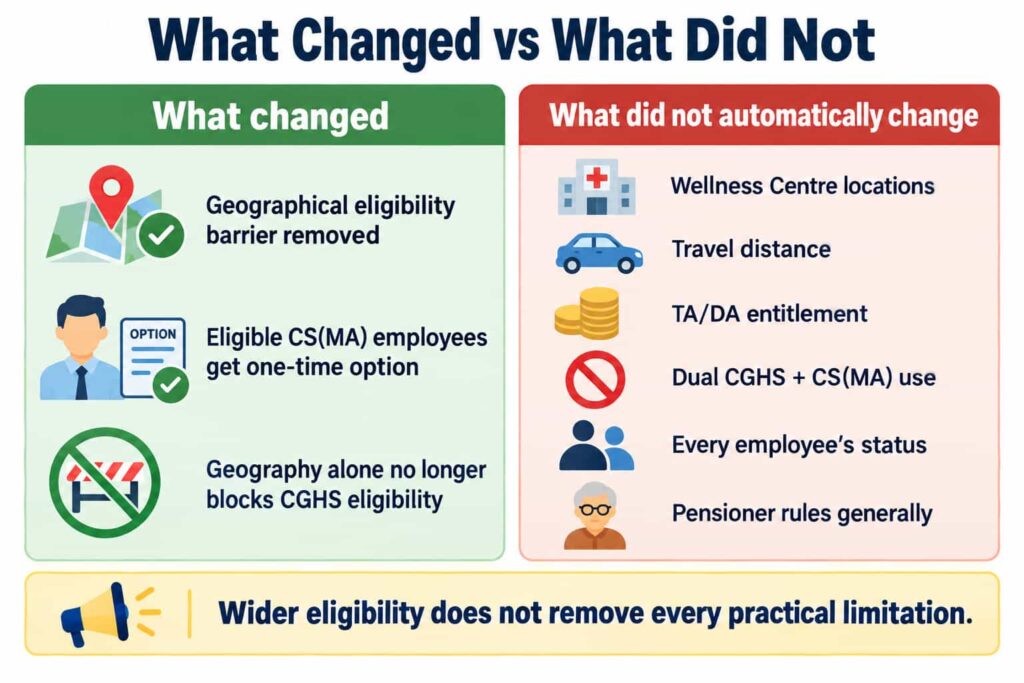
A simple example explains the real impact
Suppose a serving Central Government employee is posted in a location that previously kept the employee under CS(MA) because the posting was outside CGHS geographical limits.
Earlier, geography itself could prevent the employee from becoming a CGHS beneficiary.
Under the new framework, that barrier can be removed and the employee may be able to opt for CGHS.
But suppose the nearest practical CGHS facility remains a significant distance away.
The employee now has greater choice, but must personally decide whether the benefits of CGHS justify:
- travel;
- family convenience;
- recurring visits;
- medicine collection;
- prescribed subscription; and
- loss of simultaneous CS(MA) entitlement.
That is why the order expands access without automatically making the decision easy.
Why this CGHS change matters for Central Government employees?
The policy represents a change in the way CGHS eligibility is conceptualised.
Earlier, geography played a central role in deciding whether a serving employee belonged inside or outside the CGHS framework.
The new approach allows an otherwise eligible employee’s choice to play a greater role, even when the employee resides or works beyond the earlier geographical boundary.
But the Government has paired that flexibility with clear safeguards:
one-time option
family-wide application
continuous subscription
no dual benefit
no TA/DA
and
formal undertaking.
The result is a more flexible eligibility framework, but also a decision that employees should make carefully.
The key takeaway
The biggest change in the 17 September 2026 order is not simply that a 5-km rule has disappeared.
It is that some serving Central Government employees who previously remained under CS(MA) because of their location can now make a one-time choice to enter CGHS without geographical limitation.
But once that choice is exercised, the implications extend to eligible family members and the option is final and binding under the OM.
So before signing the undertaking, an employee should ask a practical question:
“CGHS is now available to me—but is it the right healthcare arrangement for my family?”
For many employees, that will be more important than the distance rule itself.
Sources
Ministry of Health & Family Welfare — Office Memorandum dated 17 September 2026
F. No. Z.16025/227/2026/CGHS-III/EHS(8421134) — Eligibility of serving Central Government employees for availing CGHS facilities. The reproduced OM includes the one-time Option and Undertaking Form.
Read the reproduced Office Memorandum and form
Sainik Welfare News — CGHS 5-km rule explainer
Detailed explanation of the geographical-rule change, one-time option, family coverage, TA/DA limitation and implications for serving employees.
Read the original CGHS report




Leave a Reply