


The Central Board of Direct Taxes (CBDT) has notified the Income-tax (Fourth Amendment) Rules, 2026, introducing a series of procedural changes under the Income-tax Rules, 2026.
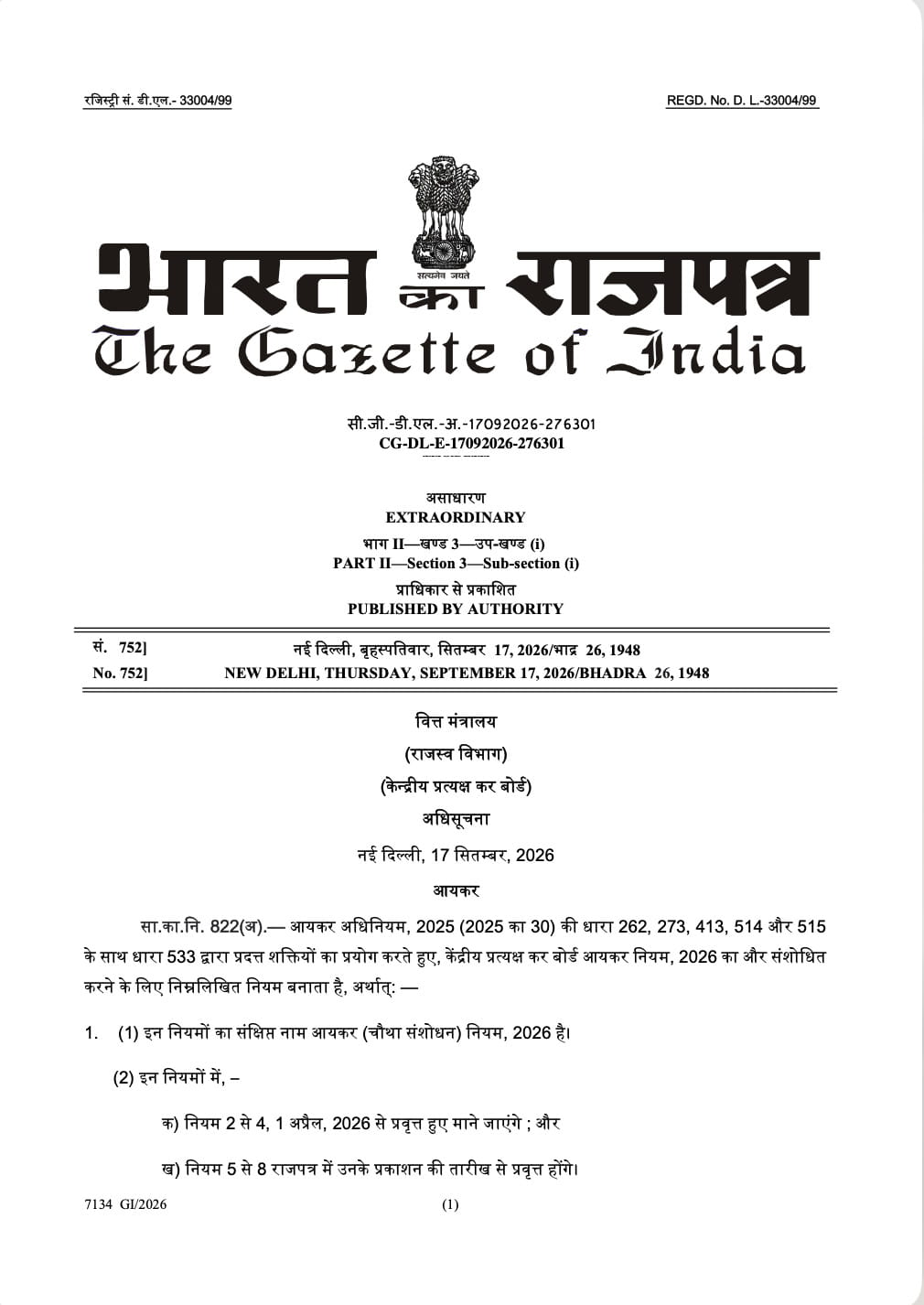
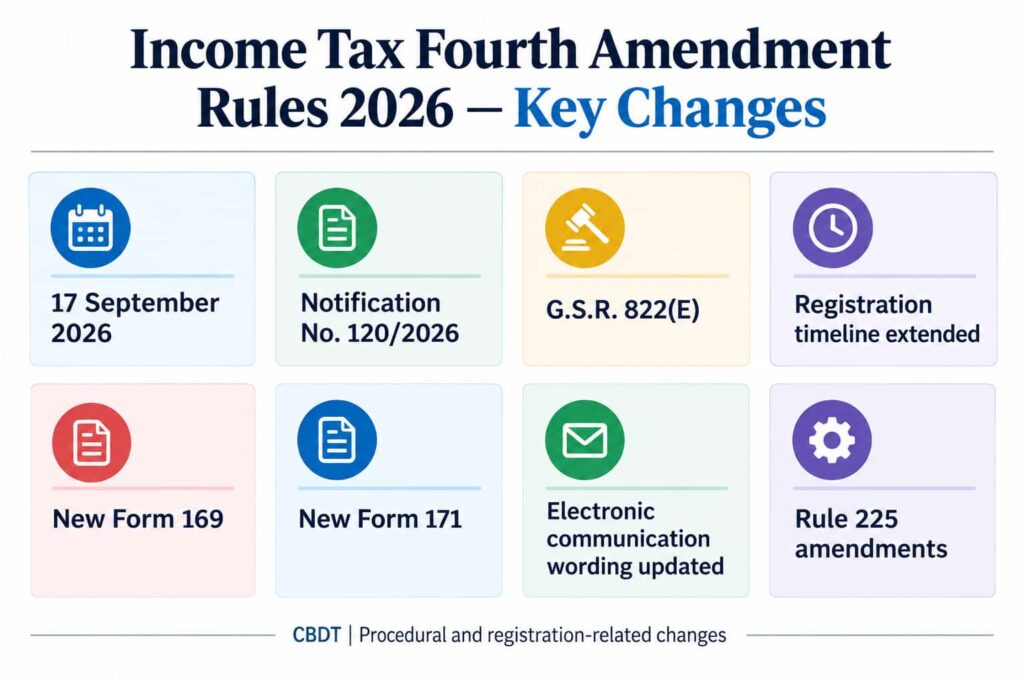
The notification was issued on 17 September 2026 through G.S.R. 822(E), Notification No. 120/2026, under the Income-tax Act, 2025.
For most individual taxpayers, this notification does not change income-tax slabs, rebates, standard deduction or the general ITR filing deadline. Its main impact is on procedural provisions and the registration framework for valuers and authorised income-tax practitioners.
When do the new amendments take effect?
The notification creates two different effective dates.
Rules 2 to 4 are deemed to have come into force from 1 April 2026.
On the other hand, Rules 5 to 8 come into force from the date of publication in the Official Gazette, which is 17 September 2026.
This distinction matters because some technical amendments operate retrospectively, while the changes relating to registration timelines and revised forms apply from the Gazette notification date.
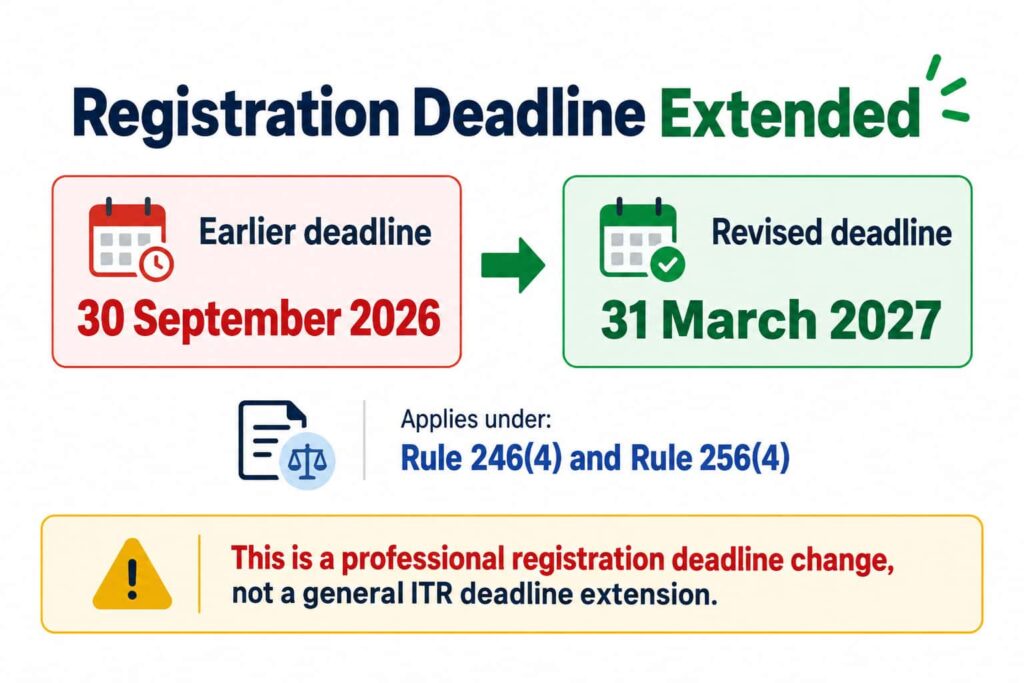
Registration deadline shifted from 30 September 2026 to 31 March 2027
One of the most practical changes appears in Rule 246(4) and Rule 256(4).
The earlier date: 30 September 2026 has been replaced with: 31 March 2027 in both provisions.
This effectively provides a longer window under the relevant registration framework connected with:
- registration of valuers, and
- registration of authorised income-tax practitioners.
The change should not be confused with an extension of the normal income-tax return filing deadline.
It relates specifically to the registration provisions covered by these rules
New Form 169 introduced for registration as Valuer
The amendment substitutes the existing Form No. 169 with a new format.
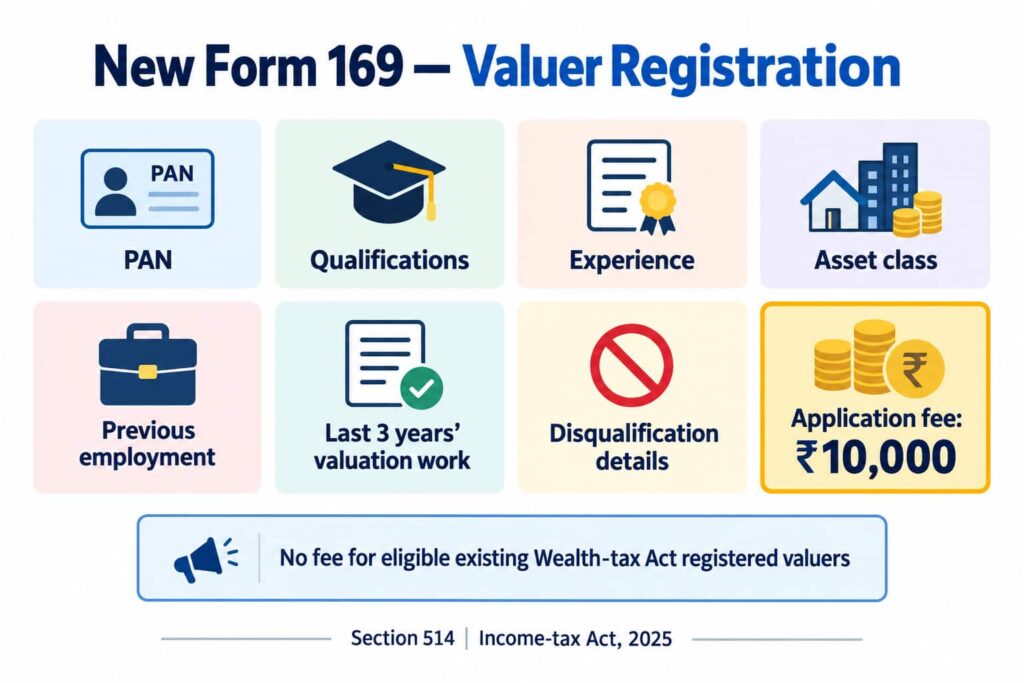
Form 169 is used for applying for registration as a Valuer under Section 514 of the Income-tax Act, 2025.
The revised form seeks detailed information from the applicant, including:
- full name;
- PAN;
- address;
- date of birth;
- mobile number and email;
- class of asset for which registration is sought;
- educational qualifications;
- previous employment;
- professional practice as consulting engineer, real-estate valuer, surveyor or architect;
- details of valuation experience;
- assets valued or works executed during the previous three years;
- existing registration, if any, under the Wealth-tax Act, 1957; and
- applicable disqualification details.
The applicant is also required to submit a formal declaration regarding professional independence and valuation standards.
Which asset classes can a Valuer register for?
The revised Form 169 identifies multiple asset categories.
These include:
- Immovable property other than certain agricultural, plantation, forest and mining assets
- Agricultural land
- Coffee, tea, rubber and cardamom plantations
- Forests
- Mines and quarries
- Stocks, shares, debentures, securities and certain business assets
- Machinery and plant
- Jewellery
- Works of art
- Life interests and similar interests
- Other assets
Importantly, the form states that separate applications are required for different classes of assets.
₹10,000 fee for Valuer registration
Another important provision appears in the notes attached to Form 169.
An application for registration as a Valuer must generally be accompanied by a fee of:
₹10,000
However, no such fee is required where the applicant is already registered as a Valuer under the Wealth-tax Act, 1957.
The revised form also indicates that some information may be pre-filled wherever possible, signalling a greater degree of digital integration in the registration process.
Professional declaration becomes an important part of Form 169
The revised form does not only collect qualifications and experience.
An applicant must also declare that he or she will:
- undertake impartial and true valuation;
- provide valuation reports in the prescribed form;
- not charge fees beyond rates prescribed by the Board; and
- not value an asset in which the Valuer has a direct or indirect interest.
This gives the new form a clear professional-conduct component.
New Form 171 introduced for Authorised Income-tax Practitioners
The notification also replaces Form No. 171.
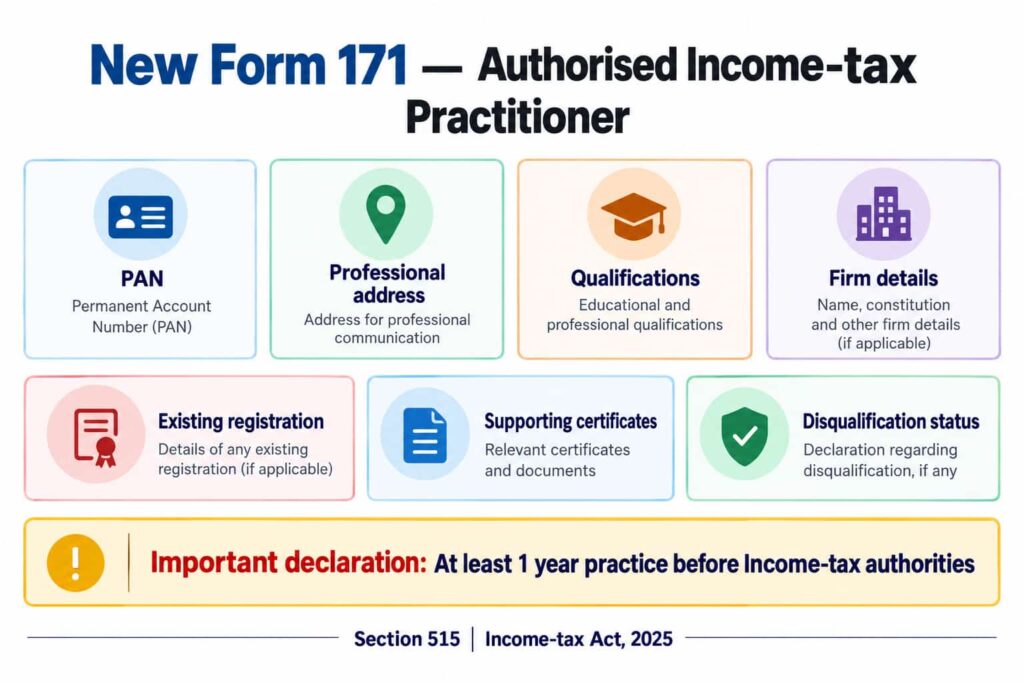
This form is used for registration as an Authorised Income-tax Practitioner under Section 515 of the Income-tax Act, 2025.
The revised form asks for information including:
- applicant’s name;
- gender;
- PAN;
- father/husband’s name;
- permanent and current residential addresses;
- mobile number and email;
- principal place of profession in India;
- details of partnership in a firm, if applicable;
- educational qualifications;
- existing registration under the Income-tax Act, 1961;
- supporting certificates; and
- any applicable disqualification.
Minimum one-year practice declaration is also required
A notable declaration in Form 171 requires the applicant to certify that he or she has been practising before income-tax authorities for not less than one year.
The applicant must also certify that no separate application for registration under the Income-tax Act, 2025 has already been made to another Chief Commissioner or Commissioner of Income-tax.
This is an important eligibility and procedural safeguard in the revised registration process.
What should professionals check now?
Anyone planning to register under the new framework should verify:
- whether the revised Form 169 or Form 171 applies;
- required educational or professional qualifications;
- applicable supporting documents;
- relevant disqualification provisions;
- registration fee, where applicable;
- asset class selected for Valuer registration; and
- the revised 31 March 2027 timeline.
Applicants should rely on the applicable Rules and official electronic registration mechanism rather than treating the new Gazette notification as a standalone application guide.
The bigger takeaway
The Income-tax (Fourth Amendment) Rules, 2026 are important, but not because they change how an ordinary employee calculates income tax.
Their main significance lies in the administrative transition to the Income-tax Act, 2025 framework.
The notification:
extends key registration timelines to 31 March 2027, introduces revised Forms 169 and 171, updates electronic communication wording and modifies several procedural provisions.
For Valuers and Authorised Income-tax Practitioners, these changes deserve immediate attention.
For individual taxpayers, the most important clarification is equally simple:
This is not a new tax-slab notification and it is not a general ITR deadline extension.
Sources:-
Income Tax Department — Official CBDT Notification Page
Notification No. 120/2026, G.S.R. 822(E), dated 17 September 2026. The official Income Tax portal lists the notification and provides its PDF download.
Open CBDT Notification No. 120/2026
2. Gazette of India — Official PDF
This is the original Gazette publication, document number 276301, containing the complete 12-page Income-tax (Fourth Amendment) Rules, 2026.
Download Official Gazette PDF





Leave a Reply