


The 8th Pay Commission process has now entered a more active and visible phase, and that is important news for millions of central government employees and pensioners across the country. After the earlier Dehradun interaction plan, the Commission has now moved a step further by issuing fresh notices for stakeholder meetings in Delhi and Pune. This development matters because it shows that the panel is no longer limited to internal preparation. It has started structured engagement with unions, associations, federations, and recognised stakeholder groups.
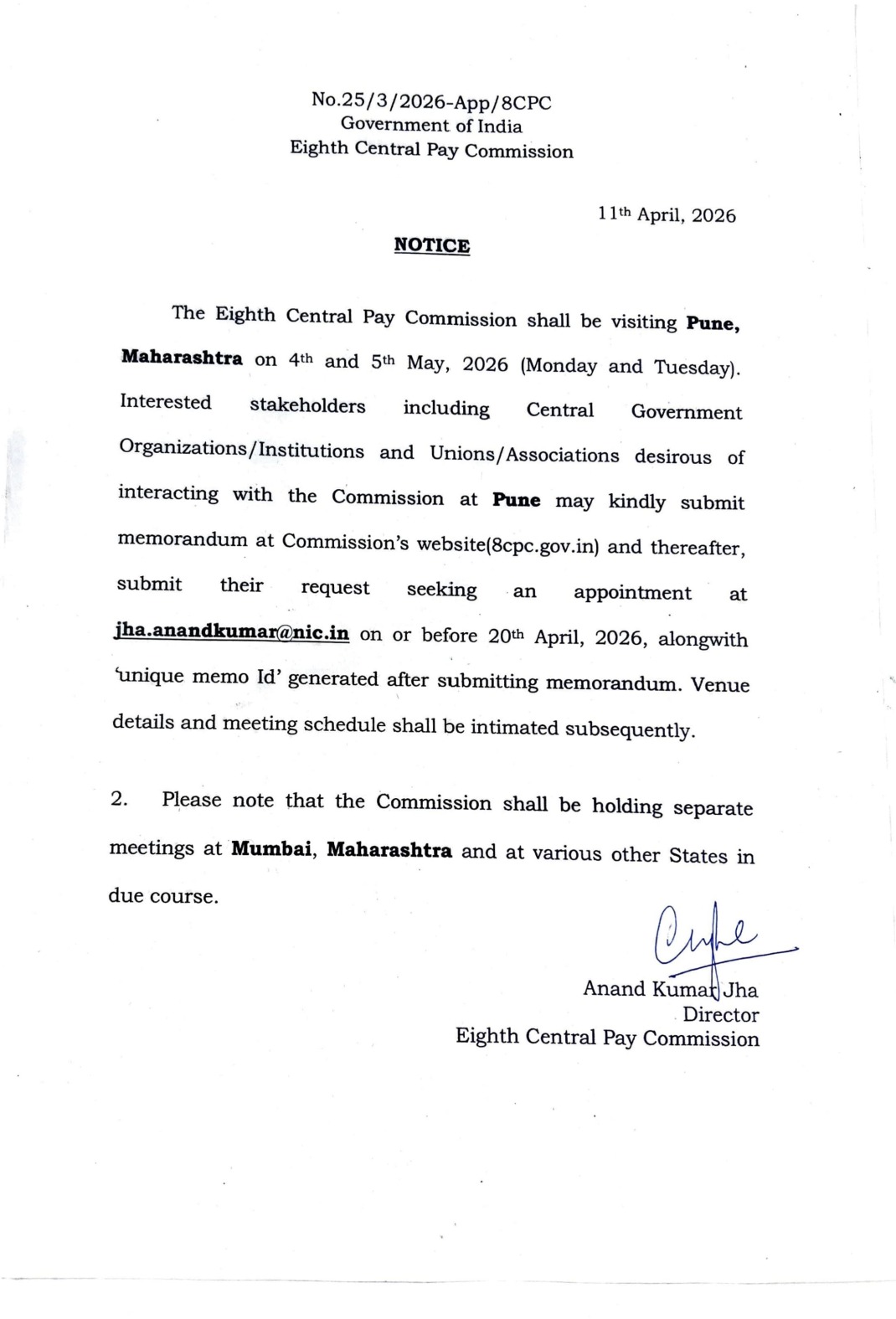
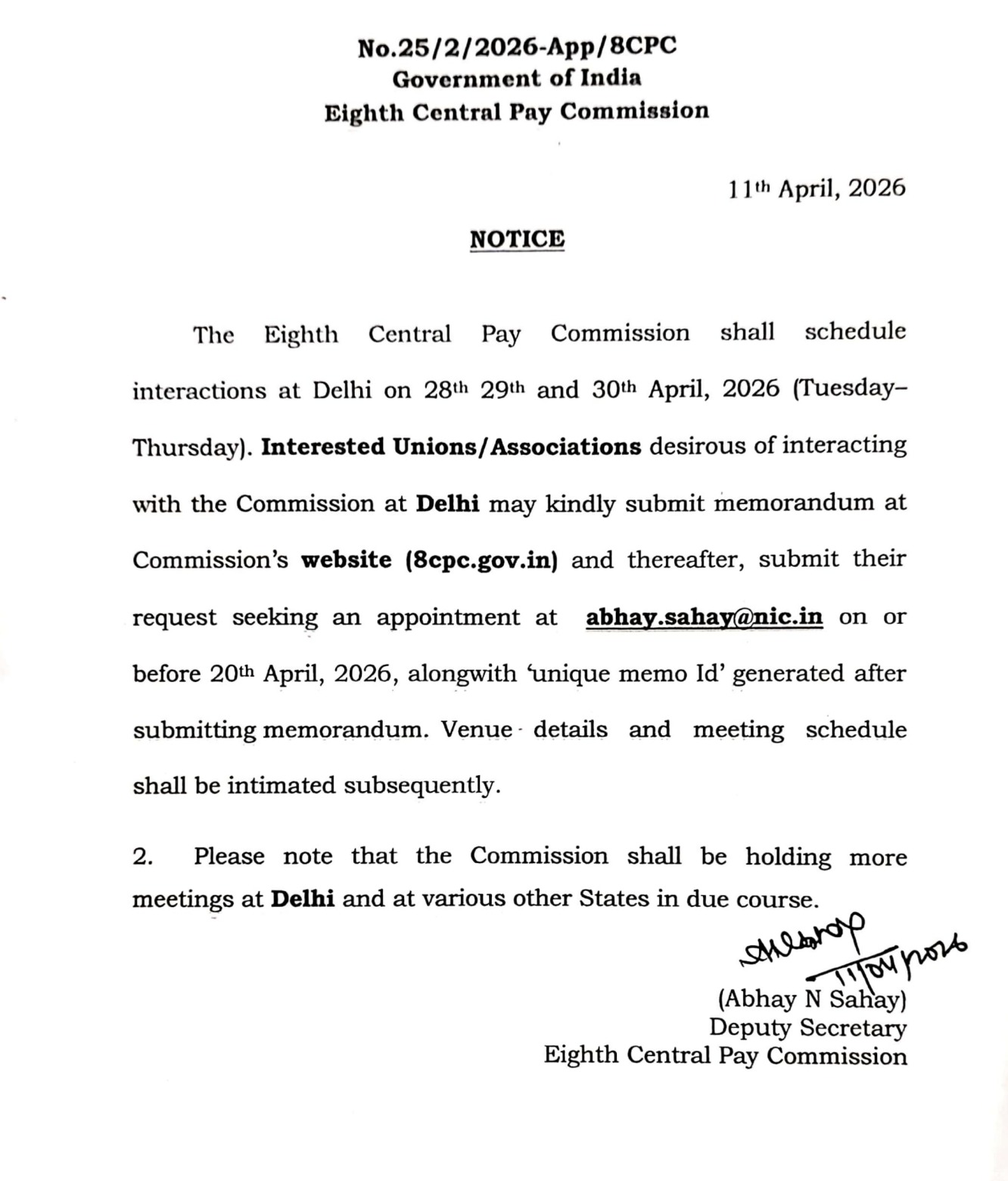
For employees, pensioners, and organised bodies waiting for signs that the Commission’s work is actually moving on the ground, these notices offer exactly that confirmation. The latest update suggests that the 8th Central Pay Commission is beginning to build its consultation process city by city, which could eventually shape major recommendations on pay revision, fitment factor, allowances, pension logic, and career progression issues.
According to the latest notices dated 11 April 2026, the Commission has fixed interaction dates in Delhi for 28, 29, and 30 April 2026. These meetings are expected to involve employee unions, associations, federations, and other recognised bodies that want to present their concerns or recommendations before the panel. Interested organisations have been asked to request an appointment before 20 April 2026. Once an appointment is approved, the time and venue are expected to be communicated separately.
This is a major development because Delhi is naturally one of the most important centres for such interactions. A large number of central government bodies, staff unions, pensioner organisations, and departmental associations are based there or have a strong operational presence in the capital. The Delhi meetings may therefore become a crucial platform where several key issues are presented directly to the Commission in a structured format.
The second important part of the update is the Pune interaction schedule. The 8th CPC team is set to hold stakeholder interactions in Pune on 4 and 5 May 2026. This expands the consultation process beyond Delhi and indicates that the Commission is likely to continue its outreach in multiple cities. For organisations based in Maharashtra and surrounding regions, this provides a practical opportunity to raise department-specific issues without depending entirely on Delhi-based representation.
The Pune leg is significant for another reason as well. It signals that the Commission may be planning a wider consultation map, not a single-city exercise. If that happens, more cities may be added in the coming weeks, which means associations and recognised groups across India should stay alert and keep their documentation ready. Even if a particular city has not yet appeared in the official notices, the trend suggests that further schedules may be announced in phases.
This matters because stakeholder meetings are not just symbolic formalities. These interactions often help a commission understand where policy pain points actually exist. Official records and departmental files tell one part of the story, but real concerns around stagnation, pay parity, promotion delays, pension impact, or allowance distortions often come out more clearly when associations present them with examples. That is why these meetings can become an important stage in shaping the direction of future recommendations.
For many organisations, the next few days will be less about reacting and more about preparing. A weak representation full of scattered demands may not create much impact. A focused and well-documented memorandum, however, can help place serious issues on record. That is why bodies planning to seek an appointment should ideally prepare a concise memorandum with clear points, relevant examples, and proper issue prioritisation.
In practical terms, many associations are likely to focus on themes that affect a broad section of employees and pensioners. These may include the logic behind minimum wage calculation and fitment factor, the need to restructure the pay matrix, unresolved parity issues across cadres, rationalisation of allowances, MACP-related distortions, and pension revision principles. For some groups, NPS and OPS concerns may also be part of the discussion. Department-specific anomalies from Railways, Defence, Postal, CPSEs, and other sectors are also expected to feature prominently in representations.
The quality of preparation will matter a lot. Organisations that want to present their case effectively should keep service-related and financial data ready. This includes pay levels, earlier grade pay history, promotion timelines, MACP movement, allowance impact, and pension implications where relevant. Real examples often make a stronger case than general statements. If an association can show how a particular rule or structure is creating unfair outcomes in actual service conditions, its submission is likely to carry greater weight.
At the same time, there is also an important message here for individual employees and pensioners. These interaction slots are generally meant for recognised bodies rather than individual applicants. That means employees who have genuine anomalies or concerns should not wait passively. They should send their points in writing to their unions, associations, or federations so that their issues can be incorporated into the final memorandum. A well-supported issue submitted through a recognised body has a much better chance of being formally presented before the Commission.
This stage of the 8th CPC process is particularly important because it is still early enough for inputs to influence direction. Once a commission begins consolidating views and working toward its internal framework, late submissions often lose momentum. That is why the present appointment window matters far beyond just meeting logistics. It is effectively a chance for organised stakeholders to help shape the narrative around pay revision, career progression, pension fairness, and financial restructuring for the next cycle.
For pensioners, this update is equally relevant. Although much public discussion around pay commissions focuses on serving employees, pension revision and parity questions remain deeply connected to the same exercise. If the Commission receives strong and well-framed representations from pensioner bodies, it may help ensure that pension-related distortions are not treated as an afterthought. This is especially important for retired personnel who have seen past anomalies continue long after implementation.
Another notable takeaway from this update is the pace of movement. From the Dehradun plan to fresh notices for Delhi and Pune, the Commission appears to be building a consultation calendar in a gradual but organised manner. That should be read as a sign that the process is now moving beyond speculation and into real stakeholder engagement. For those who track every 8th CPC development closely, this is a meaningful administrative step rather than just another general announcement.
Of course, one important caution remains. At a time when social media often amplifies half-information and premature claims, stakeholders should rely only on official notices and authenticated communication. Rumours around fitment factor, salary jump, or guaranteed outcomes may continue to circulate, but the real value lies in verified notices, documented submissions, and direct engagement through recognised channels. This is the stage for preparation and representation, not for confusion.
In the larger picture, the Delhi and Pune schedules show that the 8th Pay Commission is beginning to open its doors to formal stakeholder input. That may sound procedural, but in reality it is one of the most important phases of the entire process. This is where issues are framed, priorities are established, and pressure points start entering the official conversation. For employees, pensioners, and representative bodies, the message is simple: the window is open, and preparation now could matter later.
As the Commission continues its city-wise consultations, all eyes will now be on the outcome of these meetings and on whether more locations are added next. For central government employees, pensioners, and recognised associations, this is the time to stay organised, stay factual, and stay ready. The 8th CPC has clearly moved into an active engagement stage, and those who want their concerns heard should use this opportunity wisely.

Leave a Reply