

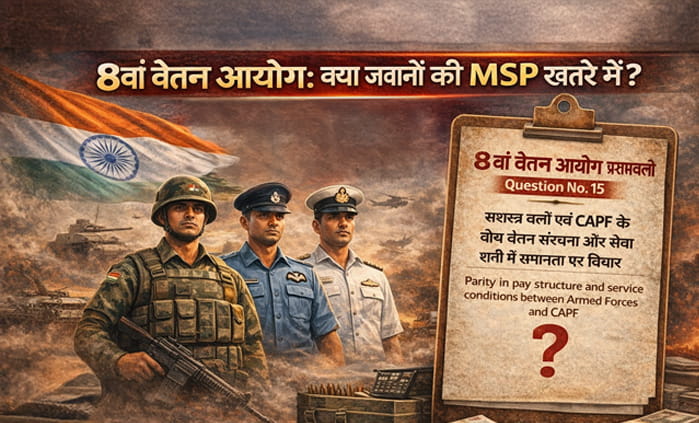
The 8th Pay Commission has opened a new line of debate that has caught the attention of serving personnel, veterans, and defence families across the country. This time, the concern is not limited to fitment factor or the usual discussion around salary revision. The real anxiety is around Military Service Pay, or MSP, after the Commission’s questionnaire raised a question linked to parity and alignment between the Armed Forces and CAPF. That single reference has been enough to trigger widespread discussion, because MSP is not seen as an ordinary allowance. For the military community, it represents recognition of a service environment defined by risk, hardship, discipline, mobility, and conditions that do not match regular civilian or quasi-civilian employment.
At the heart of the concern is Question 15 of the questionnaire. The wording has led many to ask whether MSP is being examined for restructuring, whether similar demands may be raised for CAPF, or whether the government may eventually try to dilute the logic behind MSP in the name of parity. At this stage, there is no final recommendation and no confirmed decision. But the concern itself is understandable. Once a pay commission begins asking questions around alignment, equivalence, and comparative structures, stakeholders naturally start reading those questions for policy direction.
MSP has always carried symbolic as well as financial value. It was created to acknowledge the distinct nature of military service, where the job is not defined only by duty hours or standard administrative output. Soldiers, sailors, and air warriors operate in conditions shaped by danger, separation from family, sudden movement, harsh terrain, field postings, combat preparation, and a constant service liability that is different from most other arms of government. That is why MSP has never been viewed simply as an income component. It is seen as a recognition of a unique service burden.
This is also why the comparison with CAPF becomes sensitive. The debate is not about diminishing the role or sacrifice of CAPF personnel. Their responsibilities are serious and demanding in their own right. The issue is whether all forms of hardship can be treated as identical for pay design. Once the state begins applying the same yardstick to two services that differ in structure, operational doctrine, liability, command culture, and war-fighting role, the fear is that the original basis of MSP may get blurred. That is what makes this discussion so important for the military community.
The concern around MSP is also growing because it is not emerging in isolation. It is being discussed alongside other issues that have already created unease among veterans and pensioners. The debate around disability pension taxation has made many people feel that defence-related financial protections are increasingly coming under sharper scrutiny. The long-pending issue of DA and DR arrears linked to the 18-month freeze has also contributed to distrust, because many affected families still feel their grievance has never been meaningfully resolved. When these issues are seen together, the MSP discussion begins to look like part of a larger pattern of uncertainty rather than a stand-alone question.
Another layer to the debate is pension history. For many veterans, the fear is rooted in past experience. Structural changes made in earlier pay commission eras, especially around pension formulas, are still remembered as examples of how long-term financial consequences can emerge from policy shifts that initially appear technical. That is why even a questionnaire reference can create serious concern. For military families, these are not abstract policy discussions. They affect lifetime financial planning, post-retirement stability, and the perceived respect attached to military service.
There is also an internal fairness question within the MSP debate itself. Some voices believe that if MSP exists to compensate risk and hardship, then the gap between ranks should also be examined more carefully. That opens another sensitive discussion on whether officers, JCOs, and OR should continue under the same present structure or whether the recognition of risk should be revisited in a more uniform way. This shows that the current debate is not just about whether MSP stays or goes. It is also about what principle should govern it in the future if the 8th Pay Commission chooses to review it.
The fitment factor discussion further intensifies the issue. If the 8th Pay Commission is expected to revise pay across the board, then naturally defence personnel want to know whether MSP will remain protected separately, be merged in some way, or be indirectly affected by the broader salary framework. This is why rumours spread quickly whenever a questionnaire references military pay. In the absence of formal clarification, speculation fills the gap. That is exactly why the MSP issue needs transparent consultation with defence stakeholders rather than assumptions based on broad parity language.
From a policy perspective, the safest approach would be clarity. If MSP is not under threat, that should be clearly communicated. If the Commission wants to study its structure, that too should happen openly and with full recognition of military realities. Any attempt to treat MSP as just another comparable allowance would be seen as a serious mistake by the defence community, because the logic behind MSP is rooted in the special conditions of service, not in routine administrative compensation.
The biggest point in the current 8th Pay Commission debate is this: MSP is not just a pay component, and it should not be judged through a simplistic parity formula. The concern raised by Question 15 is important because it touches a sensitive nerve within the Armed Forces and among veterans. At present, there is no confirmed decision that MSP will be cut, merged, or extended. But the fact that the question has been raised is enough to demand careful public scrutiny. For serving personnel, ex-servicemen, and military families, the priority now is to seek transparency, insist on proper consultation, and ensure that the unique nature of military service is not diluted in a broader administrative comparison. If the 8th Pay Commission wants to build trust, it must address MSP with clarity, caution, and a full understanding of what military service actually means.
Watch the Full Video for Complete Details





Leave a Reply