


The 8th Pay Commission process appears to be entering a more serious and structured phase, and for central government employees and pensioners, that makes the current developments especially important. The latest discussion around the NCJCM Staff Side Drafting Committee meeting in Delhi has drawn attention because it signals that employee-side bodies are no longer talking in fragments. They are now working to prepare a unified memorandum, a common charter of demands that can be placed before the 8th CPC leadership. This stage matters because once demands are formally consolidated and submitted, they begin to shape the larger negotiation around pay revision, pension, allowances, service conditions, and long-term financial protections for employees.
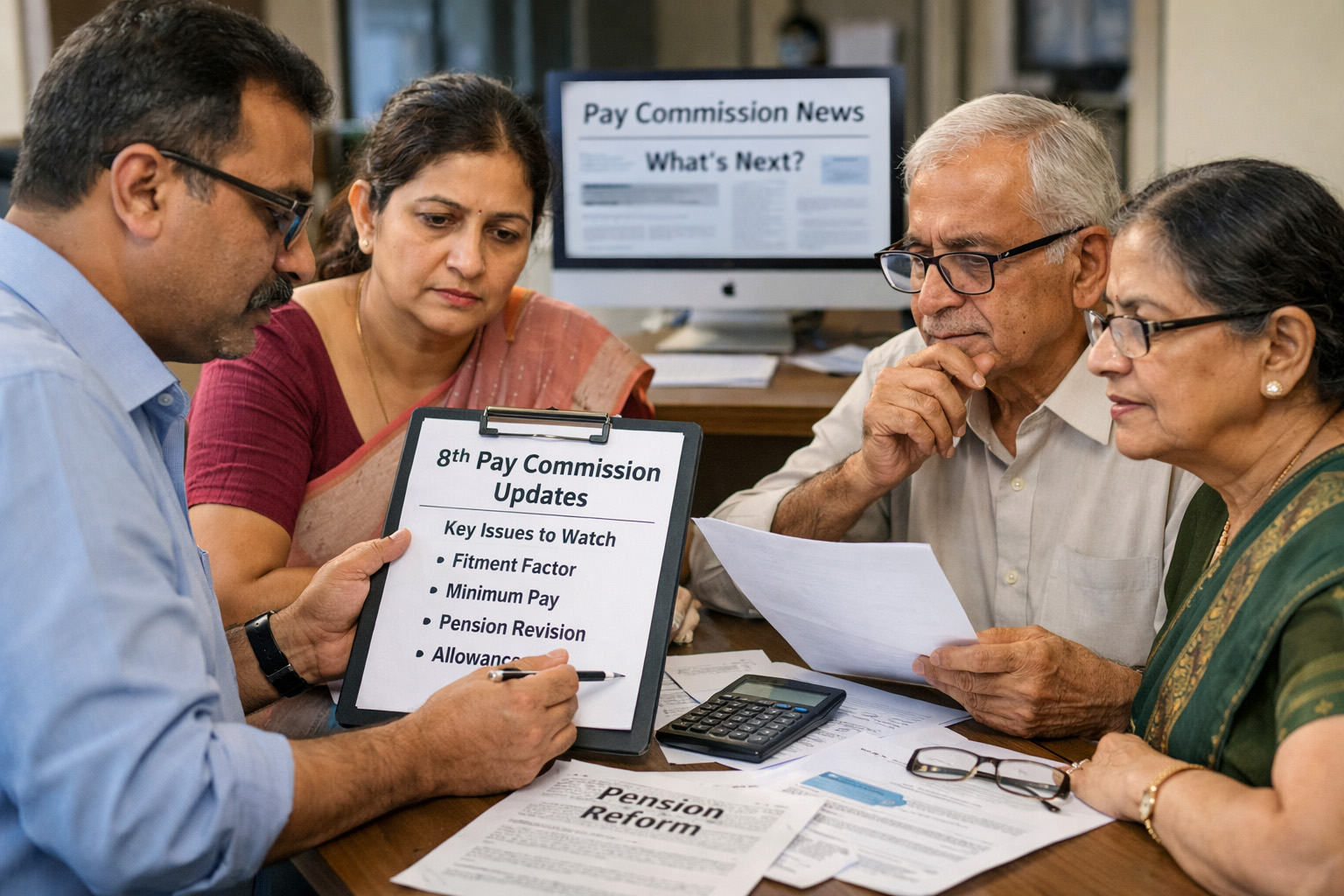
At the heart of the current discussion is the effort to build one strong and coordinated set of demands before the Commission begins deeper examination. Different federations and associations may have already sent their own views, but the importance of a common memorandum lies in its ability to present a clearer and more forceful case. In practical terms, this is the stage where staff-side representatives try to ensure that no major issue is left behind. That includes fitment factor, minimum pay, annual increment, pay matrix revision, pension reforms, medical allowance, leave encashment, LTC, and retirement-related benefits. For employees, this is not just a meeting update. It is the stage where the framework of future salary and pension expectations is being drafted.
One of the biggest talking points is the fitment factor. This remains one of the most closely watched issues in every pay commission because it directly influences revised basic pay. The demand pattern being discussed suggests different levels of fitment across pay bands, with lower levels seeing one kind of revision and higher levels potentially going up to 3.25. That is why this discussion has generated so much attention. It creates the possibility of a much higher revised minimum basic pay if such proposals are accepted in any form. At the same time, it is important to remember that these are demand-side proposals, not government-approved figures. Still, the very fact that such numbers are now part of active drafting shows the scale of expectations that employee bodies want to place before the Commission.
Alongside fitment factor, the demand for a higher annual increment has also become a major issue. At present, the annual increment system is widely seen as modest when compared to rising living costs and long-term income expectations. That is why the discussion around taking the yearly increment beyond the present structure, even into a range as high as 7 percent, is being seen as a significant development. Employees view annual increment not only as a routine yearly addition but also as a tool for preserving real income growth over time. If inflationary pressure continues and basic salary revision happens only once in several years, then the annual increment becomes even more important in protecting employee earnings between two commission cycles.
Another important point emerging from the discussions is the proposal to revisit how minimum wage is calculated. The idea of expanding the family unit from three to five has deeper implications than it may appear at first glance. Wage calculation in government service is not just about one employee as an individual. It is also linked to the standard of living required for a family. If the family unit is revised upward, the logic of minimum pay can also shift in a substantial way. This is one reason why the minimum wage debate is expected to remain central to the final memorandum. It is not merely about numbers on paper. It is about redefining what the system considers a fair baseline for living standards.
The meeting discussions are also reflecting wider concern over allowances and retirement-linked benefits. Fixed Medical Allowance, especially for pensioners and employees in areas where CGHS is not available, remains a long-standing demand. Similarly, leave encashment, LTC, and other service-related benefits are being seen as areas where the existing framework no longer fully matches present realities. Employees are also watching whether the final memorandum pushes for stronger retirement security, especially at a time when many workers remain uneasy about the future of pension policy.
That naturally brings the focus to one of the most sensitive issues in the 8th Pay Commission debate: OPS, NPS, and UPS. For a large section of employees and pensioners, this is not a side issue but one of the main concerns. The demand for restoring the Old Pension Scheme continues to carry emotional as well as financial weight. Many employee bodies believe that pension security cannot be treated as a secondary matter in the pay commission cycle. The continued resistance to NPS and the broader debate around UPS show that pension reform is likely to remain one of the most politically and emotionally charged topics before the Commission.
What makes the present moment especially important is timing. This is the stage when demands can still be shaped, refined, supported with data, and presented in a structured form. Once the memorandum is submitted and the Commission moves into formal scrutiny, the space for broad drafting becomes narrower. That is why the ongoing committee work is being closely watched. If staff-side organizations manage to align on key issues and present a strong case, the chances of those issues receiving serious consideration become much stronger. If major concerns are weakly drafted or left out, they may lose momentum later in the process.
For employees, pensioners, defence civilians, railway staff, CAPF personnel, and associated groups, the message is clear. The 8th Pay Commission is no longer just an announcement on paper. It is now moving through the stage where organized demands are being prepared and priorities are being fixed. This means the discussion over 3.25 fitment factor, a 7 percent annual increment, pension protection, higher minimum pay, and allowance revision is not just speculation. It is becoming part of the formal pressure-building process.
The latest movement around the NCJCM Staff Side Drafting Committee shows that the 8th Pay Commission debate is becoming sharper, more detailed, and more consequential. Questions around fitment factor, annual increment, minimum wage norms, allowances, and pension reforms are now taking center stage. While no final decision has been made yet, the seriousness of these discussions indicates that the coming months could be crucial for crores of employees and pensioners. Much will depend on how effectively the unified memorandum captures these demands and how strongly they are argued before the Commission. For now, the signal is clear: the real drafting phase has begun, and the outcome of this stage may shape the future of salaries, pensions, and service benefits for years to come.
Watch the Full Video for Complete Details


Leave a Reply