

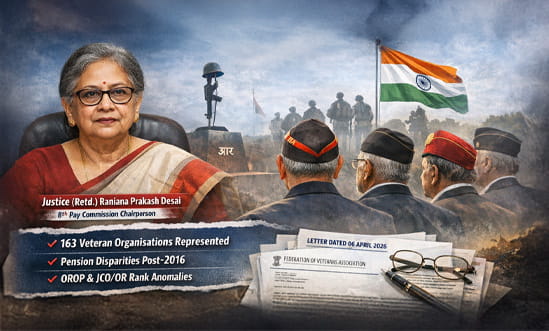
The 8th Pay Commission has begun to gather momentum, and with that, key stakeholder groups are moving quickly to ensure their concerns are heard at the right stage. Among the most important developments is a fresh representation from the Federation of Veterans Association, which has sought a direct meeting with the Chairperson of the 8th Central Pay Commission, Justice (Retd) Ranjana Prakash Desai. For lakhs of defence pensioners, veer naris, war widows, disabled soldiers, and retired personnel across ranks, this is not just another letter. It is a serious attempt to place long-pending pension and OROP concerns before the Commission before recommendations take shape.
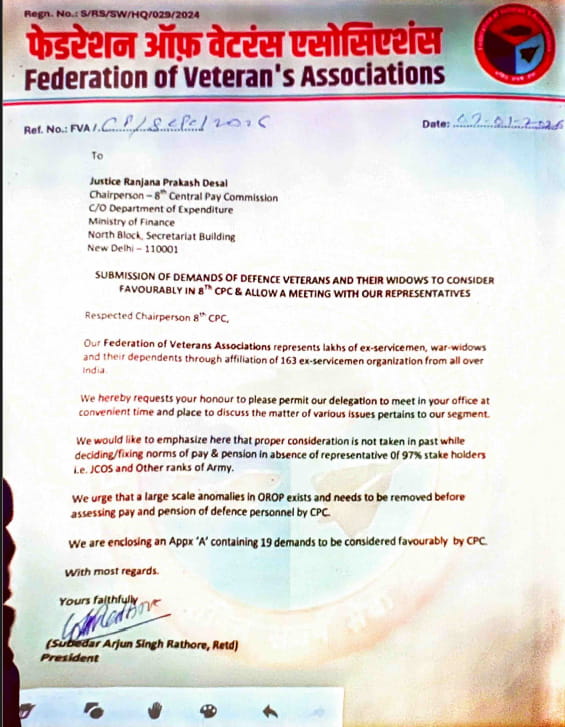
According to the representation dated 6 April 2026, the federation has once again requested a suitable time slot for a delegation meeting with the Commission. The letter also refers to an earlier communication sent in January 2026, showing that veterans’ groups have been trying to secure an opportunity for detailed discussion for some time. The demand is simple but significant: if policy is being shaped now, then the voices of those directly affected by pension revisions and anomaly corrections must be part of the consultation process.
What makes this development more important is the scale of representation being claimed. The Federation of Veterans Association says it speaks on behalf of lakhs of defence pensioners and veeranganas through 163 affiliated veteran organisations. That gives the request both weight and urgency. Their core argument is that any meaningful review of defence pension issues cannot be complete unless the largest stakeholder group, especially Junior Commissioned Officers and Other Ranks, is heard directly.
The concerns being raised are not abstract. Veterans say several pension and pay anomalies that surfaced after the 7th Pay Commission still remain unresolved or were never addressed in a fully practical way. They fear that unless these realities are properly understood now, the same pattern may continue under the 8th CPC as well. In particular, the federation wants the Commission to examine how pension structures, parity issues, and rank-wise revision formulas affect retired personnel at the ground level.
One of the most sensitive issues highlighted in the representation relates to cases where some post-2016 retirees are reportedly drawing less pension than certain pre-2016 retirees in comparable situations. Even if such cases are limited or category-specific, the very existence of such examples raises a larger question about fairness and consistency in pension fixation. For veterans, this is not just a technical calculation issue. It is about parity, dignity, and trust in the pension system.
The federation has also drawn attention to the complexity of OROP-related matters. While official tables and formula-based approaches may appear sound on paper, veterans often argue that the actual impact is different once the rules are applied to real service histories, ranks, retirement dates, and categories. This is where they believe an in-person discussion becomes necessary. A written memorandum can list demands, but a face-to-face meeting allows associations to explain why certain anomalies are recurring, how they affect families, and what kind of corrective framework may be needed.
Another major point raised is the vulnerability of the affected community. Many widows, disabled soldiers, elderly pensioners, and rural veterans do not have the means to pursue long administrative or legal battles. For them, delayed correction is often equal to denied relief. This is why veterans’ groups are pushing for clear and practical solutions at the Pay Commission stage itself, rather than leaving unresolved gaps to become future litigation or long-term grievance files.
The federation has reportedly already submitted a 19-point charter of demands. However, its latest communication makes it clear that documentation alone is not enough. Their stand is that discussion and clarification are equally important, especially in matters where field realities differ from file-level interpretation. A structured meeting with the Commission, therefore, is being seen as a crucial opportunity to explain the real nature of pension anomalies and the need for preventive correction in future recommendations.
This development matters far beyond one association or one letter. The 8th Pay Commission is still in a formative stage, and this is precisely when stakeholder inputs can influence the final direction of pay and pension recommendations. Once the framework is drafted and formalised, the space for major correction becomes narrower. That is why every such representation, especially from large and organised groups, deserves close attention from veterans and pensioners across the country.
For defence pensioners, serving personnel, and families tracking pension revision, the message is clear: this is the stage where evidence, comparison cases, and documented anomalies carry maximum value. Those facing similar problems should keep pension records, PPOs, bank statements, and supporting service documents ready. Strong representation backed by documents often has a greater chance of being noticed when larger policy discussions are underway.
In the coming weeks, the bigger question will be whether the 8th Pay Commission gives veteran groups a dedicated hearing and how seriously these issues are taken during consultations. If such meetings happen, they may shape how pension parity, OROP complications, and anomaly prevention are handled in the final recommendations.
At its heart, this issue is about more than numbers. It is about ensuring that those who served the nation do not have to spend their retired years fighting avoidable pension confusion. The veterans’ demand for a direct meeting is, therefore, not just a procedural request. It is a call for fairness, clarity, and equal treatment in a system that affects lakhs of former servicemen and their families.
Watch our full video for complete details!

Leave a Reply