


When people hear the words “8th Pay Commission,” the first thing that usually comes to mind is salary hike. Employees think about fitment factor, pensioners think about revision, and families begin calculating what the next round of changes could mean for their monthly finances. But a Pay Commission is not only about pay. It also looks at the wider system of benefits, allowances, and welfare support that shapes the lives of government employees after years of service.
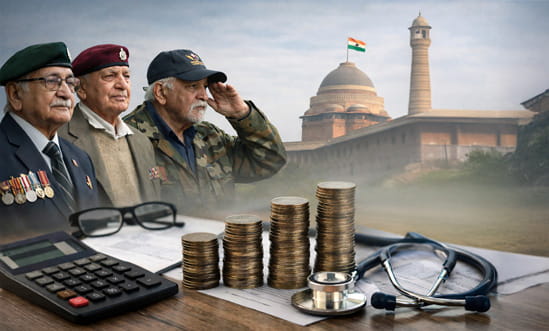
One issue that has quietly stayed in the background for years is healthcare.
That is why the conversation around the 8th Pay Commission has become interesting in a different way. Beyond pay and pension, there is growing curiosity about whether this new Commission could finally revive the long-pending debate around replacing or reforming the Central Government Health Scheme, better known as CGHS.
For lakhs of Central Government employees, pensioners, and their dependents, healthcare is not a side issue. It is a daily reality. Salaries matter, pensions matter, but medical security often matters just as much, especially for retired families, senior citizens, and those living outside the major cities where government facilities are more easily available.
CGHS has served as a key support system for Central Government employees and pensioners for decades. It provides access to consultations, medicines, treatments, diagnostics, and empanelled hospitals. For many families, it has been a crucial pillar of security. But it has also faced criticism for a long time. Its biggest limitation is reach. CGHS is not equally accessible across the country, and that creates a serious gap for employees and pensioners who live outside its effective network.
This is not a new concern. In fact, the demand for a more practical and wider healthcare system has appeared in earlier Pay Commission thinking as well.
The 6th Pay Commission had suggested the introduction of an optional healthcare scheme for Central Government employees and pensioners. It proposed that employees could join such a scheme through a fixed contribution, while also recommending that future employees be compulsorily brought under a more structured system. The message was clear even then: the existing framework had limitations, and long-term reform was necessary.
The 7th Pay Commission took that thinking even further. It clearly leaned toward the idea that health insurance could be a more suitable and sustainable model for delivering long-term medical protection to employees, pensioners, and their families. It also highlighted a particularly sensitive issue involving pensioners who live outside the operational reach of CGHS. For them, even though they were entitled to support in principle, actual access remained a challenge.
That is what makes the present moment important.
Reports earlier suggested that the government was considering an insurance-based model called the Central Government Employees and Pensioners Health Insurance Scheme, or CGEPHIS. If such a model is revived or recommended in a serious way by the 8th Pay Commission, it could mark one of the most meaningful welfare changes for employees and pensioners in years.
The importance of that possibility goes beyond policy language. A stronger healthcare framework can change everyday life. It can reduce the stress of medical emergencies, improve access for retirees outside metro cities, and give families more confidence about life after retirement. For many government pensioners, especially the elderly, healthcare access is often more urgent than even pension arithmetic. A delayed reimbursement, an unavailable facility, or the absence of an empanelled hospital nearby can create real hardship.
This is why the healthcare question deserves much more attention in the 8th Pay Commission debate than it usually gets.
The larger point is simple. A modern welfare system cannot rely only on revised pay scales. It must also look at how employees and pensioners actually live. Medical inflation continues to rise. Family health expenses can wipe out savings quickly. Retired personnel often need more regular consultations, diagnostics, medicines, and specialist care. If a healthcare scheme is limited in reach or outdated in design, then even a higher salary or pension may not fully protect a household from stress.
That is where the 8th Pay Commission has an opportunity.
It can go beyond the usual focus on salaries and address a long-pending structural issue that affects lakhs of people. If it reviews CGHS honestly and recommends either a major expansion or a more practical insurance-backed model, the impact could be far-reaching. It could especially help pensioners, families in smaller towns, and those who currently feel left out of the healthcare net because of geography rather than eligibility.
At the same time, expectations need to remain realistic. The 8th Pay Commission has not yet announced any final recommendation on this front. There is still a difference between reports, past suggestions, and actual implementation. But the fact that this issue is once again being discussed is important in itself. It shows that healthcare reform remains unfinished business in the larger story of Central Government employee welfare.
For readers, the key takeaway is this: the 8th Pay Commission may become important not only for pay revision, but also for the future of medical security. If the Commission seriously reopens the CGHS reform question, it could touch the lives of employees and pensioners in a much deeper way than a simple percentage hike ever could.
In the end, the real test of any Pay Commission is not only how much salary it raises, but how well it understands the practical needs of the people it is meant to serve. And when it comes to those needs, healthcare remains one of the most urgent and most human issues of all.
Watch our full video for complete details!

Leave a Reply