

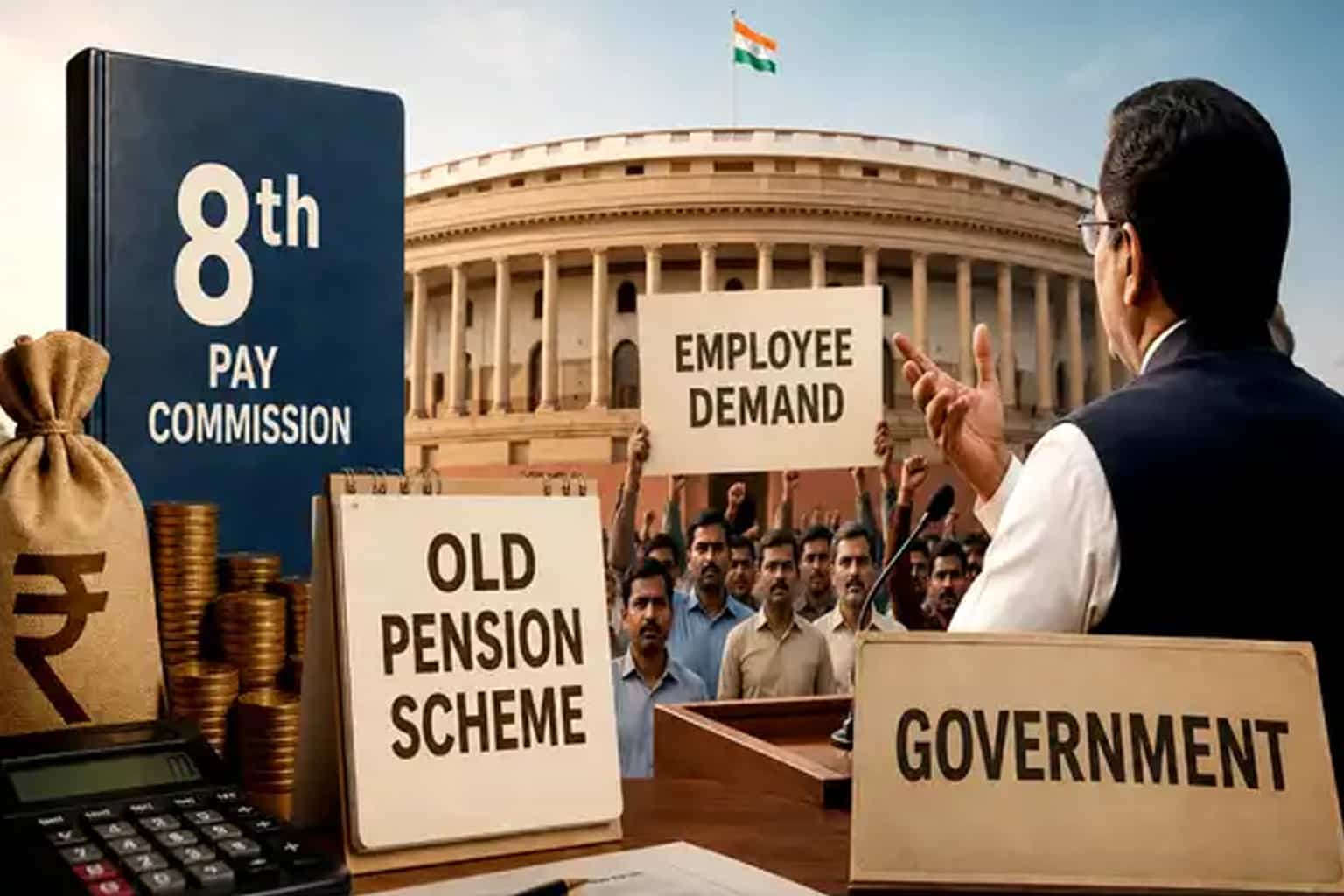
When people hear that employee representatives have placed a 3.83 fitment factor and ₹69,000 minimum basic pay before the 8th Pay Commission, the first reaction is usually simple: this sounds like a very big jump. But the real story is not only the size of the demand. The bigger story is the thinking behind it. This round of staff-side proposals has pushed the 8th CPC debate away from routine pay revision and toward a more fundamental question: what should a fair government salary actually be based on in 2026?
That is why this issue has gained so much attention.
In earlier discussions, many employees and pensioners were waiting mainly for signals about fitment factor, implementation timing and possible arrears. Now the conversation has become more detailed. The National Council-JCM staff side’s reported memorandum places several linked demands together: minimum basic pay of ₹69,000, fitment factor of 3.833, annual increment of 6 percent, higher HRA slabs, and wider revision in pension-related benefits. These are not final decisions of the Commission or the government. They are proposals submitted for consideration. But they matter because they show the scale at which employee representatives want the next revision to be discussed.
The most important change is the logic behind the minimum pay demand.
According to the reported staff-side reasoning, the old assumption of treating a family as a smaller unit is no longer adequate. One of the arguments placed before the 8th CPC is that the wage structure should reflect a family of five units, not the older smaller benchmark. That may sound like a technical change, but it has very practical meaning. It reflects the idea that a government employee today often supports not just spouse and children, but in many cases elderly parents and wider household responsibilities as well. In other words, the demand is not framed only as a salary increase. It is framed as a correction in the way minimum living cost is understood.
This is exactly why the ₹69,000 figure has become more than a headline number.
If minimum pay is revised upward at that scale, the effect does not remain limited to Level 1 employees. Minimum pay acts as the foundation of the wider pay structure. Once the base changes, the rest of the pay matrix, progression logic, pension calculation and many linked benefits also begin to move. This is why the fitment factor debate matters so much. A fitment factor is not just a multiplier in a formula. It is the bridge between today’s basic pay and tomorrow’s revised structure. The higher the factor, the stronger the effect on salary and pension. That is why the staff-side proposal of 3.83 has drawn such attention.
But there is another reason the current debate feels different.
This time, employees are not only arguing that prices have gone up. They are effectively saying that the structure of government compensation itself should better reflect the modern cost of living. Housing, education, healthcare, transport and daily essentials have all become much heavier burdens than they were when the 7th CPC framework was built. In that context, the push for 6 percent annual increment and sharper allowance revision is being presented as part of the same larger issue. A one-time rise in pay may create short-term relief, but employees clearly want a framework that also protects purchasing power over time.
That makes this a broader quality-of-life debate.
For a serving employee, higher basic pay affects far more than monthly cash in hand. It shapes future increment value, retirement calculation, gratuity, pension base and overall financial confidence. For pensioners too, the issue is not distant. If a stronger pay revision framework is eventually accepted, pension outcomes can also move upward because pension is linked to basic pay structure. This is why pensioners are watching the fitment factor discussion as closely as serving staff. Even though the current numbers are only demands, they provide a reference point for what employee representatives consider a meaningful correction rather than a symbolic revision.
At the same time, a reality check is necessary.
The official 8th CPC process is still in the consultation and memorandum stage. The Commission’s own website now states that the last date for submission of responses has been extended to 31 May 2026, and it also makes clear that submissions are to be made only through the specified online route. Hard copies, PDFs and email memorandums are not being entertained. That means the current phase is still about recording, comparing and examining demands. None of the headline figures circulating in discussion should be treated as approved benefits.
This extended window is important for one more reason.
It gives employees, pensioners, unions and associations extra time to move beyond slogan-style demands and submit better arguments. Simply repeating “3.83 fitment factor” or “₹69,000 minimum pay” may create excitement, but the stronger case lies in explaining why those figures are being demanded. If wage logic is being tied to a family of five, then representations should clearly show how household expenses have changed. If annual increment is being raised as an issue, then submissions should explain why present progression is not enough against inflation and actual living costs. If allowances are being discussed, then the case should connect them to real service conditions, city costs or duty hardship.
That is where the current 8th CPC debate becomes more serious than many earlier discussions.
This is no longer only a conversation about “how much hike can come.” It has become a debate about what standard of life government pay should protect. The ₹69,000 minimum pay demand has gained importance not merely because it is large, but because it challenges the old assumptions on which lower pay calculations were built. It asks whether the next pay commission will view salary as a basic administrative cost or as a realistic support system for employees and pensioners living in today’s economy.
In the end, that is why this demand has changed the tone of the 8th CPC discussion.
The final award may be lower, modified or structured differently. That will depend on the Commission’s review and the government’s eventual decision. But the staff-side proposal has already done one important thing: it has forced the debate to move from vague expectation to concrete wage philosophy. And for employees, pensioners and defence families, that shift may prove just as important as the final numbers themselves.




Leave a Reply