

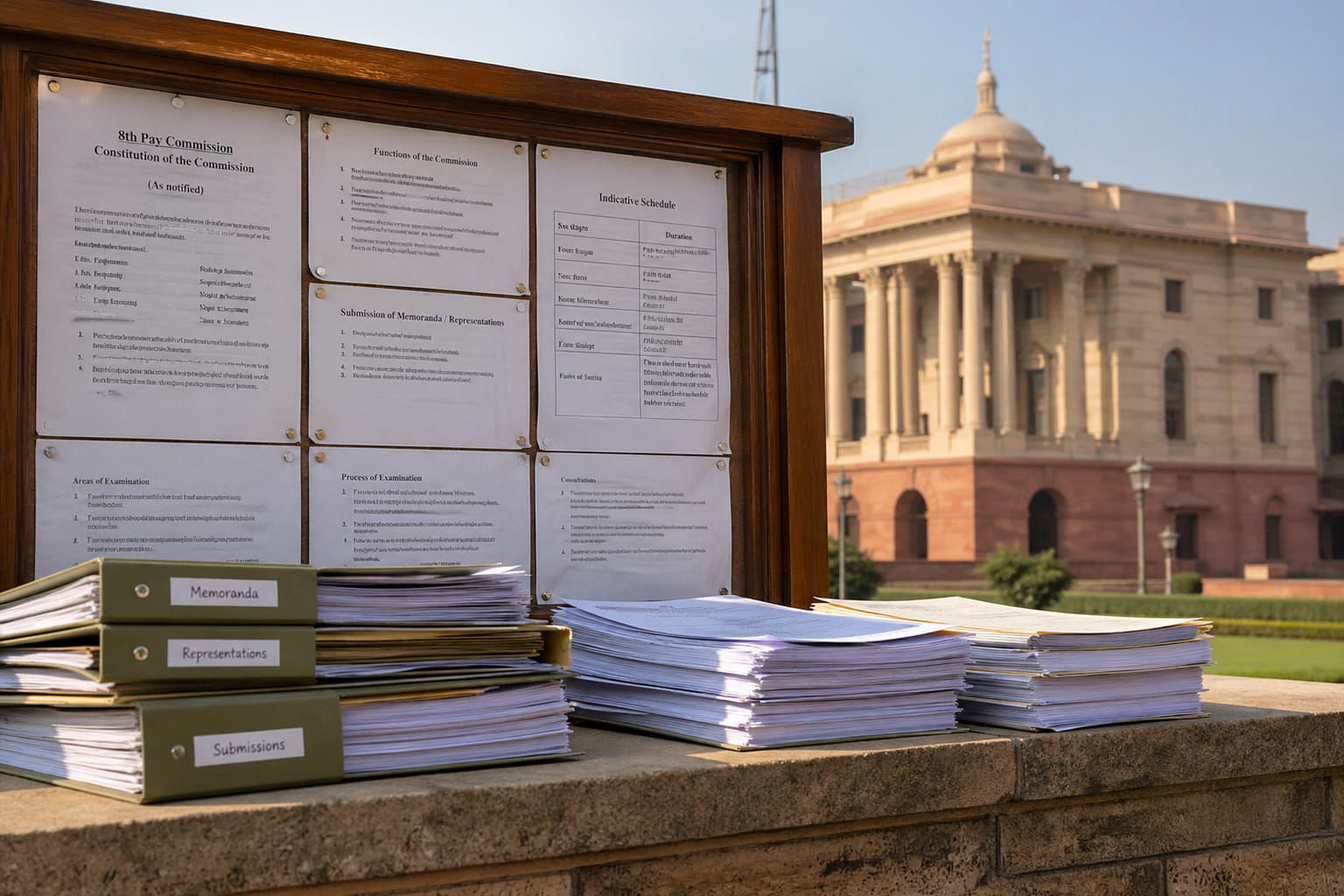
For a long time, the biggest question among central government employees, pensioners, defence pensioners and ex-servicemen was simple: when will the 8th Pay Commission be formed?
That question had become the centre of almost every discussion. People were watching the Budget period, government announcements, employee union statements and every small signal from Delhi. For serving employees, it was linked to future salary revision. For pensioners, it was linked to retirement security. For veterans and defence families, it was linked to long-pending issues of pay, pension, parity and welfare.
But that stage is now over.
The 8th Central Pay Commission has already been constituted through the Government of India notification dated 3 November 2025. The official 8th CPC website also confirms that the Commission has been established at Chanderlok Building, Janpath, New Delhi. This means the earlier question of formation is no longer the main story. The real question now is different: how seriously will employees, pensioners and associations use this stage before the Commission finalises its recommendations?
That is why the present phase may be more important than the announcement itself.
A Pay Commission does not change salaries and pensions overnight. It studies the existing system, examines employee demands, looks at pension obligations, reviews allowances, considers government finances and then prepares recommendations. The final report is only the visible result. The real work happens much earlier, during the consultation, data collection and representation stage.
This is the stage India has now entered.
The official composition of the 8th CPC is also clear. Justice Ranjana Prakash Desai is the Chairperson, Prof. Pulak Ghosh is the Part-Time Member, and Shri Pankaj Jain is the Member-Secretary. This composition matters because the Commission’s work is not limited to one salary table. It has to examine service conditions, pay structures, pension issues, allowances and the wider financial impact of its recommendations.
For an employee, this can affect minimum pay, fitment factor, pay matrix, annual increment, MACP, promotion stagnation, HRA, TA, LTC and other allowances.
For a pensioner, it can affect pension revision, Dearness Relief, commutation, family pension, medical facilities, gratuity and dignity in retired life.
For defence personnel and veterans, the issues can be even more specific. Military service involves early retirement, difficult postings, field conditions, rank structure, disability concerns, MSP, OROP anomalies, ECHS, CGHS and other service-linked matters that cannot be treated like ordinary administrative points.
This is why the 8th Pay Commission is not just a salary discussion. It is a family budget issue, a retirement planning issue and, for many veterans, a question of fairness.
The Terms of Reference are also important because they define the working boundary of the Commission. The official website lists the Terms of Reference dated 03 November 2025. In simple language, this means the Commission will work within a formal mandate. Every demand must therefore be placed in a way that connects with that mandate.
This is where many people make a mistake.
They think that if a problem is widely discussed on WhatsApp, YouTube, social media or in local meetings, the Commission will automatically understand it. But a Pay Commission does not work only on public emotion. It works on written inputs, data, memorandums, representations, comparative points and official submissions.
That is why this phase demands seriousness.
The official memorandum submission page says the Commission invites representations, memorandums and suggestions from central government employees, defence personnel, pensioners, service associations, unions, ministries, departments, Union Territories and other listed stakeholders. It also states that submissions are to be made through the specified online link, and paper-based memoranda, hard copies, PDFs or emails are not being considered or entertained by the Commission.
This single point should wake up every employee and pensioner.
If the official route is online and structured, then casual discussion is not enough. A demand must be written clearly. It must identify the issue, explain who is affected, show the present problem, suggest the correction required and provide a logical justification.
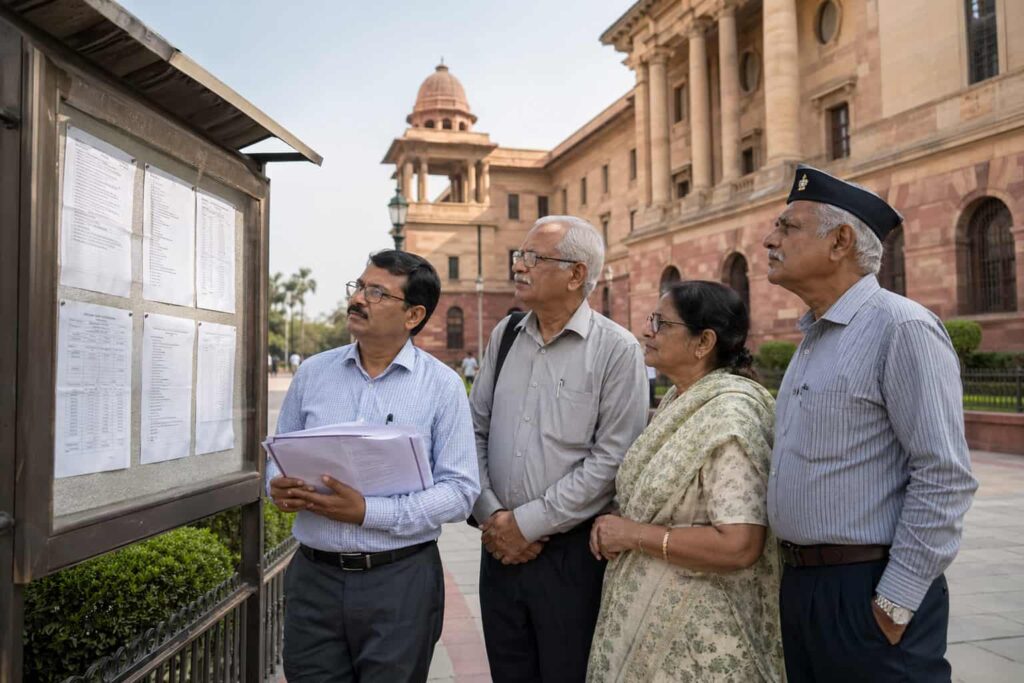
For example, writing “pensioners are suffering” may express pain, but it does not create a strong case. A better representation would explain which pensioner category is affected, which rule or calculation is creating hardship, what financial loss is happening and what correction is requested.
The same method applies to fitment factor, minimum pay, MACP, pay parity, allowance revision, commutation, medical facilities and defence-specific anomalies.
The Commission’s own website shows that the process has moved into an active phase. Its “What’s New” section lists updates on forthcoming 8CPC meetings, clarification regarding memorandum submission, Delhi interactions on 28 and 29 April 2026, and Pune visit on 4 and 5 May 2026. This shows that the 8th CPC is no longer only a headline. It is now a working process.
That is why associations, unions and welfare groups must act responsibly. Emotional statements may attract attention, but researched submissions carry more weight. A strong memorandum should include facts, examples, rule references, financial impact and practical solutions.
Individual employees and pensioners also have a role. They should not wait only for association leaders. If their issue is personal, local or category-specific, they should place it on record through the official system. In a process of this scale, documented participation matters.
The most important message is this: the announcement was the beginning, not the result.
Many people are still waiting for a final salary figure or a viral fitment factor claim. But the real foundation is being laid now. The issues that enter the Commission’s study properly may have a better chance of serious examination than the issues that remain only in conversations.
For employees, pensioners and veterans, this is the time to move from waiting to preparation. Read official updates. Understand the Terms of Reference. Draft issues clearly. Submit through the proper route. Keep proof wherever available. Help elderly pensioners, veer naris and veterans who may not be comfortable with online systems.
The 8th Pay Commission announcement question is over. But the real wait has just begun because now the country is waiting for recommendations, acceptance and implementation.
And before that final stage arrives, this is the moment to make sure your issue is not missing from the record.


Leave a Reply