

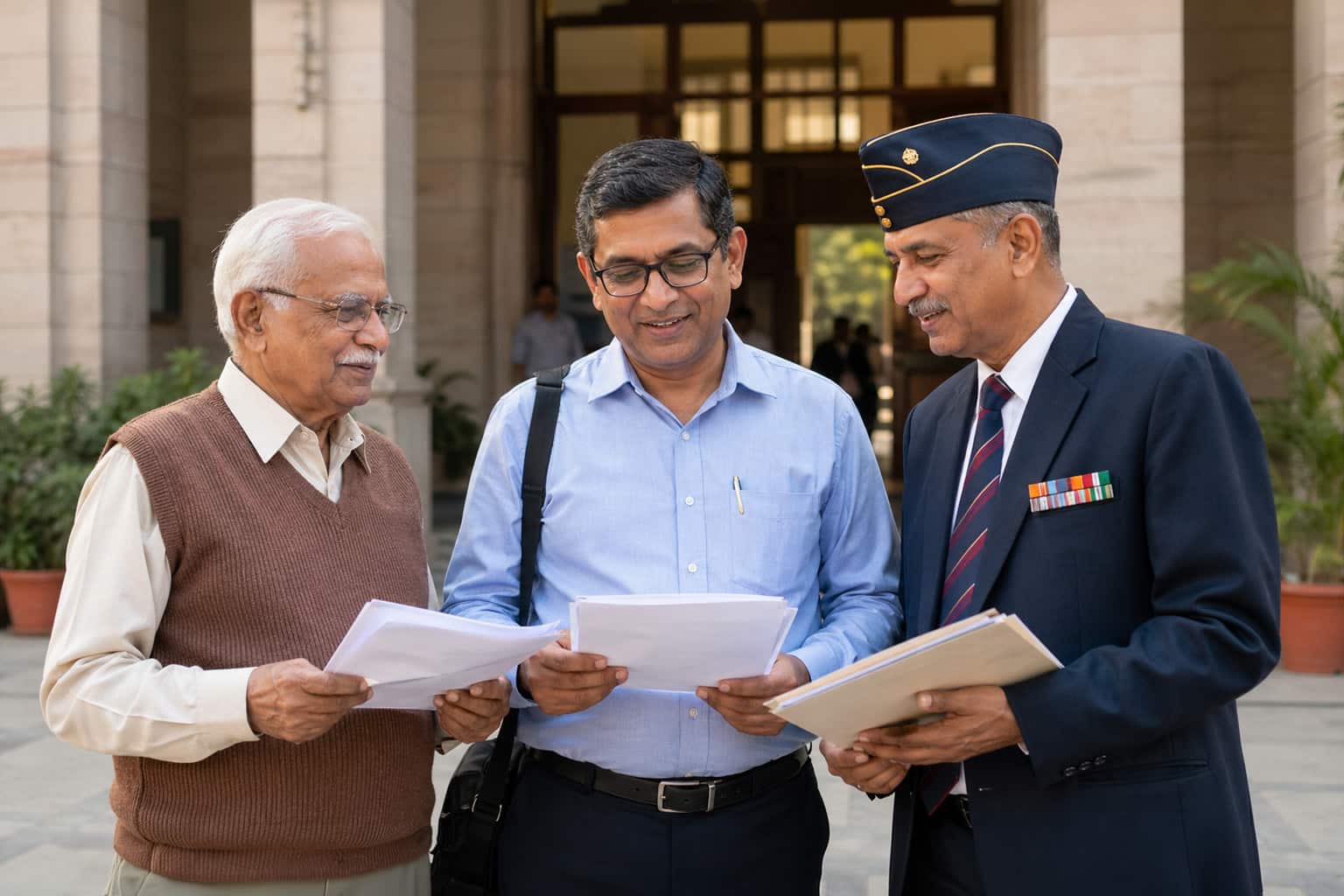
The 8th Pay Commission is no longer just a policy exercise happening behind closed doors. What is emerging now is a more participative process where the role of employees, pensioners, and stakeholder groups is becoming far more influential than in previous cycles.
This shift is subtle, but it carries serious implications.
For the first time in a long time, the outcome of the pay commission may not depend only on internal government calculations. It may also depend on how effectively stakeholders communicate their realities, justify their demands, and engage with the system that has been opened for them.
Why this phase is less about waiting and more about participation?
Traditionally, many employees and pensioners followed pay commission updates as passive observers. They would track news, hear expectations, and wait for final recommendations.
But the current process is changing that pattern.
The commission is actively seeking inputs, encouraging formal submissions, and creating channels where concerns can be documented and reviewed. This means the process is no longer one-directional.
Instead of simply waiting for outcomes, stakeholders now have a window to influence them.
This is a fundamental change in how the system operates.
How structured inputs are becoming the deciding factor?
One of the clearest signals from recent developments is that not all inputs will be treated equally.
Casual discussions, social media debates, or informal expectations may create awareness, but they do not automatically become part of the official review process. What truly matters is structured input.
This includes properly written memorandums, clearly defined issues, and logical arguments backed by facts.
The commission is expected to rely heavily on documented submissions while preparing its recommendations. This makes the quality of representation more important than the quantity of opinions.
For employees and pensioners, this means a shift from emotional discussion to evidence-based communication.
Why some demands gain traction while others fade away?
In every pay commission cycle, there are certain issues that gain visibility and eventually make it into the final recommendations. At the same time, many equally important concerns remain unnoticed.
The difference usually lies in presentation.
Demands that are clearly articulated, supported by real-world examples, and aligned with broader policy logic tend to receive attention. On the other hand, vague or repetitive concerns often get absorbed into general categories.
This is especially critical for sectors with unique service conditions.
Defence personnel, technical departments, and field-based roles often have challenges that cannot be understood through standard frameworks. Unless these challenges are explained in detail, they risk being evaluated under generic rules.
That is where the gap begins.
The hidden risk of missing the submission window
One of the most overlooked aspects of the 8th Pay Commission process is timing.
There is a limited window during which stakeholders can submit their concerns. Once that window closes, the process moves into analysis and drafting, where new inputs are rarely considered.
This creates a silent risk.
Many employees and pensioners may continue discussing issues even after the submission phase has passed, without realizing that the opportunity to formally present those issues is already gone.
This is why awareness is as important as action.
Understanding when to act can make the difference between being heard and being left out.

Why expectations alone will not shape the outcome?
There is no shortage of expectations surrounding the 8th Pay Commission. Discussions around salary revision, pension correction, and allowances have created a strong sense of anticipation.
But expectation alone does not influence policy.
The commission works within a framework that balances employee welfare with financial sustainability. To influence that balance, stakeholders need to move beyond expectations and focus on justification.
Why is a particular demand necessary?
How does it reflect current realities?
What data supports it?
These are the questions that carry weight.
Without clear answers, even widely discussed issues may struggle to find space in the final recommendations.
How collective representation can create stronger impact?
Individual concerns are important, but collective representation often carries more influence.
Associations, unions, and organized groups have the ability to consolidate multiple issues into a single, well-structured document. This not only strengthens the argument but also ensures that the concerns reflect a broader section of stakeholders.
Such representation is more likely to be taken seriously during the review process.
It also helps in maintaining consistency, avoiding duplication, and presenting a unified perspective.
Why this process could shape long-term outcomes?
The significance of the current phase goes beyond immediate salary or pension changes.
The recommendations of the 8th Pay Commission will define financial structures for years to come. They will influence not just current employees, but also future entrants and retirees.
This makes the process long-term in nature.
Decisions taken now will affect pay progression, retirement benefits, and financial planning for an entire generation of employees and pensioners.
That is why the current participation phase carries such weight.
What should be the priority right now?
At this stage, the focus should be on clarity, preparation, and timely action.
Stakeholders need to identify their key concerns, organize them logically, and present them through the proper channels. Waiting for outcomes without participating in the process may lead to missed opportunities.
It is also important to separate realistic demands from unrealistic expectations. A balanced and well-argued submission is far more effective than an ambitious but unsupported one.
The goal should be impact, not just expression.
Conclusion
The 8th Pay Commission is moving through a phase where influence is not automatic. It has to be earned through participation.
The system is open, but it is also structured. It rewards clarity, preparation, and timely action.
For employees, pensioners, and defence personnel, this is not just another update cycle. It is a chance to shape the outcome in a meaningful way.
Because in the end, the final recommendations will reflect not only what the commission believes is right, but also what stakeholders successfully manage to bring into the conversation.

Leave a Reply