


When a serving police constable publicly accuses his own department of corruption, the issue goes beyond one viral clip. It becomes a test of institutional credibility. People do not just ask whether the allegations are true. They also begin asking why a constable felt the need to speak outside the system in the first place.
That is what makes the recent Lucknow case so important.
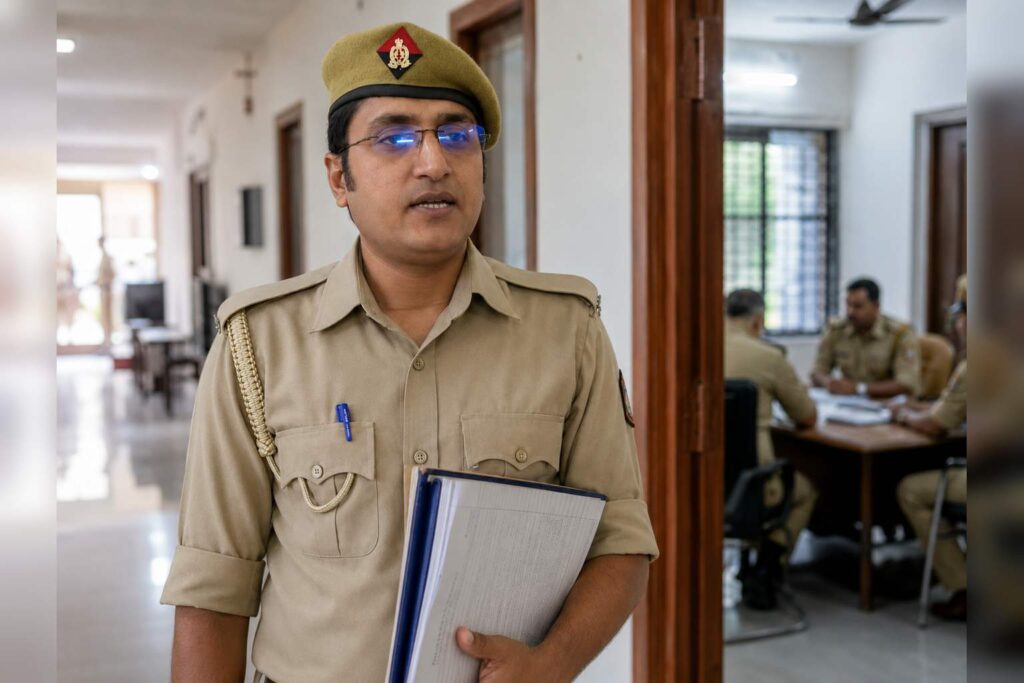
A constable identified in reports as Sunil Kumar Shukla, posted at Reserve Police Lines under the Lucknow Commissionerate, has made serious allegations regarding duty deployment and posting practices. According to media reports, he claimed that money was being collected in connection with duty assignments. The video quickly spread online and drew public attention because it touched a nerve: the fear that internal systems meant to ensure discipline and fairness may sometimes work very differently on the ground.
At the same time, it is necessary to approach the matter responsibly.
These are allegations, not proven conclusions. Public anger, social media excitement and emotional reactions cannot replace verification. The truth of the matter will have to come from duty records, official logs, inquiry findings, witness accounts, communication trails and any documentary or financial evidence that supports or contradicts the claims.
That caution is not a formality. It is essential.
In cases like this, two mistakes are common. The first is to assume that a viral video must be fully true just because it feels convincing. The second is to reject the complaint immediately just because it creates embarrassment for the department. Both responses are flawed. Serious allegations deserve investigation, not instant belief and not instant dismissal.
The reported claims matter because duty deployment is not a minor office issue for constables and head constables. It affects everything from workload and field exposure to family time, personal stress and daily working conditions. If the system is transparent, personnel may still have hard duties, but they know the process is fair. If they begin to believe that unofficial payments influence who gets what duty, the damage goes far beyond one posting chart. It strikes at morale.
That is why this case is not only about one constable’s video. It is about trust inside a force that depends heavily on discipline and internal confidence.
The official response from the Lucknow Police Commissionerate is also important. Reports say the Commissionerate has stated that a committee has been formed for a fair and detailed inquiry into the allegations. It has also maintained that duty deployment in Reserve Police Lines is carried out under the prescribed SOP and under the supervision of gazetted officers, with periodic changes in duty-in-charge as required.
This means the matter now stands at a critical point. The allegations are out in public, and the department has acknowledged the seriousness by setting up an inquiry. What happens next will decide whether this remains another short-lived controversy or becomes a meaningful case study in police accountability.
The deeper question, however, is not only whether corruption existed. It is also whether lower-rank personnel have enough confidence in internal complaint mechanisms.
In a well-functioning institutional system, a constable should have a credible route to report unfair treatment, corruption, pressure or misuse of authority without feeling that his only remaining option is to make a public video. When an employee in a disciplined force goes outside the chain of command, it can mean many things. It may mean courage. It may mean frustration. It may mean distrust. Sometimes it may also mean that the person believes internal channels will not protect him.
That possibility cannot be ignored.
At the same time, going public also carries real danger for the complainant. Public exposure may attract sympathy, but it can also bring scrutiny, professional isolation, hostility from colleagues, or accusations that the issue is being sensationalised. A whistleblower may gain visibility yet become more vulnerable within the institution. That is why the question of whether going public will help or harm the constable is not dramatic. It is very real.
If the allegations are supported by evidence, his decision may be seen as an act that forced a hidden issue into the open. If the claims do not stand up to scrutiny, the same act could weaken his own position badly. This is exactly why a credible inquiry matters so much. It protects not only the institution, but also the principle that truth should be determined through facts, not noise.
A proper inquiry in such a case should not remain vague. It should examine specific operational points. Were duty rosters prepared according to the approved system. Were there unexplained alterations. Did any intermediary exercise unofficial influence. Did any personnel report demands for money. Are there witnesses, messages, cash patterns or other supporting materials. Were supervisory officers aware of irregularities or completely unaware. Without this level of seriousness, no inquiry will restore confidence.
The department must also guard against another danger: retaliation, whether direct or indirect. If a complainant fears that speaking up will lead to punishment before the facts are even tested, then future complaints may never surface. At the same time, innocent officers and staff must also be protected from trial by viral video. A fair process must do both.
This case also points to a wider reform issue. Police systems across the country have long struggled with questions of welfare, workload, internal pressure and transparency. Lower-rank personnel often work long hours under difficult conditions. In such a structure, even the perception of unfair duty distribution can become deeply corrosive. If staff begin to think that hardship is being assigned through influence or money rather than through official process, discipline weakens from inside.
That is why technology and record-based transparency can help. Duty allocation systems with stronger digital logs, review layers, recorded approvals, complaint channels and auditable changes can reduce both wrongdoing and suspicion. They also protect honest officers by creating a verifiable chain of decision-making.
The public, meanwhile, should respond with maturity. This should not become an excuse for attacking the entire police force or declaring guilt before inquiry. Nor should it be brushed aside as mere drama. The correct public expectation is simple: examine the allegations carefully, publish the truth, take action if wrongdoing is proved, and fix the system if loopholes exist.
In the end, this case is bigger than one video.
It raises a basic institutional question: when a constable says the system is not working fairly, does the system have the strength to examine itself honestly? That is the real test. A transparent inquiry will not only address one allegation. It will show whether the department values truth more than discomfort.
For now, the only responsible conclusion is this: let the facts be tested, let the inquiry speak, and let both corruption and false accusation be treated seriously. Anything less will only deepen the distrust this video has already exposed.




Leave a Reply