


India’s national security messaging has become noticeably sharper in recent years, and the Army Chief’s latest remarks have added another clear signal to that trend. Speaking at an interaction in New Delhi, General Upendra Dwivedi delivered a message that was direct, forceful and impossible to ignore. At the centre of his statement was one simple idea: if terrorism continues to be used against India, the response will not remain trapped in old patterns of routine protest and symbolic warning.
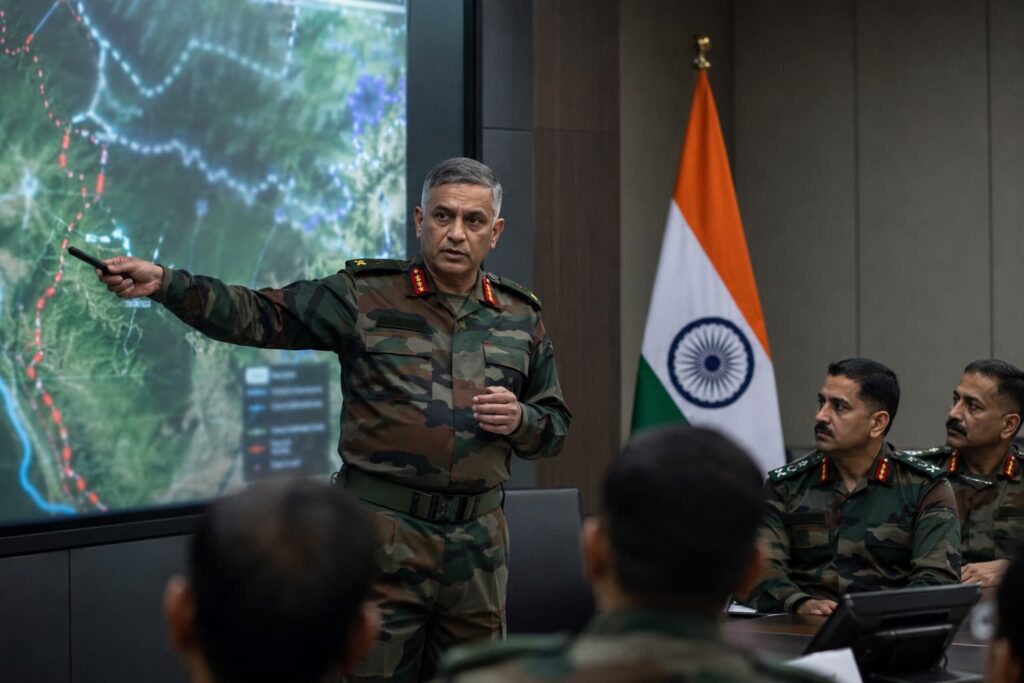
That is why his remarks matter.
At one level, the statement was a response to a question about what India would do if conditions similar to those before Operation Sindoor emerge again. But at a deeper level, it reflected how India now wants both its adversaries and its own citizens to understand the country’s security doctrine. The message is no longer built only around patience, restraint and diplomacy. It now carries a more visible deterrent element. In plain language, India wants it understood that terrorism will carry a cost.
This is the broader context in which the statement should be read.
For years, India faced the challenge of cross-border terrorism in a way that often seemed repetitive. A major attack would take place, outrage would follow, the diplomatic language would harden, and the international community would be reminded of the threat. But over time, India’s approach began to change. The shift became more visible after operations that showed a willingness to respond in a calibrated but active way. That is why Operation Sindoor remains important in the public memory. It is seen not just as one event, but as part of a wider pattern in which India has tried to communicate that terror cannot remain a low-cost strategy for the other side.
The Army Chief’s warning fits into that pattern.
His words were not only meant for Pakistan. They were also meant to reinforce a national position. India is increasingly projecting that the old separation between terrorism and consequence is over. If hostile networks are supported, sheltered or enabled, the expectation of a passive Indian response becomes harder to sustain. This is not simply military rhetoric. It is a form of strategic signalling.
Strategic signalling matters because modern conflict is not shaped only on the battlefield. It is also shaped in the mind of the adversary. A country that wants to prevent future attacks must make the potential attacker believe that the cost will be real, the response may be swift, and the consequences may go beyond what was previously expected. That is the real purpose of deterrence. It is not merely to punish after an event. It is to influence behaviour before the next event happens.
This is why the statement deserves more serious attention than a social media headline.
When the Army Chief delivers such a message, it carries weight because it comes from an institution that is expected to translate national will into operational readiness when required. A warning has meaning only when it is backed by credibility. That credibility comes from capability, preparedness, intelligence coordination and political intent. India’s recent military posture suggests that these elements are increasingly being viewed together rather than separately. A future response, if required, would not be understood only as a ground action or a border event. It would be part of a much broader national security response involving surveillance, intelligence, joint-service readiness and diplomatic framing.
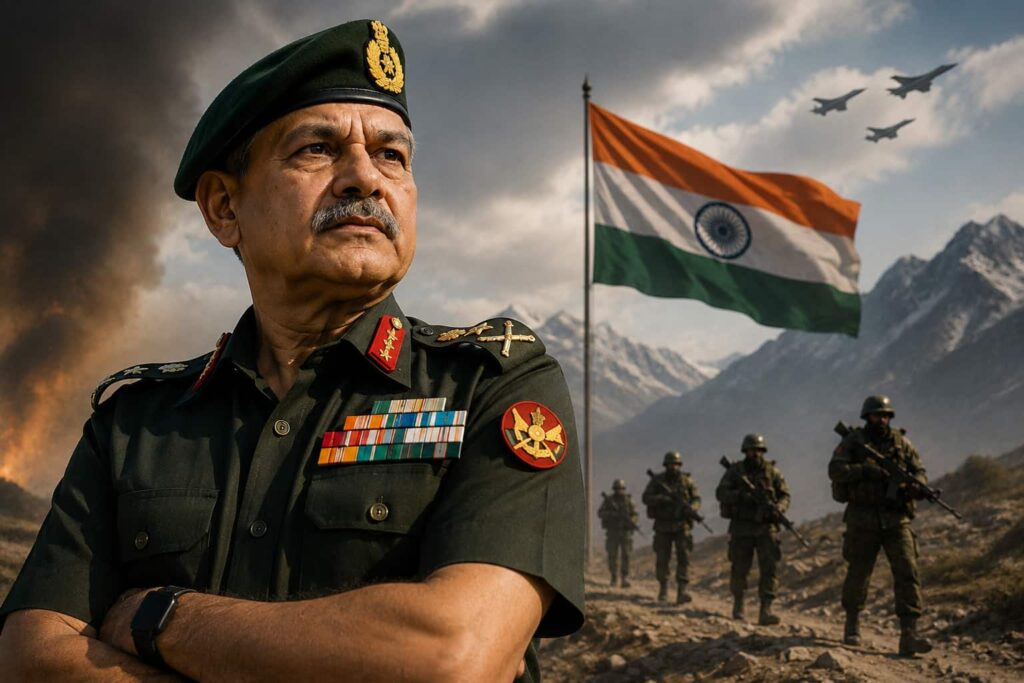
That is also why the timing of the remarks matters.
The anniversary of Operation Sindoor gave the statement symbolic strength. Anniversaries in national security are not only about memory. They are also about reminding both the domestic audience and the external adversary what that event came to represent. In this case, the reminder is that India is not eager for escalation, but neither is it willing to normalise terror as background noise. That difference is important. A country can seek peace and still insist on deterrence. In fact, deterrence often exists to prevent the next cycle of violence.
This is where the debate often becomes simplistic in public discussion. Some people hear a strong military statement and immediately assume it means war is imminent. Others dismiss it as only rhetoric. Both readings miss the point. A professional military statement of this kind is usually neither emotional chest-thumping nor a direct announcement of immediate action. It is a warning rooted in doctrine. It tells the adversary that the space for miscalculation is shrinking.
For Indian citizens, this should be understood as part of a larger security shift rather than a one-day headline.
The real significance lies in how the country now describes terrorism. Earlier, attacks were often framed mainly as security incidents requiring investigation, diplomacy and internal response. Now the language is more integrated with national defence logic. Terror is being placed in the same frame as strategic provocation. That changes the conversation. It raises the threshold of seriousness and makes it harder for the other side to assume that deniability or proxy distance will automatically shield it from consequence.
This also has an emotional dimension for soldiers, veterans and their families. For them, terrorism is not an abstract foreign policy issue. It is tied to real sacrifice, operational strain and the constant risk faced by personnel in sensitive areas. A clearer national response posture can therefore carry morale value. It tells those on the front line that the cost they bear is recognised within a broader doctrine of action, not just words.
At the same time, responsible national security analysis must remain disciplined. A stronger message does not mean India has abandoned measured judgment. It means India wants to widen the range of consequences available to it. The most effective deterrence is often not reckless. It is controlled, deliberate and credible. That is why the Army Chief’s message should be seen as firm, not impulsive.
There is another reason this matters. In today’s environment, public messaging itself is part of strategic competition. After every operation or crisis, a parallel battle begins over interpretation. Governments speak, media narratives evolve, hostile propaganda appears and public opinion becomes contested territory. In that setting, authoritative statements from senior military leadership do more than express intent. They help shape the narrative around what India sees as acceptable and what it considers intolerable.
So what is the plain meaning of this moment?
It means India wants the line to be visible. If terrorism against India continues, the expectation of business-as-usual cannot continue with it. The country is telling its adversaries that the cost of allowing such networks to function may rise. It is also telling its own people that the national response framework is changing from passive endurance to active deterrence.
That is the real value of the Army Chief’s latest warning.
It is not just a sharp sentence delivered at a public event. It is part of a larger message that India wants to send after Operation Sindoor and after years of dealing with terror-linked threats. Peace remains the preferred condition, but peace without accountability is no longer being projected as sustainable. In that sense, the statement marks more than anger. It marks a harder strategic line.
And that may be the clearest takeaway of all. India is not only warning against terrorism. It is redefining the terms on which future provocations will be judged.



Leave a Reply