

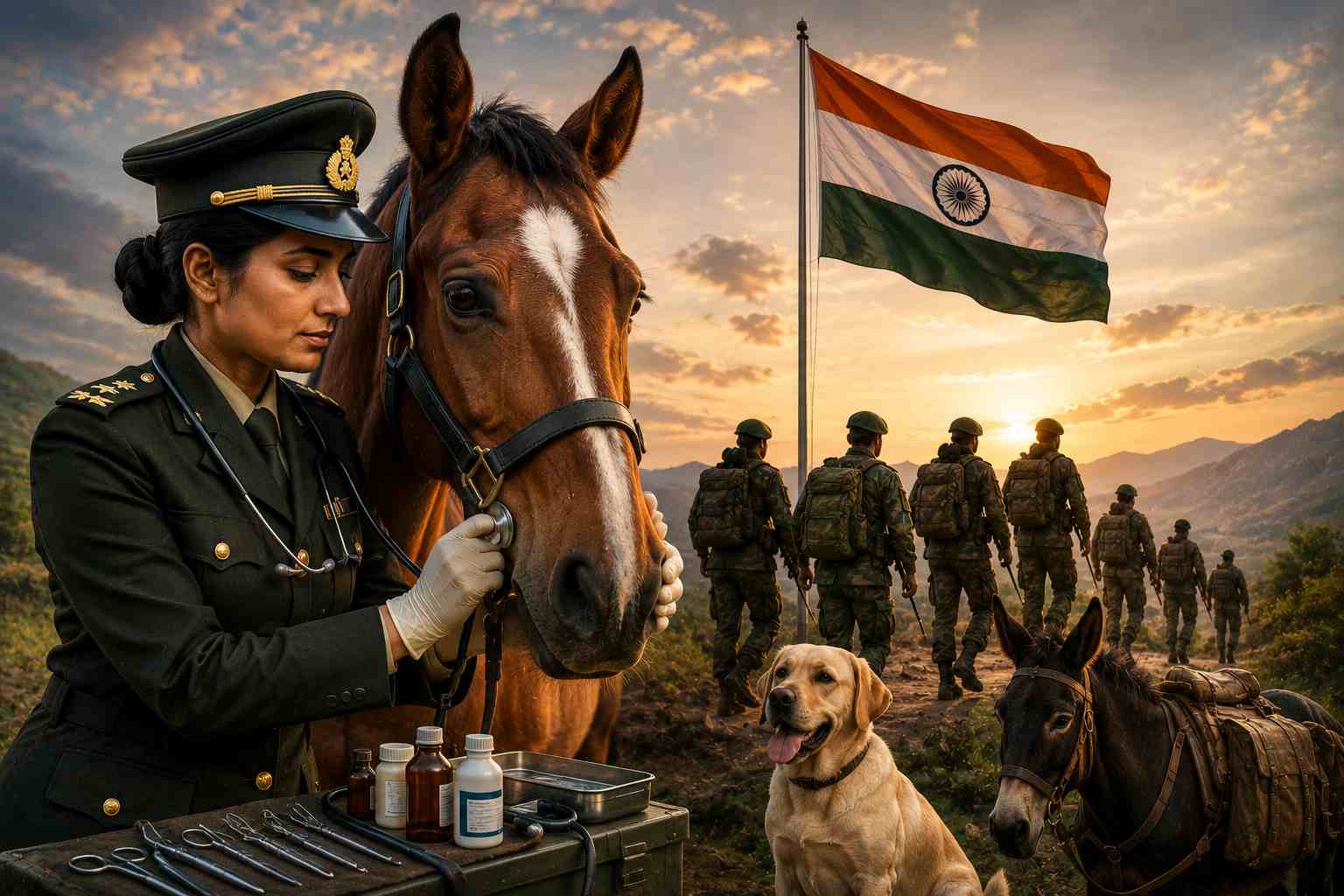
For many young people, an Army career is usually associated with NDA, CDS, infantry, armoured corps or technical entries. Very few realise that the Indian Army also offers officer-level openings for qualified professionals in specialised branches. One such route is the Remount and Veterinary Corps, often known simply as RVC.
That is what makes the RVC SSC 2026 entry important.

This is not a regular recruitment drive for general applicants. It is a focused opportunity for veterinary graduates who want to use their professional qualification in military service. In simple terms, it is a path for those who have studied veterinary science and now want to wear the uniform as officers.
That combination makes the entry special.
A veterinary graduate usually thinks of clinics, livestock care, research work, state services, private practice or academic work. The Army opens a very different possibility. It allows such a candidate to take his or her professional training into a disciplined defence environment where responsibility goes far beyond a normal workplace role. The person is not just joining as a veterinarian. The person is entering as a commissioned officer in a specialised branch of the Indian Army.
That difference matters.
The Remount and Veterinary Corps has a unique role within the Army structure. While many people think of modern warfare only in terms of weapons, vehicles and technology, the military still depends on a much wider ecosystem. In difficult terrain, remote zones, ceremonial functions, equestrian requirements and certain support roles, animal management and veterinary expertise continue to carry importance. This is where RVC officers become valuable.
In other words, the branch may not receive the same public attention as combat arms, but its role remains meaningful and professional.
That is why this recruitment should not be seen as a niche vacancy with limited relevance. It is actually a serious career option for the right category of candidate. A veterinary graduate who joins through RVC enters a service environment built on discipline, leadership, mobility, adaptability and long-term responsibility. The role demands professional knowledge, but it also demands the mindset of an Army officer.
This is exactly where many aspirants misunderstand specialised entries.
Some assume that if the entry is based on an educational qualification, then academic eligibility alone is enough. But the Army does not select only a degree holder. It selects an officer. That means the candidate must be able to handle pressure, communicate with confidence, show decision-making ability, adapt to military life and carry the discipline expected in uniform. A strong academic background is essential, but it is only one part of the profile.
The other part is officer-like quality.
That is why the RVC entry should be approached seriously. It is not simply about filling a form before the deadline. It is about understanding whether the candidate is genuinely prepared for the life that follows selection. Military service comes with structure, responsibility, movement, pressure and expectations that are very different from ordinary civilian work. A candidate who sees this only as a government job may not be understanding the opportunity fully.
A candidate who sees it as service, however, will understand why it matters.

Another reason this recruitment deserves attention is because it remains unfamiliar to many eligible students. Every year, large numbers of aspirants prepare for highly visible defence entries, while some specialised opportunities remain underexplored simply because awareness is low. Veterinary graduates often do not know that their professional degree can open a direct Army path. By the time they hear about it, deadlines are close and preparation becomes rushed.
That is why time-sensitive awareness becomes important.
Anyone interested in this route should first do the basics properly. Check the official Army recruitment notification, confirm educational eligibility, verify age conditions, keep required documents ready and avoid waiting until the last date. When an application window is short, last-minute delays can create unnecessary problems. Internet issues, upload failure, login trouble or document mismatch can spoil the process for otherwise eligible candidates.
A serious aspirant should behave like a serious applicant from the beginning.
That means keeping degree details, identity records, date of birth proof, photographs, signatures and other required papers organised in advance. It also means checking whether names, dates and qualification details match across documents. Small inconsistencies often cause larger trouble later. Candidates who are disciplined at the application stage usually handle the later stages with better confidence as well.
And the later stages matter a lot.
Selection in such an entry is not limited to document submission. It is a full military selection process. That means candidates should think ahead to screening, interview, medical standards, personality assessment and the broader expectations of officer entry. A person may be academically strong and still fall short if confidence, communication, mental sharpness or composure are missing. The Army’s requirement is complete, not partial.
For this reason, aspirants should not only focus on the form. They should also begin preparing themselves mentally for the nature of the selection.
This is also an important opportunity for families to understand. Many parents naturally guide veterinary graduates toward safer and more predictable civilian paths. But a defence entry like RVC offers something different: professional respect, officer status, national service and a structured career environment. It may not suit everyone, but for the right candidate it can become a highly meaningful route.
That is why this entry should be discussed not only as a vacancy but as a career decision.
For readers of a general-interest website, the bigger takeaway is that the Indian Army functions through many specialised streams that the public often overlooks. Combat arms may receive the most attention, but the Army’s strength depends on a broad network of professional branches and specialist officers who help keep the system effective. RVC is part of that wider backbone.
It shows that military service is not one-dimensional.
A modern Army requires medical expertise, technical knowledge, logistics support, legal input, engineering ability and specialised scientific roles. Veterinary officers are part of that larger framework. Their contribution may not always appear in headlines, but it remains connected to operational readiness, support systems and military professionalism.
That is why the RVC SSC 2026 route deserves to be taken seriously by eligible graduates.
It is rare, specialised and time-bound. More importantly, it offers something that many professional careers do not: the chance to combine education with uniformed service. For a candidate who wants both purpose and profession in one path, that can be a powerful opportunity.
The final message is simple.
If you are an eligible veterinary graduate and you have ever thought about serving in uniform, do not ignore this route just because it is less publicised than other Army entries. Read the official notification carefully, prepare your documents properly, apply through the correct portal and treat the process with the seriousness it deserves.
Because for the right candidate, this is not just another application deadline.
It may be the beginning of an Army officer’s journey.


Leave a Reply