


For most pension stories, the biggest attention goes to the widest category. If a new DR or DA order affects lakhs of people, headlines spread immediately. But some of the most meaningful pension developments are the quieter ones, the orders that matter deeply to a smaller group that is often ignored in mainstream coverage.
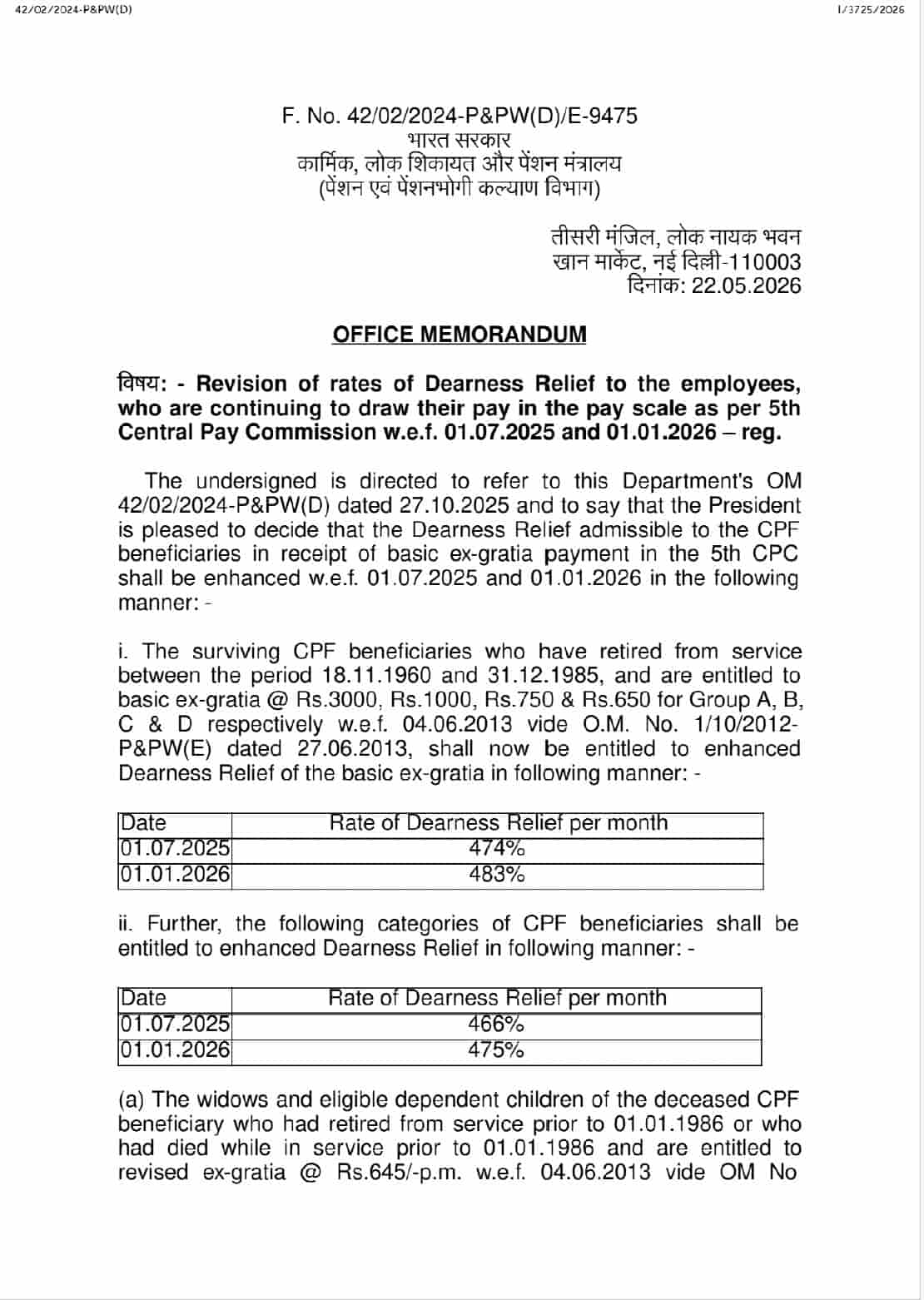
The 22 May 2026 order from the Department of Pension and Pensioners’ Welfare is one such case. It is official, it is new, and it has real value, but only if readers understand correctly who it applies to and who it does not. The circular is officially listed in the DOPPW circular system and on the Pensioners’ Portal, which confirms that this is not a rumour or a forwarded social media claim.
At first glance, the subject line may make some readers think this is a broad Dearness Relief revision for all old pensioners linked to the 5th CPC series. But once you study the actual order carefully, the picture becomes much clearer. The body of the Office Memorandum says the revised DR is meant for CPF beneficiaries in receipt of basic ex-gratia payment in the 5th CPC series, not for the entire pensioner population in one sweep. That distinction is the most important part of the story.
This is why careful storytelling matters.
If this order is written as a general DR update for all central government pensioners, readers will be misled. If it is written properly, however, it becomes a very strong welfare clarification for a smaller but important pension-linked category. In pension reporting, accuracy is often more valuable than excitement, especially when the affected readers are elderly beneficiaries, widows or dependents trying to understand whether a circular applies to them.
So what does the official order actually say?
The Office Memorandum, bearing file number 42/02/2024-P&PW(D)/E-9475 and dated 22 May 2026, says the President has approved enhanced Dearness Relief for CPF beneficiaries receiving basic ex-gratia payment in the 5th CPC series with effect from 01.07.2025 and 01.01.2026. The order also spells out the categories and the revised rates.
For one category, the order says the surviving CPF beneficiaries who retired between 18 November 1960 and 31 December 1985 and receive the specified ex-gratia amounts will now get DR at 474% from 01.07.2025 and 483% from 01.01.2026. That is the first major operative part of the circular.
For another listed category, the order gives DR at 466% from 01.07.2025 and 475% from 01.01.2026. This second category includes widows and eligible dependent children of deceased CPF beneficiaries who retired before 01.01.1986 or died while in service before that date, and certain earlier CPF-linked retirees receiving ex-gratia payment under the old framework.
That makes this circular meaningful in a very specific way.
It is not a big headline for the entire pension universe, but for the families covered by it, it is a practical and official relief update. In many such cases, the beneficiaries are older, the family history is complex, and the entitlement category itself is not always well understood even by the people receiving it. That is why a clean explanation is often more useful than a dramatic headline. This is an inference based on the narrow beneficiary structure described in the official order.
Another important point in the order is procedural. It says the amount of Dearness Relief should be rounded up where necessary and that the pension disbursing authorities, including nationalised banks, will calculate the relief in each individual case. It also says the order is issued in pursuance of Ministry of Finance OMs dated 06.10.2025 and 22.04.2026, which shows that the 22 May circular is part of a documented administrative chain, not a one-off note.
This helps us understand the real significance of the circular.

The value of the order lies not only in the rate revision itself, but in the fact that this old category has not been forgotten in the pension system. In public debate, people often assume pension reform only moves in the largest and loudest segments. But government pension administration also continues to issue category-specific orders for legacy groups whose cases remain alive within the system. This order is one such example. That is an inference from the continuing official listing of similar CPF/ex-gratia DR orders in the DOPPW circular archive.
For website readers, the practical takeaway is simple.
If someone is a regular 7th CPC pensioner or family pensioner, this circular should not automatically be read as a new universal DR order for them. But if the person belongs to the old CPF/ex-gratia beneficiary stream, or is a widow or eligible dependent within the categories named in the order, then this circular becomes very important and may directly affect the amount payable.
That is also why this story has a strong human angle.
Behind every such narrow official order is a group of people who are rarely part of mainstream pension headlines. These are often old beneficiaries, widows or dependent family members who are not tracking every new circular every week. For them, a properly explained website article can be more valuable than a dozen sensational updates that do not apply to their case at all. This is an interpretive point, but it follows directly from the beneficiary categories and the niche nature of the order.
The best way to frame this story, therefore, is not as “big DR relief for all pensioners.” The stronger and more honest framing is this:
the government has issued a fresh official DR order for a limited old CPF/ex-gratia pension-linked category, and those affected should check it carefully instead of assuming it is either irrelevant or universal. That is what makes the story both useful and trustworthy.
In the end, this is the kind of pension story that deserves space precisely because it is smaller, more technical and easy to overlook. Not every meaningful welfare update arrives with a national headline. Some of them arrive quietly through an Office Memorandum, and their value lies in reaching the exact families who need them. The 22 May 2026 DOPPW circular is one such case.


Leave a Reply