

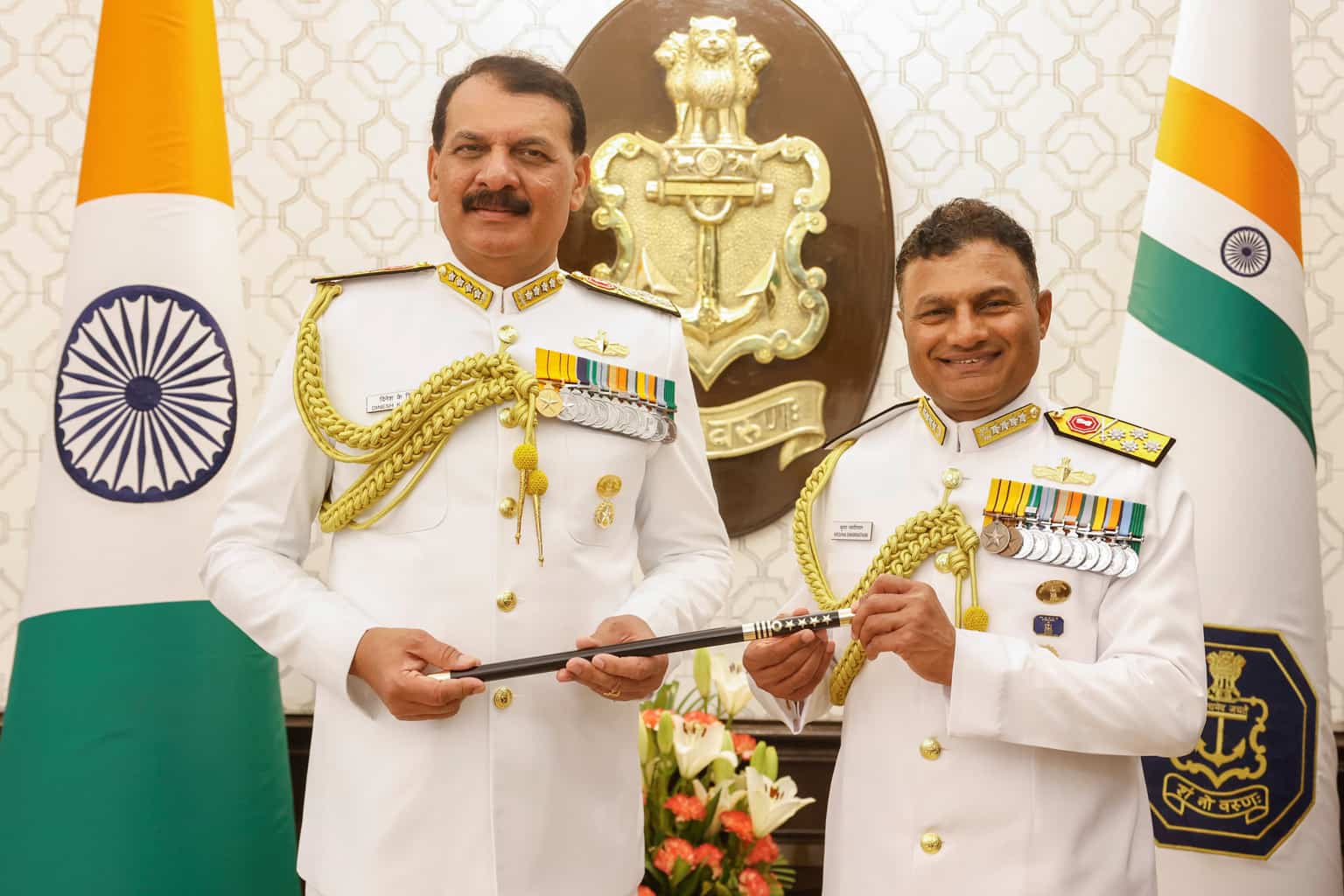
Admiral Krishna Swaminathan has assumed charge as the 27th Chief of the Naval Staff. This is not just a change of command in the Indian Navy. It comes at a time when India’s maritime security, Indian Ocean strategy, naval modernisation, jointness and technology-driven warfare are becoming central to national defence.
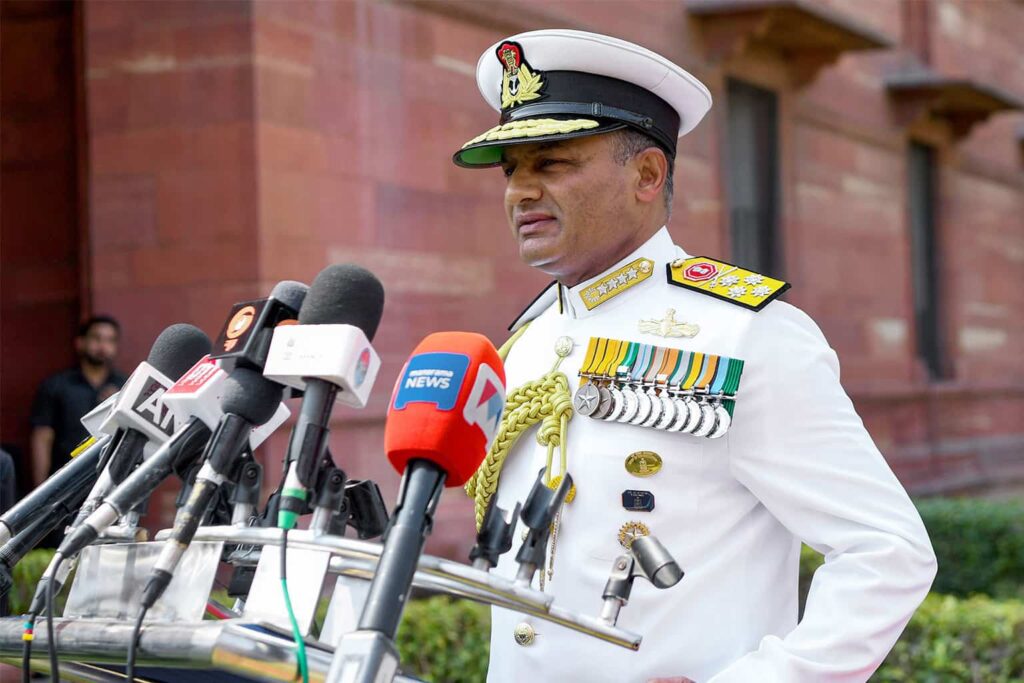
When people think about national security, they often imagine soldiers at the border, fighter jets in the sky or tanks moving across difficult terrain.
But for India, a large part of security also begins at sea.
The sea carries India’s trade, energy supply, merchant shipping, port activity, island security and wider strategic influence. Oil tankers, cargo ships, undersea routes, naval bases and maritime chokepoints may not be part of daily public conversation, but they quietly affect the country’s economy and security every single day.
That is why the appointment of a new Chief of the Naval Staff is not a routine defence update.
Admiral Krishna Swaminathan taking charge as the 27th Chief of the Naval Staff should be seen as an important moment for India’s maritime future. PIB has confirmed that he assumed charge on 31 May 2026, succeeding Admiral Dinesh Kumar Tripathi, who superannuated after 41 years of service.
The basic news is simple: India has a new Navy Chief.
But the real story is deeper.
This leadership transition comes at a time when the Indian Navy is expected to remain ready across a complex maritime environment. The Indian Ocean Region is no longer a quiet security space. It is now linked with great-power competition, China’s naval presence, Pakistan-facing maritime concerns, submarine activity, drone threats, cyber and electronic warfare, piracy risks, trade route security and regional partnerships.
In such a situation, a Navy Chief’s role goes far beyond ceremony.
The Chief of the Naval Staff is responsible for combat readiness, maritime planning, future force structure, modernisation, operational posture, manpower direction and coordination with the Army and Air Force. He does not only lead ships and submarines. He leads the force that protects India’s maritime interests.
Admiral Swaminathan’s background makes this appointment especially relevant.
Before taking charge as Navy Chief, he served as Flag Officer Commanding-in-Chief of the Western Naval Command. PIB’s appointment release also noted that he is a specialist in Communication and Electronic Warfare and was commissioned into the Indian Navy on 1 July 1987.
These details should not be treated as routine biography.
Western Naval Command is one of the most sensitive operational commands of the Indian Navy. It is linked with the Arabian Sea, the western seaboard, offshore energy assets, trade routes, naval bases and Pakistan-facing maritime security. A commander who has led this command brings experience from a theatre where operational alertness and maritime awareness are extremely important.
His specialisation in Communication and Electronic Warfare is equally important.
Modern naval warfare is not only about bigger ships or longer-range missiles. It is also about who can detect first, communicate securely, protect networks, resist electronic interference, coordinate faster and make decisions under pressure. A modern warship is not only steel and weapons. It is a moving network of sensors, radars, communication systems, electronic systems, command links and weapons.
If communication is disrupted, if electronic systems are jammed, if networks are targeted or if surveillance is compromised, the battlefield can change quickly.
That is why this professional background matters in today’s naval environment.
The Navy’s future will be shaped not only by ships, submarines and aircraft, but also by information, sensors, drones, cyber resilience, electronic dominance, space-based support and secure communication. Admiral Swaminathan’s career profile fits this direction of future maritime warfare.
His first message after taking charge also gives a clear indication of priorities.
Reports say Admiral Swaminathan emphasised operational readiness and combat effectiveness after assuming command. He also highlighted “JAI,” meaning jointness, atmanirbharata and indigenisation, as key ideas for the Navy’s direction.
These words matter.
Operational readiness means the Navy must be prepared before a crisis begins. A force does not become ready on the day of conflict. Readiness is built every day through training, maintenance, exercises, logistics, technology upgrades, morale, leadership and clear command direction.
Combat effectiveness means the Navy must not only possess platforms, but must be able to use them effectively in real operational situations. A ship, submarine or aircraft is valuable only when the crew, systems, weapons, communication and command chain work together under pressure.
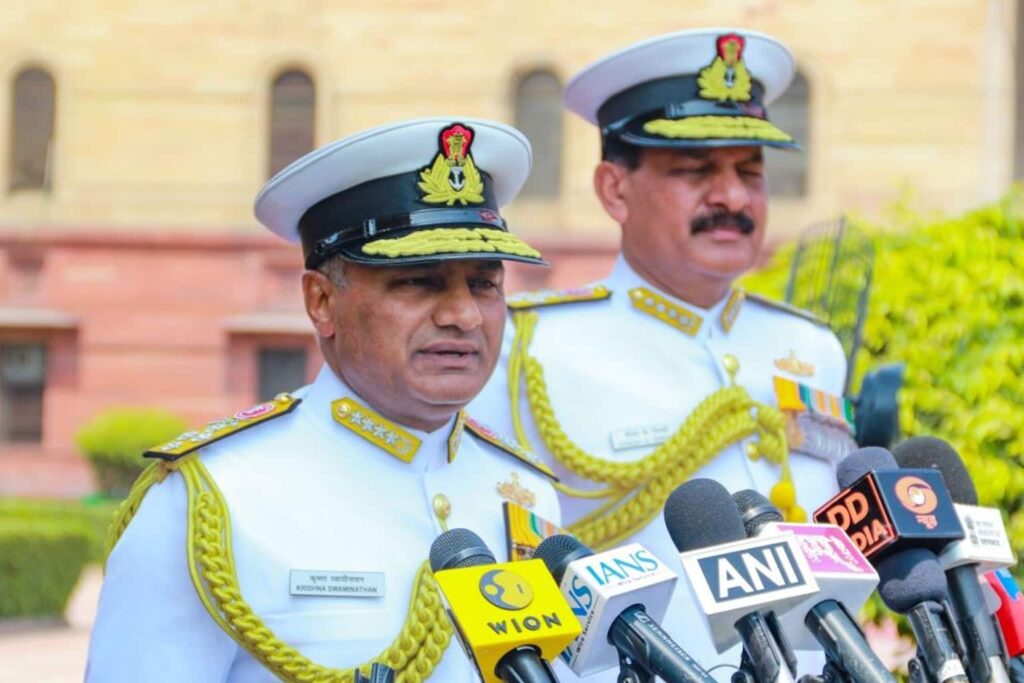
Jointness means the Navy cannot operate in isolation from the Army and Air Force. Future conflict may require land, sea, air, cyber, space and electronic systems to work together. A maritime crisis may need air power, satellite support, land-based surveillance, cyber protection and diplomatic coordination.
Atmanirbharata and indigenisation are equally strategic.
For a Navy, self-reliance is not only a slogan. Naval platforms take years to build and decades to serve. Ships, submarines, sensors, engines, weapons and communication systems require long-term support. If a country depends too heavily on foreign systems, supply chains can become a weakness during crisis.
Indigenisation strengthens national control over technology, maintenance, upgrades and future capability.
This is why Admiral Swaminathan’s leadership phase can be understood through one central word: readiness.
India needs a Navy that can see farther, respond faster, communicate securely, operate jointly and build more capability at home.
For common citizens, this may still sound like a distant defence subject. But maritime security is directly connected with daily life.
India depends on sea routes for trade and energy. A disturbance at sea can affect fuel supplies, imports, exports, logistics, ports and the wider economy. The Navy protects not only India’s coastline but also the movement that keeps the economy connected with the world.
In simple terms, the Navy is not only defending water. It is defending trade, energy and national stability.
The Indian Ocean is also becoming a major space for strategic influence. Countries are increasing naval presence, expanding partnerships, monitoring sea lanes and strengthening maritime infrastructure. For India, the ocean is not just geography. It is a security responsibility.
That is why the Navy Chief’s appointment matters beyond defence circles.
This news also carries an important message for defence aspirants. The future officer will need more than courage and discipline, though both remain essential. Future military leadership will demand understanding of technology, cyber-electronic threats, communication security, drones, artificial intelligence, sensors, joint operations and information warfare.
A young naval officer may have to understand ship handling, but also electronic warfare. He may have to lead sailors, but also work with aircraft, submarines, satellites and unmanned systems. He may have to take decisions in an environment where information moves quickly and mistakes can have strategic consequences.
Admiral Swaminathan’s profile shows that professional depth matters. Specialisation matters. Technology awareness matters.
For serving personnel and veterans, a change of command carries another meaning. It signals priorities. It tells the force what will be emphasised. It shapes training culture, operational focus and long-term thinking.
In this case, the visible focus appears to be readiness, combat effectiveness, jointness and self-reliance. These are not decorative phrases. They are the pillars of a modern Navy.
The appointment also comes at a time when India is giving more attention to tri-service coordination and future theatre-level thinking. Maritime threats cannot be seen separately from air, land, cyber and space dimensions. A future warning sign may not always be a visible warship. It could be a drone movement, an electronic signal, a suspicious vessel, a submarine contact, a cyber probe or sudden pressure on trade routes.
The Indian Navy must therefore prepare for a battlefield that is faster, more networked and more transparent than before.
This is why the blog around Admiral Swaminathan’s appointment should not be written only as a profile article. His awards, career and appointments are important, but the larger story is India’s maritime future.
The appointment is the news.
The real issue is what kind of Navy India needs in the coming years.
India needs a Navy that can protect trade routes, secure island territories, support regional partnerships, respond to crises, build indigenous capability and operate effectively with the other services. It needs leadership that understands both traditional seamanship and modern electronic warfare.
Admiral Krishna Swaminathan’s appointment should therefore be read as a leadership transition at a crucial moment for India’s sea power.
The correct tone is balance.
This is not a moment for exaggerated claims. It is not only a ceremonial handover. It is not just a biography of a senior officer. It is a serious defence development connected with maritime security, naval readiness and technology-driven warfare.
For Sainik Welfare News readers, the takeaway is clear. The Indian Navy is entering a phase where ships and submarines will remain important, but networks, sensors, electronic warfare, joint planning and indigenous systems will become equally important.
A Navy Chief’s appointment is not only about who wears the rank.
It is about what direction the fleet takes under his command.
The sea may look calm from the shore, but for a maritime nation like India, it is a living security front. With Admiral Krishna Swaminathan taking charge, the Indian Navy enters another important chapter where readiness, technology, jointness and self-reliance will remain in sharp focus.
Sources:-
Official PIB release: Admiral Krishna Swaminathan assumes charge as 27th Chief of the Naval Staff
https://www.pib.gov.in/PressReleasePage.aspx?PRID=2267227&lang=1®=3
Official PIB release: Vice Admiral Krishna Swaminathan appointed as Chief of the Naval Staff
https://www.pib.gov.in/PressReleasePage.aspx?PRID=2259243
Times of India report on Admiral Swaminathan’s first message after taking charge
https://timesofindia.indiatimes.com/defence/news/navy-will-maintain-highest-level-of-operational-readiness-combat-effectiveness-admiral-swaminathan-after-taking-charge/articleshow/131421714.cms





Leave a Reply