

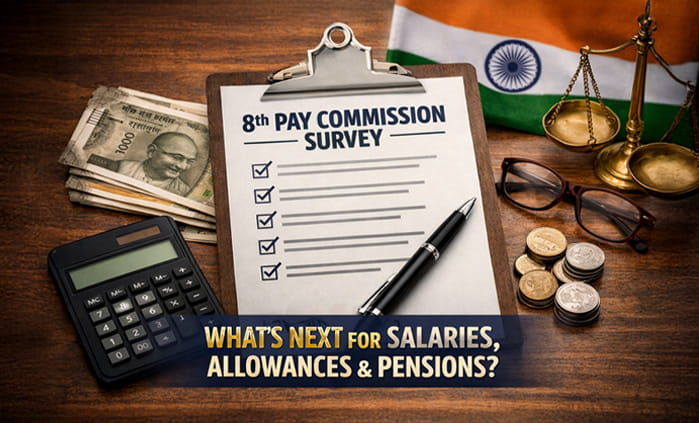
The 8th Pay Commission’s feedback exercise may have closed on March 31, 2026, but the larger significance of that consultation is only becoming clearer now. What looked, at first glance, like a routine online questionnaire was actually a carefully designed signal of the issues the Commission considers most important. The official 8th CPC portal and MyGov page show that the exercise was built around 18 structured questions and invited responses from a wide range of stakeholders, including employees, pensioners, associations, unions, judicial staff, researchers, academicians and interested individuals. The Commission also made it clear that responses would be accepted only through the MyGov portal.
That point matters because it tells us this was not merely a symbolic consultation. The format was formal, time-bound and selective in its process. The public-facing questionnaire opened on February 5, 2026 and closed on March 31, 2026 at 11:45 PM IST, while a separate route was provided for authorized or nominated nodal officers of ministries, departments and Union Territories. In other words, the Commission was trying to capture both institutional feedback and individual responses in a structured way.
What makes the exercise especially interesting is the kind of questions that were asked. The Commission did not begin with a narrow question like how much salaries should increase. Instead, it appears to have started from a broader policy lens: how should employee expectations be balanced against inflation, fiscal pressures, development expenditure and the wider economy? That framing is important because it shows that the Commission is not viewing pay revision only as a payroll issue. It is treating it as part of a larger economic and administrative decision.
The questionnaire then moved toward the structure of government pay itself. It raised questions around comparisons with the public and private sectors, the logic of the fitment factor, the way top-level salaries should be determined and whether annual increments should remain uniform or vary by grade or service conditions. These are not cosmetic questions. They go to the heart of how the next pay structure could be designed. A commission that asks such questions is not just looking for a percentage increase. It is testing whether the existing salary architecture still reflects present-day realities.
Another major takeaway from the consultation is that allowances remain a live issue. The Commission asked whether the current allowance structure should continue in its present form or whether a more flexible model could be considered. This matters because allowances often shape the real take-home value of a pay package, especially in a system where different roles, geographies and service conditions create very different pressures on employees. The fact that this issue was directly included suggests that the 8th CPC may not treat allowances as a side topic. It may see them as a central part of compensation reform.
Pension emerged as an equally serious concern. Reports on the questionnaire highlight that the Commission explicitly drew attention to the growing pension burden, with the number of pensioners standing close to 70 lakh against roughly 50 lakh central government personnel in 2025-26. Even more importantly, the questions were framed in a way that suggests the Commission is thinking about long-term sustainability, not just immediate payouts. That makes pension one of the most sensitive and consequential areas to watch in the months ahead.
The consultation also hinted at a possible rethinking of how dearness compensation and wage protection should evolve. One of the notable discussion areas was whether the future approach should remain tied mainly to inflation or move toward a broader model that also considers formal sector wage growth. If that direction gains traction, it could reshape how people think about compensation revision under the 8th CPC. Instead of being seen only as a response to rising prices, pay revision could increasingly be framed as a wider exercise in aligning government compensation with changing labour-market conditions. That is not yet a conclusion, but it is a meaningful possibility suggested by the way the questions were structured.
There was also a clear recognition that not every service can be treated identically. The questionnaire reportedly included distinct concern areas for defence forces, CAPF, railways and scientific departments. That is significant because these are large, influential and operationally diverse sectors. If the Commission is probing their needs separately, it may be testing whether the next pay framework should remain largely uniform or become more tailored in places where service conditions differ sharply. For defence personnel and pensioners in particular, this part of the exercise deserves close attention because it could influence future discussions on Military Service Pay, pay relativity and pension-related burdens.
What also stands out is that the consultation did not stop at salary and pension. It moved into deeper questions about the future of government service itself. Productivity-linked bonuses, performance differentiation, lateral entry, part-time work and flexi-time were all part of the broader discussion around reform. That suggests the Commission may be examining not just what the government pays, but how government work is evolving. It is a subtle but important shift. Pay commissions have traditionally been associated with wage revision, but this questionnaire indicates that the 8th CPC may be thinking in a more structural and forward-looking way.
For employees and pensioners, the real importance of this exercise lies in what it reveals. The questionnaire is effectively a roadmap of the pressure points the Commission is studying: pay fairness, inflation protection, allowances, pension burden, defence-specific concerns, performance incentives and administrative flexibility. Even though the response window is over, the questions themselves still offer a valuable preview of the debates likely to shape the final recommendations.
In that sense, the March 31 deadline was never the whole story. The more important story is what those 18 questions revealed. They showed that the 8th Pay Commission is not merely preparing for another routine salary revision cycle. It appears to be studying the deeper design of public compensation in India, including what should change, what should remain protected, and how the system can respond to modern economic and administrative realities. That is why this consultation deserves to be remembered not as a procedural formality, but as an early window into the thinking that may shape the next pay and pension era.
Want to know more? Watch the full video here:



Leave a Reply