

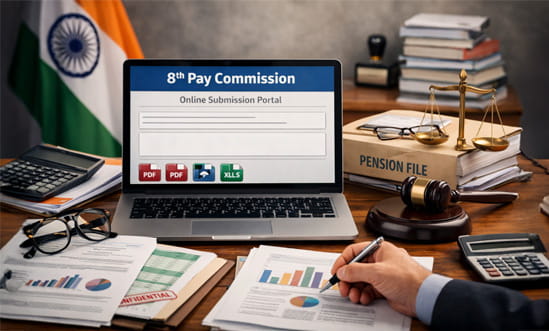
A useful and timely change has been made to the 8th Pay Commission’s online memorandum submission system, and it could make a real difference for central government employees, pensioners, and representative associations.
For weeks, many stakeholders had been pointing out that the original submission format was too restrictive. Important service matters such as pay revision, pension concerns, promotion-related issues, and allowance anomalies often need explanation, examples, and supporting documents. A limited space for writing and minimal upload support made that difficult.
Now, that problem appears to have been addressed.
The updated portal offers more room to explain issues in detail and allows users to attach a wider set of supporting documents. For anyone planning to send recommendations or highlight long-pending concerns, this is a significant improvement.
A practical improvement, not just a technical one
At first glance, an update to an online form may not seem like major news. But in the context of a Pay Commission, the quality of submissions matters a great deal. If employees and pensioners are unable to present their concerns properly, many valid issues risk being overlooked or misunderstood.
That is why this change matters.
The revised system now gives stakeholders the ability to write in a more complete and structured manner. Instead of compressing complex concerns into a short note, users can now describe the problem properly, explain how it affects a category of employees or pensioners, and suggest a reasonable remedy.
This is especially important because the 8th Pay Commission is expected to examine a wide range of issues, from pay matrix revision and fitment logic to allowances, retirement benefits, and career progression. Each of these subjects often involves detailed facts, department-specific conditions, and numerical comparisons.
What has changed on the portal
One of the most important upgrades is the increase in the writing limit. The portal now allows submissions of up to 10,000 characters. That is a major improvement over the earlier format, which left many users struggling to fit serious matters into a very short response.
This expanded space is likely to help those who want to raise issues related to minimum pay, annual increment patterns, pay level disparities, stagnation in service, HRA concerns, pension calculation problems, and other category-specific demands.
Another important update is in the attachment section. Users are now able to upload up to four PDF files along with one Excel file. This may prove extremely useful for those who want to submit not just opinions, but documented evidence.
For example, associations and employees can now attach comparison tables, departmental references, circulars, court orders, sample calculations, and other records that help support their demands. In many cases, well-organized documents speak more powerfully than long arguments.
Who can use the submission facility
The portal is open to different types of stakeholders, which makes the process more inclusive. Submissions can be made by individual citizens, serving employees, pensioners, unions, associations, ministries, departments, Union Territories, and judicial staff.
This wide eligibility is important because the impact of a Pay Commission does not remain limited to one service group. Its recommendations influence salary structures, pension outcomes, allowances, and service-related benefits across a large section of government-linked personnel.
As of now, the memorandum submission window is open until 30 April 2026. That means those who wish to make a submission should not delay unnecessarily.
What should people focus on in their memorandum
A strong submission should be focused, organized, and backed by facts. Instead of writing in broad or emotional terms, it is better to identify clear issues and explain them in a simple and direct manner.
Pay-related matters remain one of the biggest areas of concern. Many employees may want to comment on minimum pay, fitment factor, annual increments, pay matrix structure, or gaps between different levels and cadres. If there is a mismatch between responsibilities and pay, that should be shown with practical examples.
Allowances are another major subject. This includes HRA, dearness-related compensation, travel support, risk and hardship allowance, uniform-related expenses, deputation issues, and other work-condition-based benefits. In many departments, employees feel that the present allowance structure no longer reflects actual conditions on the ground.
Career progression is equally important. Matters linked to MACP, delayed functional promotions, cadre blockage, and stagnation often affect morale as much as salary. A well-drafted memorandum can help draw attention to these issues with much greater clarity.
Then there are retirement and post-retirement matters. Pension revision, gratuity, leave encashment, commutation, NPS, UPS, OPS, and OROP-linked complications continue to remain sensitive and relevant topics. These are not abstract issues. They directly affect financial stability and quality of life after retirement.
How to make the submission more effective
The updated portal gives people more flexibility, but that flexibility should be used carefully. A long memorandum is not automatically a strong memorandum. The real value lies in clear presentation.
The best approach is to explain the issue in a structured way. First, state what the problem is. Then explain who is affected. After that, describe what change is being sought and why that change would be fair and practical.
It also helps to include real examples. Mentioning a pay level, category, city classification, retirement year, or duty condition can make the issue more understandable. General complaints are easy to ignore. Specific cases are harder to dismiss.
The Excel upload option should be used wisely. Simple calculations, pay comparisons, pension impact tables, or allowance breakdowns can give extra weight to a submission. Similarly, PDFs should be reserved for useful documents such as official orders, departmental communications, judgments, or historical references.
Most importantly, the language should remain factual and solution-oriented. The aim is not just to complain, but to present a case that can be studied seriously.
Why this stage is important
There is one lesson that employees and pensioners have seen repeatedly over the years: when valid concerns are not recorded properly at the right stage, they often turn into long battles later.
Once recommendations are finalized and implemented, correcting anomalies becomes far more difficult. It may then require representations, follow-up appeals, litigation, or years of waiting for partial corrections.
That is why this update to the submission portal should be seen as a valuable opportunity. It gives stakeholders a better mechanism to put forward their points before the final shape of recommendations begins to harden.
Final thoughts
The 8th Pay Commission’s decision to improve its memorandum submission portal is a welcome move. By increasing the writing space and allowing more supporting files, the process has become more practical, more serious, and more useful for those who genuinely want their issues to be examined.
For employees, pensioners, and associations, this is the time to be clear, organized, and evidence-based. A properly prepared submission today could do far more than a protest after the report is released.
In matters of pay, pension, and service justice, timing and clarity often make all the difference.
Watch the full video for complete details!

Leave a Reply