

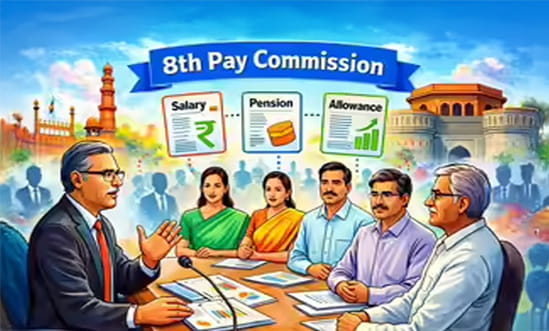
The discussion around the 8th Pay Commission is gaining momentum again, and this time the spotlight is on the 21-point demand charter reportedly submitted by the NCJCM draft committee. For central government employees and pensioners, this has become an important update because the proposals touch almost every major issue that affects service life and retirement security, from minimum pay and annual increments to pension, HRA, MACP, and leave benefits.
It is important to understand one thing at the very beginning. These are not the final recommendations of the 8th Pay Commission. They are proposals placed before the larger process. Even so, they matter because they show the direction in which employee-side representatives want the conversation to move.
That is exactly why this development is being discussed so widely.
A demand charter that goes far beyond salary revision
Whenever a new Pay Commission comes into focus, the public conversation usually revolves around basic pay and fitment factor. But the latest set of demands goes much further. It does not stop at salary revision alone. It also addresses pensions, family pension, promotion structures, retirement benefits, insurance, leave, compensation, and housing support.
This wider scope makes the draft especially significant. It reflects the fact that employees and pensioners are not just asking for a numerical revision. They are asking for a broader correction of long-standing concerns in the current system.
Minimum pay and fitment factor remain the biggest headline points
Among all the proposals, the demand for a minimum pay of Rs 69,000 has drawn the most attention. This figure is reportedly based on a family-of-five benchmark and is being seen as a strong attempt to reset the discussion around living costs, wage standards, and salary adequacy in the present economic environment.
Closely linked to this is the proposed fitment factor of 3.833 for serving employees as well as pensioners. This figure is crucial because fitment is the foundation of pay revision. It determines how existing salaries and pensions are translated into the new framework. A higher fitment factor naturally creates stronger expectations among employees, especially those who feel that earlier revisions did not fully address inflation and rising household expenses.
The draft also reportedly seeks implementation from January 2026, which makes the timing just as important as the figures themselves.
Pension proposals are likely to attract the strongest response
For pensioners, several of these demands could become central to the entire 8th CPC debate. The charter reportedly includes a proposal for pension at 67 percent of last pay drawn and family pension at 50 percent. These are major demands because they directly affect post-retirement financial stability.
Another sensitive issue is commutation restoration. The proposal seeks restoration after 11 years instead of 15 years, which is something many pensioners have been demanding for a long time. For retired employees, this is not just a technical correction. It is an issue linked to fairness and financial relief in old age.
There is also a call for restoration of the Old Pension Scheme for employees who joined after 1 January 2004. This keeps the OPS versus NPS debate alive and shows that pension reform remains one of the most emotionally and politically important subjects in government service.
MACP, increments, and career growth are also in focus
The draft does not only speak for pensioners. It also addresses the concerns of serving employees, especially those related to career progression. One of the major demands is five financial upgradations under MACP within 30 years of service. This proposal is likely to attract support from employees who feel that promotions and financial progression remain too slow under the current setup.
The suggestion of 6 percent annual increment, compared to the present 3 percent, is another proposal with long-term implications. A higher annual increment would affect not just take-home salary over time, but also eventual retirement benefits.
For many employees, these demands are just as important as the fitment factor because they shape the overall career journey, not just the starting salary under a new pay revision.
Welfare and family benefits form a major part of the charter
One of the more notable aspects of the 21-point demand list is its emphasis on employee welfare. The proposals reportedly include:
HRA at 40 percent for X cities, 35 percent for Y cities, and 30 percent for Z cities
Leave encashment ceiling increased from 300 to 600 days
Paternity leave of 45 days
Parents care leave of 60 days during the entire service period
Maternity leave of 240 days with removal of the two-child restriction
Bonus of at least 30 days based on actual basic pay plus DA
Higher insurance cover and enhanced compensation in case of on-duty death
These proposals suggest that the demand charter is trying to reflect the changing realities of work, family responsibility, and employee expectations. In that sense, it is not only about higher pay. It is also about building a more supportive service framework.
The proposal to merge 18 pay levels into 7 is a major structural idea.
Perhaps the most interesting part of the draft is the proposal to reduce the present 18 pay levels into 7 merged levels. This would be a major structural change in the pay matrix.
Supporters of such a move may see it as a way to simplify the existing system and reduce unnecessary complexity. But any such merger would also bring important questions. Would it create new anomalies? Would it compress pay differences between categories? Would it affect promotion value and seniority perception?
That is why this idea stands out. It is bold, but it would need very careful examination before it could ever be implemented.
What this means right now?
At the current stage, employees and pensioners should treat these proposals as an important development, but not as a final outcome. The 8th Pay Commission still has to examine different submissions, study the issues, and eventually frame its recommendations. After that, the government will decide what to accept.
Still, the significance of this draft cannot be dismissed. It clearly shows which issues matter most to stakeholders: pay revision, pension justice, promotion reform, housing support, family benefits, and correction of perceived imbalances in the current system.
Final word
The latest 8th Pay Commission update has added fresh energy to the conversation. The NCJCM draft committee’s 21-point charter is ambitious, wide-ranging, and clearly designed to push for a more meaningful revision of salaries, pensions, and service conditions.
Whether all these demands are accepted or not is a separate question. But one thing is certain: this charter has already set the tone for the debate ahead. For employees and pensioners across the country, it offers an early look at the kind of changes that many stakeholders want the 8th Pay Commission to seriously consider.
Watch our full video for complete details!





Leave a Reply