

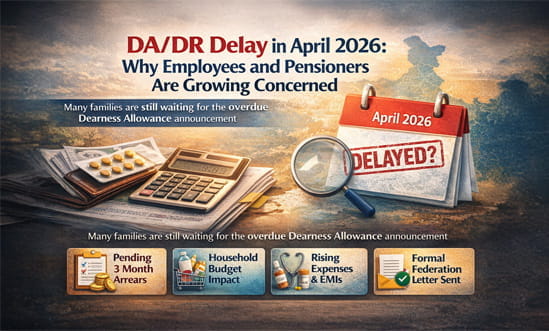
For most people, Dearness Allowance and Dearness Relief may sound like routine government terms. But for central government employees and pensioners, they are closely tied to everyday life. They affect monthly planning, family budgets, medicine expenses, school fees, loan payments, and many other household needs. That is why the current delay in the January 2026 DA/DR announcement has become such an important issue.
Usually, this revision follows a familiar pattern. Employees and pensioners expect the announcement around the end of March, and many also expect arrears to start moving soon after. Over time, this pattern has created a sense of predictability. Families plan around it. Pensioners wait for it. Employees mentally include it in their April budgeting. So when that routine cycle is disturbed, concern naturally begins to grow.
This year, that concern has become stronger because April is moving ahead, yet the expected declaration is still being awaited. What has made the issue even more significant is that the matter has now been formally raised before the Finance Minister through a federation letter dated 8 April 2026. That changes the tone of the discussion. This is no longer just informal office chatter or online speculation. The concern has now been expressed through an official representation.
At the heart of the issue is a very simple question: why has the usual DA/DR announcement not come yet? For employees and pensioners, the delay is not just about a government file moving slowly. It is about uncertainty. People are trying to understand when the revised rate will be declared and when the arrears will actually reach their accounts.
That is where the impact becomes real. Many families were expecting the usual three-month arrears benefit. For some households, that extra amount is meant for school-related expenses. For others, it helps manage increasing household costs, medical bills, transport, or monthly EMIs. In lower pay levels, even a few thousand rupees matter. For pensioners and higher pay bands, the amount can be larger and equally important. So when the expected timeline shifts, it is not just a technical delay. It directly affects financial comfort.
It is also important to understand what this delay does not mean. A delayed declaration does not automatically mean the benefit has been removed or denied. The entitlement depends on the notified rate once government approval is completed. So the present concern is not about losing DA or DR. The concern is about the timing of the order and the delay in arrears reaching employees and pensioners.
This is why so many people are following every update closely. Under the 7th Pay Commission system, DA and DR revisions are connected with CPI-IW based calculations and require formal approval before notification. In normal circumstances, employees expect movement by late March. But when that expected timeline passes without a clear order, the wait becomes more stressful. Questions begin to multiply. Has the file moved? Is Cabinet approval pending? Will the arrears come later this month? These are the doubts driving the public discussion right now.
The issue is affecting both serving staff and pensioners. DA applies to employees in service, while DR applies to pensioners. That means the delay is being felt across two very large communities at the same time. For working employees, it may disturb monthly planning. For pensioners, it may increase worry over fixed expenses, especially when prices of essentials and healthcare remain high. That is why the subject is getting attention far beyond one department or one employee group.
Another reason this story is connecting with so many people is that it feels personal. Government notifications are often seen as dry administrative matters, but this is different. A delayed DA/DR order is not just about numbers in a circular. It affects how families plan the month. It affects whether someone waits before buying medicines in bulk, whether a bill is postponed, or whether some financial breathing room is available in April. That is exactly why this issue is creating such a strong response.
At the same time, this is also the moment to stay careful and avoid misinformation. Delays often create space for rumours, exaggerated claims, and half-correct updates online. The smarter approach is to focus only on official developments. Once the order is issued, employees should check their payslips, pensioners should verify their pension slips or bank credits, and any mismatch can then be raised with the concerned DDO, PAO, bank, or pension disbursing authority.
The delay in the January 2026 DA/DR declaration has become a serious talking point because it affects real people in real ways. What may look like a routine announcement from the outside actually has a direct impact on monthly budgets, arrears expectations, and financial planning for millions of employees and pensioners.
Right now, the biggest issue is not entitlement, but uncertainty. People are still waiting for the official declaration, and until that happens, questions will continue. In a time when household expenses are already under pressure, even a routine DA/DR order carries much more weight than usual. That is why this update is being watched so closely, and why the final government announcement will matter to so many families across the country.
Watch the full video for complete details!


Leave a Reply