

A recent Pension Adalat success story has highlighted the release of ₹46.38 lakh disability pension arrears to an Indian Army personnel, along with the start of monthly pension. For defence pensioners, disabled veterans, family pensioners and widows, this case is an important reminder that pension records, arrears and grievances must be tracked carefully through official channels.
For a defence pensioner, pension is not only a financial benefit.
It is the result of service, sacrifice and years spent in uniform. It is connected with dignity after retirement, medical care, household needs, family support and long-term security. When a pension case remains pending, it is not just an office delay. It can disturb the daily life of an entire family.
This is why the recent Pension Adalat update from PIB deserves attention from the defence community.
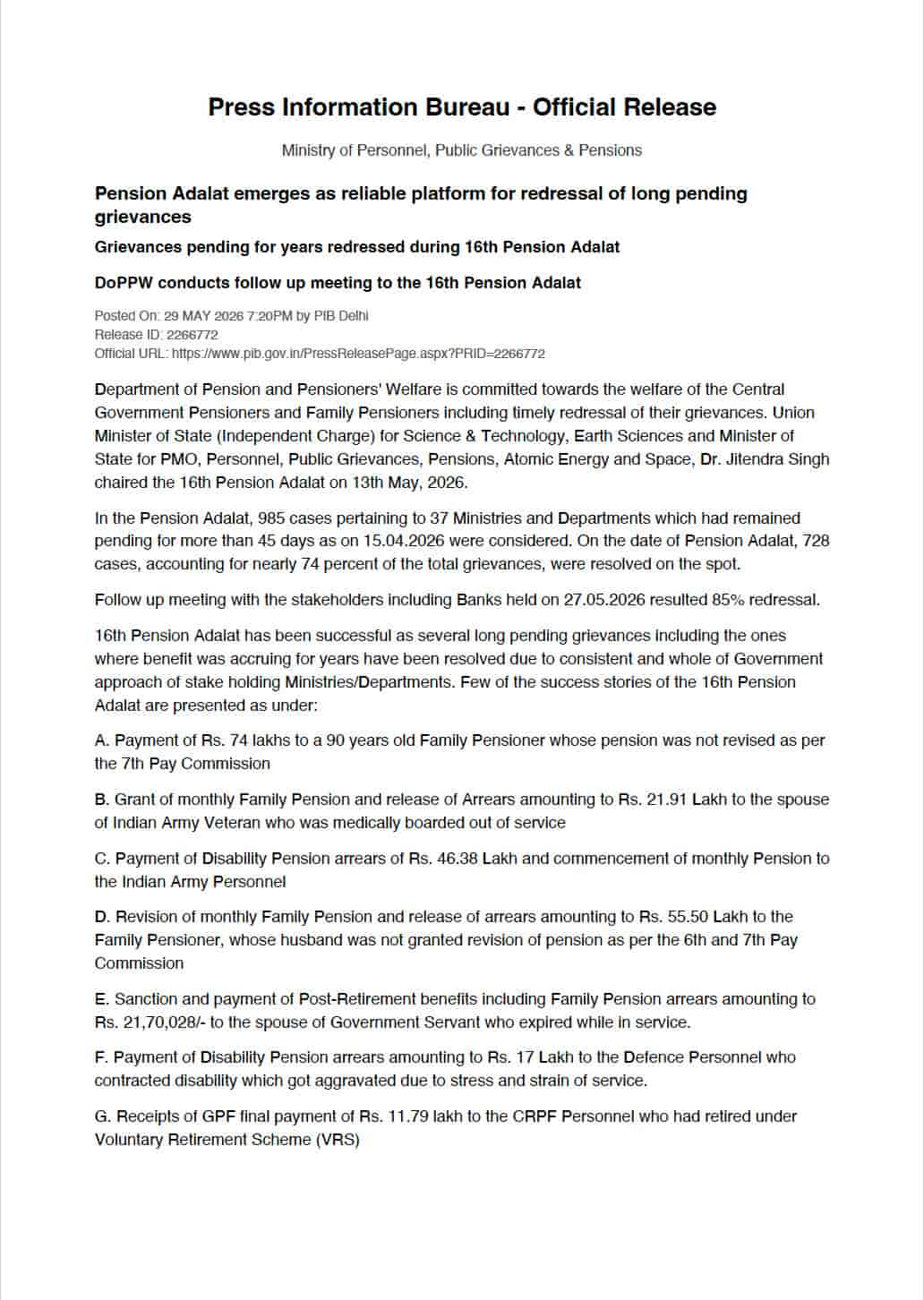
According to the official PIB release, disability pension arrears of ₹46.38 lakh were released to an Indian Army personnel, and the monthly pension was also started. The case was mentioned among the success stories of the 16th Pension Adalat conducted by the Department of Pension and Pensioners’ Welfare.
This is not just a story of one pensioner receiving arrears.
It is a reminder that many pension cases can remain stuck because of documentation gaps, delayed processing, unclear communication, bank-level issues, department-level pendency or missing follow-up. For a defence pensioner, especially a disabled veteran, such delays can become deeply stressful.
A disability pension is not a casual payment. It is linked with service conditions, medical findings, disability percentage, entitlement rules, pension sanction and long-term health support. If a disability is accepted as attributable to or aggravated by military service, the pensioner’s entitlement becomes a serious matter of rightful dues.
That is why a case where ₹46.38 lakh arrears were released should be read carefully.
It gives hope, but it also gives a warning.
The hope is that long-pending pension grievances can move when they reach the right platform. The warning is that pensioners and families should not assume that every due amount will automatically come without tracking, documents and follow-up.
What happened in the 16th Pension Adalat?
The 16th Pension Adalat was chaired by Dr. Jitendra Singh on 13 May 2026. As per the PIB release, 985 pension grievance cases from 37 Ministries and Departments were taken up. These were cases pending for more than 45 days as on 15 April 2026.
Out of these 985 cases, 728 cases were resolved on the spot, which is nearly 74 percent. Later, a follow-up meeting with stakeholders, including banks, was held on 27 May 2026. After the follow-up, overall redressal reached 85 percent.
These figures are important because they show that Pension Adalat is not merely a formal meeting. When cases are identified, reviewed and placed before the concerned authorities, pension grievances can move faster.
But the most important part is the Indian Army disability pension case where arrears of ₹46.38 lakh were released and monthly pension began.
For a defence family, this kind of case carries a direct message: do not let pension matters remain unattended.
Why this case matters for defence pensioners?
In many defence pension cases, the pensioner or family knows that something is wrong, but does not know where the problem is stuck.
Sometimes monthly pension does not start even after sanction. Sometimes arrears are not paid from the correct date. Sometimes a corrigendum PPO is issued but the bank does not reflect the change. Sometimes a disability pension matter remains pending between different offices. Sometimes the pensioner has documents, but the grievance is not written clearly enough.
This is where the problem becomes painful.
A retired soldier may visit the bank repeatedly. A family pensioner may be told to contact another office. A widow may not know whether the problem is with the record office, pension sanctioning authority, bank or online system. An elderly pensioner may not be able to chase the matter physically or digitally.
This is why pension awareness is as important as pension entitlement.
A rightful benefit can be delayed if the documents are incomplete, the grievance is not filed properly, or the family does not know the basic pension details.
The biggest lesson: Keep documents ready
The first major lesson from this case is documentation.
Every defence pensioner should keep pension papers safely and in an organised manner. This includes the Pension Payment Order, corrigendum PPOs, discharge or retirement documents, disability medical board records, bank pension details, pension slips, official letters, grievance numbers, earlier replies and pension revision documents.
In disability pension cases, medical and service-related records become especially important. These records can help show what was sanctioned, from which date it was applicable, what amount was paid and what arrears may still be pending.
Many pensioners lose time because documents are scattered.
One paper may be in an old file. Another may be with the bank. A copy of the PPO may be missing. The family may not know the grievance number. In such cases, even a valid pension issue becomes difficult to present.
A simple family-level pension file can make a big difference.

Families must know the pension details
The second lesson is family awareness.
In many defence families, only the pensioner understands the pension file. The spouse may not know the PPO number. Children may not know where disability pension papers are kept. Family members may not know whether the pension is being disbursed through bank channel, SPARSH or another system.
This can become a serious issue when the pensioner becomes elderly, unwell or unable to follow up personally.
Every defence pensioner should ensure that at least one trusted family member knows the basic pension details. The family should know where the PPO is kept, which bank account receives pension, whether there are corrigendum PPOs, whether disability pension is involved, and whether any grievance is pending.
This is even more important for family pension cases.
When the pensioner passes away, the spouse or family may suddenly have to handle pension conversion, bank formalities, life certificate, arrears and documentation. If the family has no knowledge of the records, the process becomes harder.
Other Pension Adalat cases also matter
The PIB release also mentioned other important cases connected with defence pension and family pension.
One case involved monthly family pension and arrears of ₹21.91 lakh granted to the spouse of an Indian Army veteran who was medically boarded out of service. Another case involved ₹17 lakh disability pension arrears where the disability was aggravated due to stress and strain of service. Another case involved ₹13.17 lakh family pension arrears to the spouse of an Army personnel, along with the commencement of monthly pension.
These cases show that pension delays can affect different categories.
Disabled personnel can be affected. Widows can be affected. Family pensioners can be affected. Retired personnel can be affected. In every case, the impact is not just financial. It is emotional and practical.
A delayed pension may mean delayed medical treatment. A pending arrear may mean family debt. A family pension delay may affect household survival. A disability pension issue may affect long-term care.
This is why pension grievance redressal should never be treated lightly.
What pensioners should not misunderstand?
The ₹46.38 lakh case is important, but it should not be misunderstood.
It does not mean every disability pensioner will receive the same amount. Pension arrears depend on several factors: rank, qualifying service, entitlement date, disability percentage, pension rules, revision orders, payment history and the period for which arrears are due.
So the message is not that every case will bring ₹46.38 lakh.
The real message is this: if a rightful pension benefit is pending, it must be identified, documented and pursued properly.
Each pension case is different. But every pensioner has the right to know whether the pension being paid is correct, whether arrears are pending, and whether sanctioned benefits have actually reached the bank account.
Why official grievance channels matter?
A pensioner should not wait silently if something is wrong.
If monthly pension has not started, it should be checked. If arrears are not received, it should be tracked. If disability pension has been sanctioned but not paid, it should be followed up. If family pension is delayed, the family should act through the proper channel.
The correct approach is to use official routes.
Pensioners should preserve written communication, grievance numbers, official replies and bank responses. A verbal complaint at a counter is often not enough. A written or online grievance creates a record.
This is where platforms like Pension Adalat, CPENGRAMS, SPARSH support systems, bank pension cells, record offices and official helpdesks become important. The exact route may depend on the type of pension and the department involved, but the principle is the same: keep proof, track status and follow up regularly.
Serving personnel should also learn from this
This case is not only for retired personnel. Serving soldiers should also understand its importance.
Pension problems often begin before retirement, when records are not checked carefully. Service details, family details, disability proceedings, medical documents, nomination records and bank information should be verified while still in service.
A small mistake in documents can become a major pension issue later.
Serving personnel should ensure that their family details are correctly recorded. They should preserve medical documents. They should understand the importance of disability-related records. They should keep their spouse informed about basic service and pension matters.
Pension awareness should not begin after retirement. It should begin before retirement.
Community support can reduce pension suffering
Many elderly defence pensioners are not comfortable with online systems. Some do not understand digital portals. Some widows do not know pension terminology. Some families do not know which document is important.
This is where community support becomes valuable.
Veteran groups, regimental networks, pension helpdesks, family members and informed volunteers can help elderly pensioners understand the process. They can help check documents, guide them on official channels and prevent them from falling into traps of fake agents.
But support must be responsible.
No pensioner should share OTP, banking passwords, ATM PIN, UPI details or sensitive personal information with unknown persons. Pension help should come through trusted and official routes only.
The human message behind the ₹46.38 lakh case
Behind this amount is not just a payment entry.
There is a soldier who waited. There may be a family that followed up. There may have been years of uncertainty. There may have been medical needs, household worries and repeated visits to offices or banks.
For a defence pensioner, delayed arrears are not only about money. They are about recognition. They are about whether the system has correctly honoured a service-linked entitlement.
This is why the case matters beyond the amount.
It tells defence pensioners that they should remain alert. It tells families that they must understand pension documents. It tells veterans that pending disability pension or arrear issues should not be ignored. It tells the system that structured grievance redressal can bring real relief.
Final takeaway for defence pensioners
The release of ₹46.38 lakh disability pension arrears through the 16th Pension Adalat is a strong reminder for all defence pensioners.
Check your pension records. Keep your PPO and corrigendum PPOs safe. Track disability pension and family pension issues. Preserve medical documents. Note grievance numbers. Do not ignore arrears. Help elderly pensioners and widows who cannot manage the process alone.
A defence pension is not charity. It is earned through service.
For a disabled personnel, pension may support medical care and daily life. For a family pensioner, it may be the main financial pillar of the household. For a veteran, it represents dignity after service.
One pending pension file may carry years of sacrifice, service and rightful dues.
That is why every defence pensioner should treat this case as a lesson: pension rights must be understood, documents must be protected, and grievances must be pursued through official channels.
Sources:-
https://www.pib.gov.in/PressReleasePage.aspx?
PRID=2266772https://www.scobserver.in/supreme-court-observer-law-reports-scolr/union-of-india-v-sgt-girish-kumar-limitation-for-entitlement-to-disability-pension/
https://indianexpress.com/article/legal-news/high-court-army-veteran-won-50-disability-pension-primary-hypertension-10714114/



Leave a Reply