

For many Central Government employees and pensioners, the 8th Central Pay Commission is not only about a future salary table. It is about household budgets, pension security, medical expenses, allowances, career progression, retirement dignity and the financial confidence of lakhs of families.
Every Pay Commission carries hope. Serving employees look at it through the lens of pay structure, increments, allowances and promotion-related issues. Pensioners look at it through pension revision, dearness relief, medical facilities, commutation, family pension and long-pending anomalies. Defence personnel, veterans and defence civilians look at it with another layer of expectation because their service conditions, risk factors and retirement issues are different from many civilian categories.
That is why even a small official notice from the 8th Central Pay Commission becomes important. The latest notice regarding the Commission’s visit to Lucknow, Uttar Pradesh, is not just a travel update. It is a clear signal that the consultation process is moving into a more active stage.
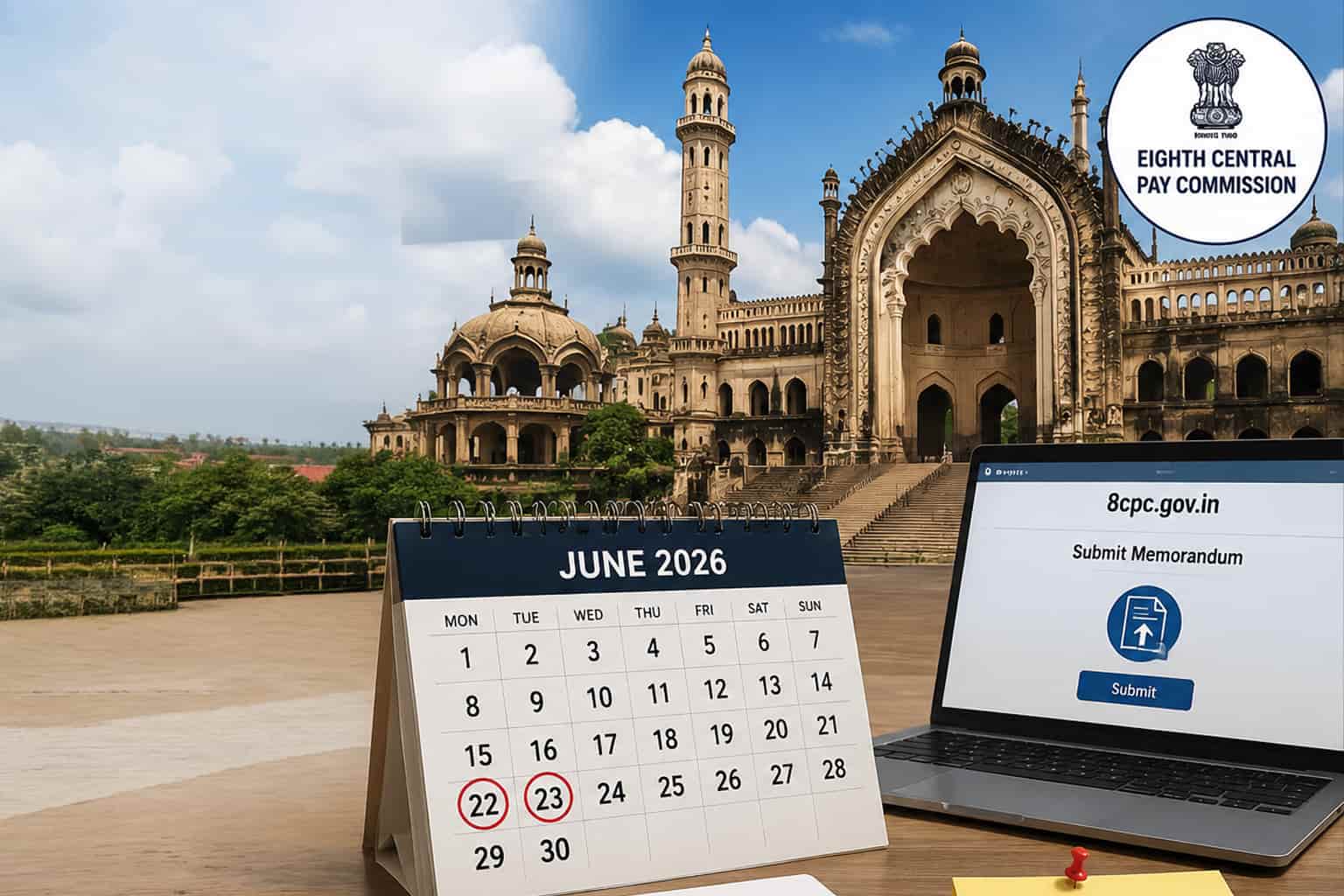
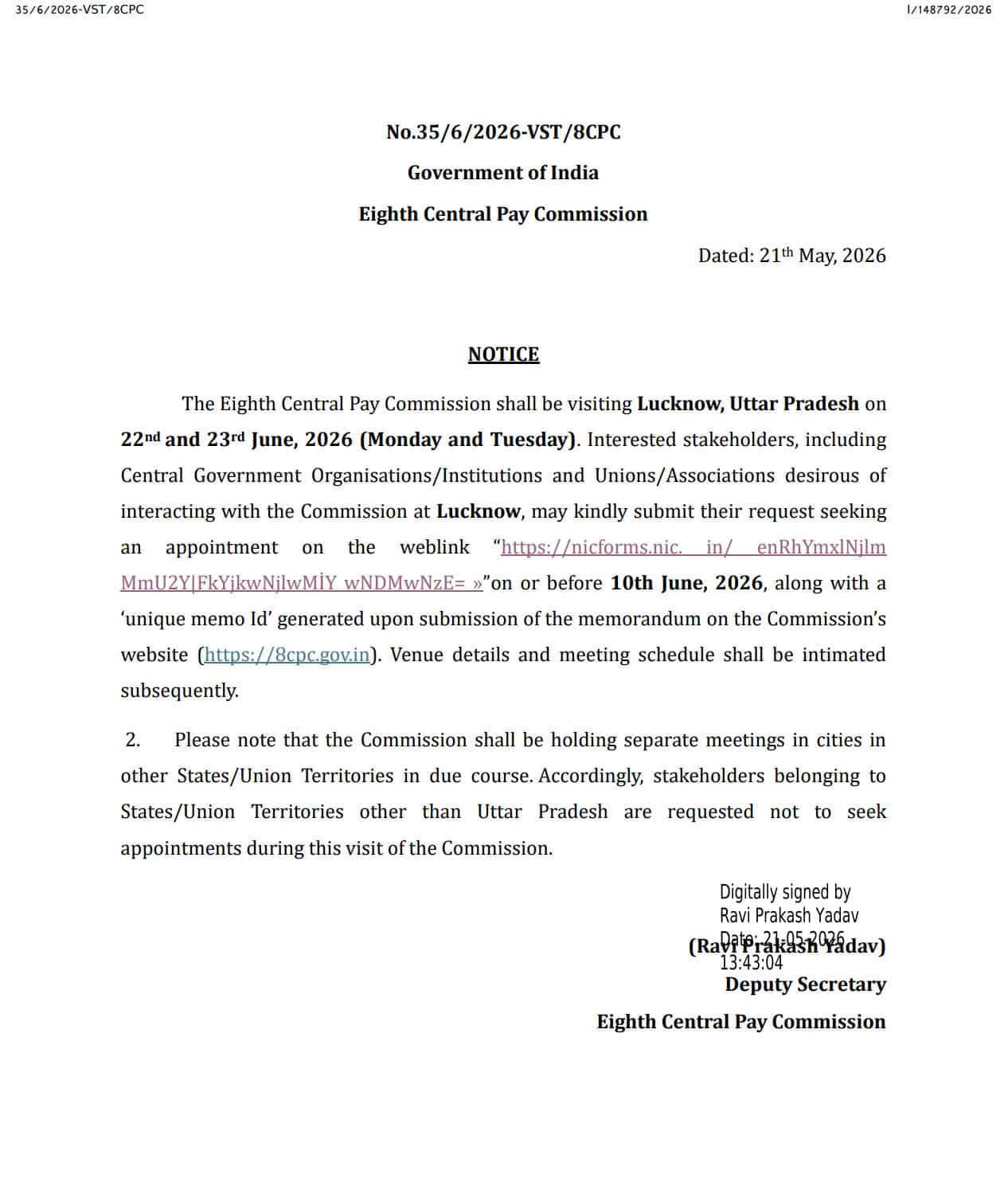
The Commission has announced that it will visit Lucknow on 22 and 23 June 2026. For Uttar Pradesh-based stakeholders, this visit can become an important chance to place their concerns before the Commission. But the most important date is not 22 June. It is 10 June 2026.
This is the last date for submitting the appointment request.
According to the official notice dated 21 May 2026, interested stakeholders such as Central Government organisations, institutions, unions and associations belonging to Uttar Pradesh can request an appointment to interact with the Commission during the Lucknow visit. The request has to be submitted through the NIC forms link mentioned in the notice on or before 10 June 2026.
This means the process is not informal. It is not a public gathering where any person can walk in and expect to meet the Commission. The Commission has created a structured route. First, stakeholders must submit their memorandum on the official 8th CPC website. After submission, a unique memo ID is generated. That memo ID is then required for the appointment request.
This one detail changes the entire meaning of the notice.
The unique memo ID is not just an administrative number. It is proof that the issue has been formally placed before the Commission. It shows that the stakeholder has not merely discussed the demand in meetings, WhatsApp groups or social media posts, but has actually submitted it through the official process.
For months, employees and pensioners have been discussing many issues connected with the 8th CPC. These include fitment factor, minimum pay, pension revision, DA and DR impact, allowances, pay level anomalies, defence pay matters, promotion problems, hardship-related issues, medical benefits and old unresolved demands. But in a Pay Commission process, only discussion is not enough.
A demand becomes stronger when it is written properly, supported with facts and submitted through the official channel.
That is why Uttar Pradesh-based organisations should treat the Lucknow visit as a serious working opportunity. If a union or association wants to speak for its members, it should not wait until the last few days. It should prepare its memorandum carefully, submit it on the official website, collect the memo ID and then use the official appointment process before 10 June.
The notice also makes one more point very clear. This Lucknow visit is specifically for stakeholders belonging to Uttar Pradesh. The Commission has said that separate meetings in cities in other States and Union Territories will be held in due course. Therefore, stakeholders from other States or Union Territories should not seek appointments for this Lucknow visit.
This is important because many employees from neighbouring regions may feel that Lucknow is accessible and therefore they can also request a meeting. But the official notice has drawn a clear line. This is a Uttar Pradesh-specific consultation opportunity. Other States and Union Territories will get separate chances later as per the Commission’s schedule.
This approach may look strict, but it also makes the process more organised. If every stakeholder from every region tries to enter one meeting schedule, the process can become crowded and ineffective. A state-wise consultation gives each region a better chance to raise its own concerns in a focused manner.
For Uttar Pradesh, this matters a lot.
Uttar Pradesh has a large population of Central Government employees, pensioners, defence pensioners, railway employees, postal employees, paramilitary-linked families, defence civilians and other service communities connected with the Central Government. Many of their issues may overlap with national demands, but some concerns may be department-specific, region-specific or category-specific.
For example, pensioner associations may want to raise issues related to pension revision, commutation, medical support, DR, family pension, grievance settlement and old anomalies. Defence-related organisations may want to raise matters related to Military Service Pay, disability pension concerns, rank parity, risk and hardship, field service conditions and ex-servicemen welfare. Railway and postal unions may have issues related to workload, allowances, classification, promotions and working conditions.
Each organisation must ask itself one simple question: if we get a chance to speak before the Commission, what exactly will we say?
This is where preparation becomes more important than emotion.
A strong memorandum should not read like a random list of demands. It should explain the problem clearly. It should mention who is affected. It should show why the issue matters. It should include facts, comparisons, examples and a clear request. Emotional appeal has value, but in a Pay Commission process, emotional appeal must be supported by structured reasoning.
A pensioner saying that expenses have increased is important. But a pensioner association showing medical cost pressure, DR impact, commutation recovery concerns and pension adequacy with examples becomes stronger. A defence association saying that military service is different is important. But showing risk, separation from family, field conditions, rank-related issues and post-retirement impact gives the demand more weight.
The Lucknow visit should therefore not be treated as a symbolic event. It should be treated as a limited window for serious representation.
Another point in the notice deserves attention. The venue details and meeting schedule will be communicated later. This means stakeholders should not rely on assumptions, forwarded messages or unofficial venue claims. After submitting the appointment request, they should wait for official communication regarding venue, timing and meeting schedule.
This is also a reminder to stay careful with unofficial links. The appointment request should be submitted only through the NIC forms link mentioned in the official notice. The memorandum submission should be connected with the official 8th CPC website. Stakeholders should avoid sharing memo IDs, organisational details or other information through random forms, unknown links or social media forwards.
In a process like this, digital safety is also part of preparation.
The larger message from this notice is that the 8th CPC process is becoming more formal, more organised and more proof-based. The Commission is not only collecting online memorandums. It is also moving towards stakeholder interactions in different locations. Lucknow is one such important location for Uttar Pradesh.
This also helps employees and pensioners understand the difference between rumour and official process.
The Lucknow notice does not announce a salary hike. It does not announce the fitment factor. It does not announce pension revision. It does not announce DA merger or arrears. It only announces an opportunity for eligible Uttar Pradesh-based stakeholders to seek appointment for interaction with the Commission during its Lucknow visit.
But this kind of process update is still important because Pay Commission recommendations are built after studying memorandums, representations, data and stakeholder inputs. The final report does not appear in isolation. It is shaped through consultation, examination and analysis.
That is why participation matters.
For an individual employee, the notice may raise a practical question: can I personally seek an appointment? The wording of the notice refers to interested stakeholders such as Central Government organisations, institutions, unions and associations. Therefore, individual employees and pensioners should coordinate with recognised unions, associations or organisations wherever possible. This can make the representation more organised and reduce duplication.
For example, if hundreds of employees raise the same issue separately in different formats, the message may become scattered. But if a recognised association collects member concerns, prepares a structured memorandum and submits it officially, the issue may be presented more clearly.
This is where unions and associations carry a responsibility. Their role is not only to forward the notice. Their role is to organise the concerns, prepare strong submissions, guide members and ensure that the deadline is not missed.
The human side of this update should not be forgotten.
Behind every Pay Commission demand, there is a family story. A serving employee may be worried about children’s education, house rent, medical expenses and future retirement planning. A pensioner may be calculating monthly medicines, hospital visits and household expenses. A defence family may be thinking about years of service hardship and whether that sacrifice is properly recognised. A widow receiving family pension may be hoping that future revision brings more stability.
For these families, the 8th CPC is not an abstract policy exercise. It is linked with daily life.
That is why the memo ID matters. It is a small technical requirement, but it represents participation in the official system. It shows that a concern has been submitted. It gives the stakeholder a traceable connection to the consultation process.
For Uttar Pradesh-based stakeholders, the action points are clear.
Prepare the memorandum properly. Submit it on the official 8th CPC website. Keep the unique memo ID safe. Use the NIC forms link mentioned in the official notice to request an appointment. Complete this process on or before 10 June 2026. Do not wait for the final days. Do not depend on rumours. Do not assume that another organisation will automatically raise the same issue.
The Commission’s visit to Lucknow on 22 and 23 June 2026 is important, but only those who complete the required process in time can hope to participate in the interaction.
For Sainik Welfare News readers and Central Government-linked families, the takeaway is simple. This is not the final pay revision announcement. This is not a confirmed salary or pension update. But it is a meaningful consultation update. It shows that the 8th CPC process is moving forward, and Uttar Pradesh stakeholders now have a clear deadline to act.
In every Pay Commission, timing matters. Documentation matters. Representation matters.
The Lucknow visit is a reminder that employees and pensioners should not only follow 8th CPC news from outside. Wherever eligible, they should participate through the proper official route. Because in the end, the strongest representation before a Commission is not the loudest social media claim. It is the most organised, timely and well-documented submission.
Sources:-
https://8cpc.gov.in/
https://8cpc.gov.in/document/notice-regarding-8cpc-visit-to-lucknow-uttar-pradesh-22-23-june-2026/
https://innovateindia.mygov.in/8cpc-memorandum-submission/
https://www.staffnews.in/2026/05/8th-central-pay-commission-visit-to-lucknow.html

Leave a Reply