


The 8th Central Pay Commission has given a final opportunity for memorandum submission. Central Government employees, pensioners, defence personnel and associations should submit their issues only through the official online portal.
For many Central Government employees and pensioners, the 8th Pay Commission is not just a policy update. It is connected with monthly salary, pension, allowances, retirement security, family pension, defence welfare and the future financial structure of lakhs of families.
That is why the latest notice of the Eighth Central Pay Commission should not be read like a routine date extension.
It is more like a final call.
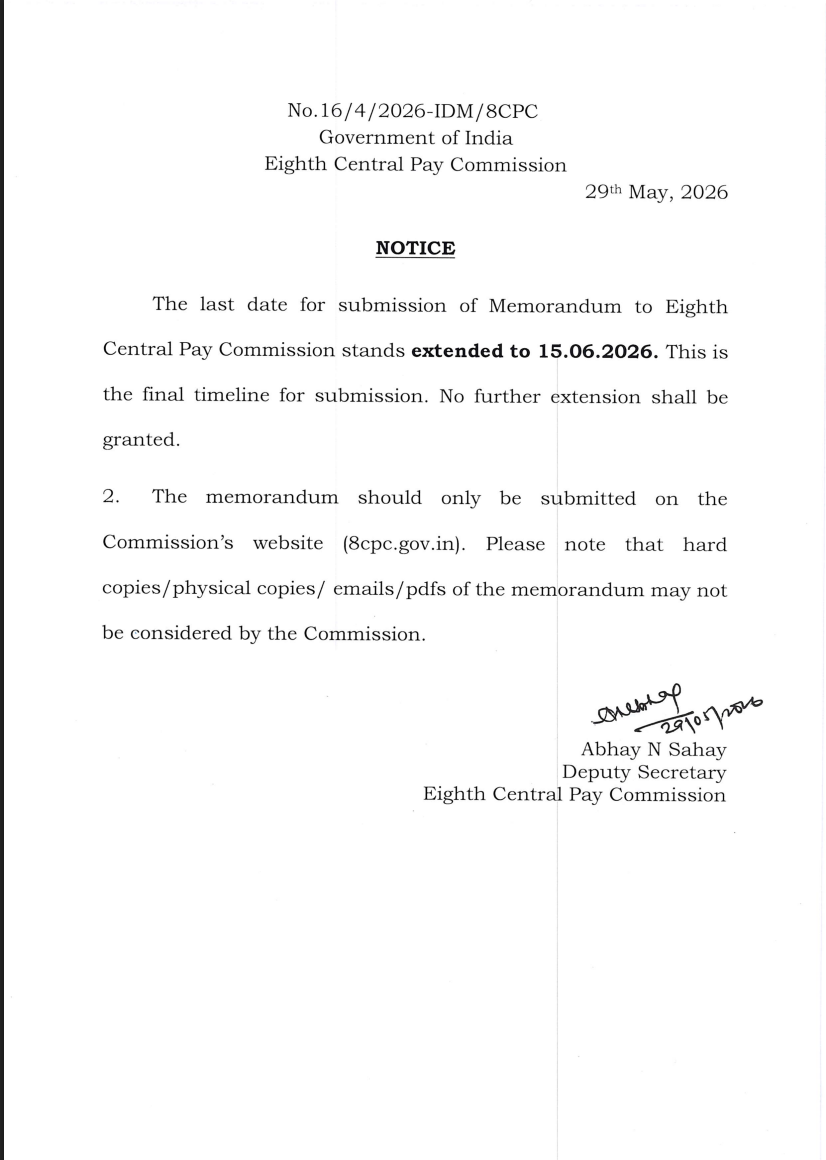
The Commission has extended the last date for submission of memorandum. But along with relief, it has also given a clear warning. This is the final timeline, and no further extension will be granted.
This one line changes the entire meaning of the notice.
Until now, many employees, pensioners, associations and organisations may have been thinking that there will be more time. Some may have been waiting for their union to submit. Some may have been expecting a hard copy route. Some may have prepared a PDF or draft letter but not submitted it on the official portal. Some may not even have checked whether their concerns have been properly placed before the Commission.
Now, that casual approach can become risky.
The 8th Central Pay Commission has made it clear that memorandums must be submitted only on the Commission’s official website. Paper submissions, physical copies, emails and PDFs may not be considered. This means the old style of sending a letter, forwarding a PDF, or depending on informal circulation will not be enough.
For employees and pensioners, the message is simple: if your issue matters, place it properly through the official online system.
This is important because the Pay Commission’s work is still in the consultation and information-gathering phase. This is the stage where employees, pensioners, unions, associations, ministries, departments and other stakeholders can place their points before the Commission. Once the window closes, it may become much harder to say that a particular issue was not considered.
A Pay Commission does not only look at one headline demand. It studies salary structure, pension revision, allowances, service conditions, defence pay issues, family pension concerns, working conditions and different categories of employees. Every group has its own problems. A railway employee may have one set of concerns. A defence pensioner may have another. A family pensioner may worry about a different issue. A civilian defence employee, an industrial employee, a UT employee or a pensioners’ association may have specific points that cannot be understood through general discussion alone.
That is why the memorandum process matters.
A memorandum is not just a complaint. It is a formal way of telling the Commission what is wrong, what needs correction and what should be considered while preparing recommendations. If written properly, it can present facts, examples, comparisons, financial impact and practical hardship.
For a pensioner, it may be about the value of pension after inflation. For a family pensioner, it may be about dignity and survival after the death of the main pensioner. For serving employees, it may be about pay levels, promotion stagnation, allowances, workload and job risk. For defence personnel and veterans, the issues may include service conditions, disability support, field hardship, rank structure, parity and welfare concerns.
These are not small matters. These are the issues that affect real households.
That is why this extension should be seen as an opportunity, but not as a reason to delay.

The Commission has already allowed more time earlier. The deadline first moved from the earlier submission window to a later date, and now it has been extended again. But the latest notice clearly says that no further extension will be granted. So this is not an open-ended process.
For employees, the first practical step is to check whether their concern has already been submitted. If an association or union is submitting on behalf of employees, members should still ask what points are being included. Many times, people assume that “someone must have submitted.” But in such an important process, assumption is not enough.
For pensioners and family pensioners, the matter is even more important. Many retired people are not comfortable with online forms. Some may depend on children, relatives, ex-servicemen groups, pensioners’ associations or welfare organisations to help them. Such people should not wait until the last moment. They should collect their points, prepare a simple structured note and submit it through the official route.
The Commission has provided structured submission routes for different categories. Individual employees and pensioners, associations and unions, ministries and departments, union territories, judicial officers and other eligible categories have their own routes for submission. This structure shows that the Commission wants organised inputs, not random letters.
Another important point is the Memo ID. When a submission is made through the online system, the applicant generally receives a reference or identification for the submission. This may become important later because it works like proof that the memorandum was actually submitted. For any future follow-up, meeting request or internal record, having proper submission proof can be useful.
The biggest mistake at this stage would be to treat the extension as a comfort zone.
The better way to understand it is this: the Commission has opened the door one last time. Those who enter with proper points may get their concerns recorded. Those who miss it may have to depend on others to speak for them.
For Central Government employees, this is the time to think beyond casual social media discussion. Instead of only sharing posts about fitment factor, salary hike, pension revision or DA merger, the more useful step is to prepare a serious memorandum. It should be specific, factual and connected with service reality.
For example, if the issue is minimum pay, explain the cost of living and family needs. If the issue is pension revision, explain how inflation affects retired people. If the issue is allowances, explain why the existing allowance does not match present duty conditions. If the issue is defence hardship, explain the nature of deployment and risk. If the issue is family pension, explain the financial pressure faced by dependents.
A strong memorandum does not need emotional language alone. It needs clarity.
The 8th Pay Commission process is not only about final numbers. It is also about documentation. The Commission can only study what is placed before it through proper channels. That is why employees and pensioners should not depend only on rumours, forwarded messages or informal discussions.
The official notice has now made three things clear.
First, the last date has been extended.
Second, this is the final timeline.
Third, the memorandum should be submitted only through the official website.
These three points should guide every employee, pensioner, association and department.
For Sainik Welfare News readers, this update is especially relevant because it affects not only serving Central Government employees but also pensioners, defence pensioners, ex-servicemen, family pensioners and veterans’ families. Many of these groups have long-pending issues that need formal representation before the Commission.
This is not the time to wait for the final Pay Commission report and then say that the demand was ignored.
This is the time to submit the demand properly.
A Pay Commission comes once in many years. Its recommendations can influence salary structure, pension formula, allowance framework and service-related benefits for a long period. Missing the memorandum window can mean missing a serious opportunity to put your concern on record.
The final message is simple.
If you are a Central Government employee, pensioner, defence pensioner, ex-serviceman, family pensioner, association member or union representative, do not treat this extension casually. Check the official 8th CPC portal, prepare your points carefully and submit the memorandum through the structured online form.
No hard copy. No ordinary PDF. No email-based assumption.
Only the official online submission route matters.
The 8th Pay Commission has given one more chance. But this time, the notice itself says that no further extension will be granted.
So the real story is not that the date has been extended again.
The real story is that the final door is still open, but it may close soon.
Sources:-
Official 8CPC notice dated 29 May 2026: deadline extended up to 15.06.2026
https://8cpc.gov.in/document/last-date-for-submission-of-responses-to-8cpc-memorandum-extended-upto-15-06-2026/
Official 8CPC “What’s New” page
https://8cpc.gov.in/whats-new/
Official 8CPC memorandum submission page
https://8cpc.gov.in/8cpc-memorandum-submission/
Official earlier extension page: deadline extended up to 31.05.2026
https://8cpc.gov.in/document/last-date-for-submission-of-responses-to-8cpc-memorandum-extended-upto-31-05-2026/
Official clarification on memorandum submission through 8cpc.gov.in
https://8cpc.gov.in/document/clarification-regarding-submission-of-8cpc-memorandum-representations-on-its-website-8cpc-gov-in/

Leave a Reply