


Jewar is no longer only a future development story. With Noida International Airport moving towards commercial operations and the Yamuna Expressway region gaining attention, the name Jewar has started appearing in serious infrastructure, housing and connectivity discussions.
For Army families, this update has now become more relevant because the Army Welfare Housing Organisation, AWHO, has issued a demand and inclination survey for a possible group housing project at Jewar City, Uttar Pradesh.
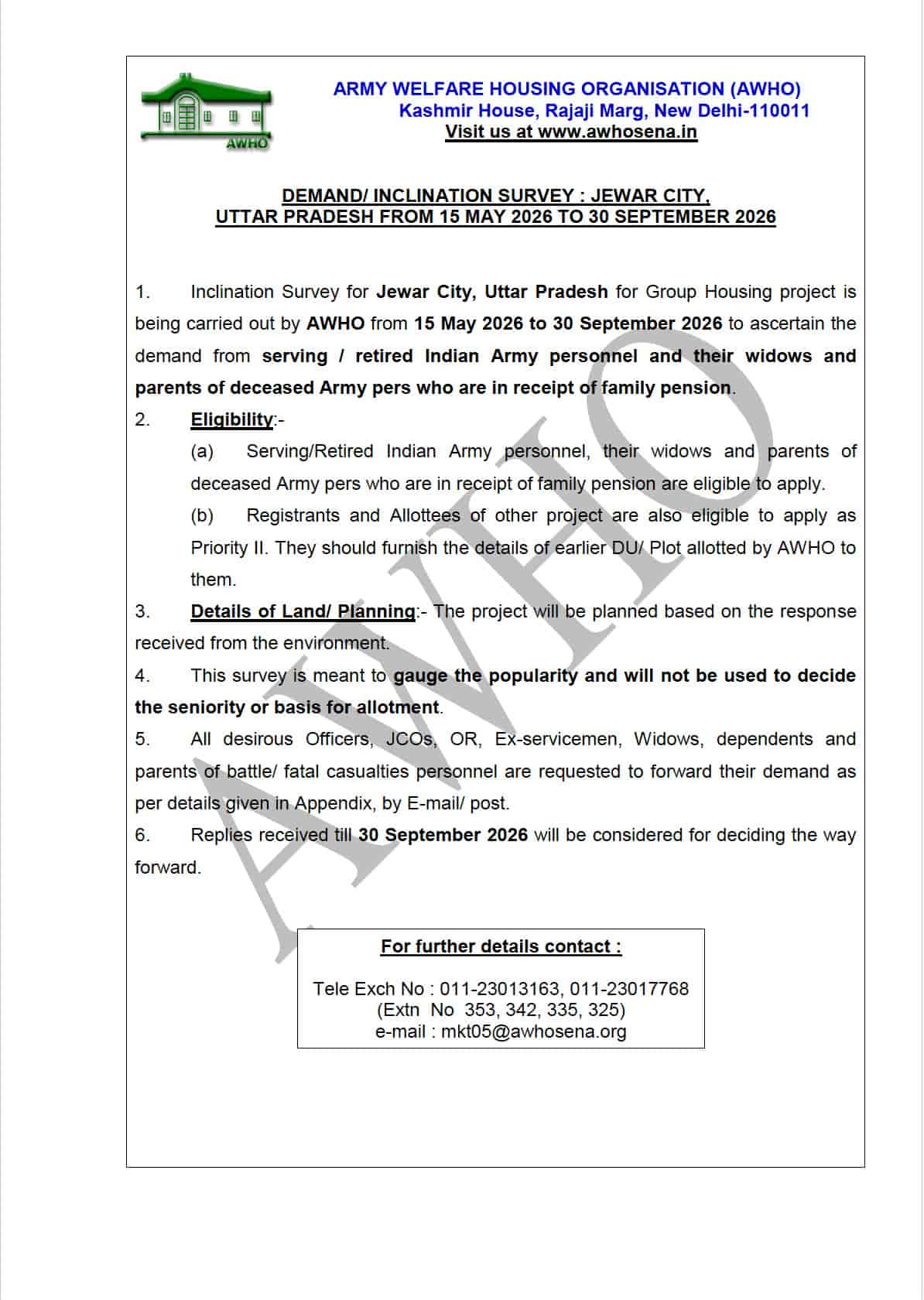
At first glance, this may look like a housing scheme announcement. But the most important point is that this is not an allotment notice. It is a survey to understand demand.
That difference must be understood clearly.
The AWHO notice indicates that the survey is being conducted from 15 May 2026 to 30 September 2026. Replies received up to 30 September 2026 will be considered while deciding the way forward. This means AWHO is collecting interest from eligible categories before taking future planning decisions.
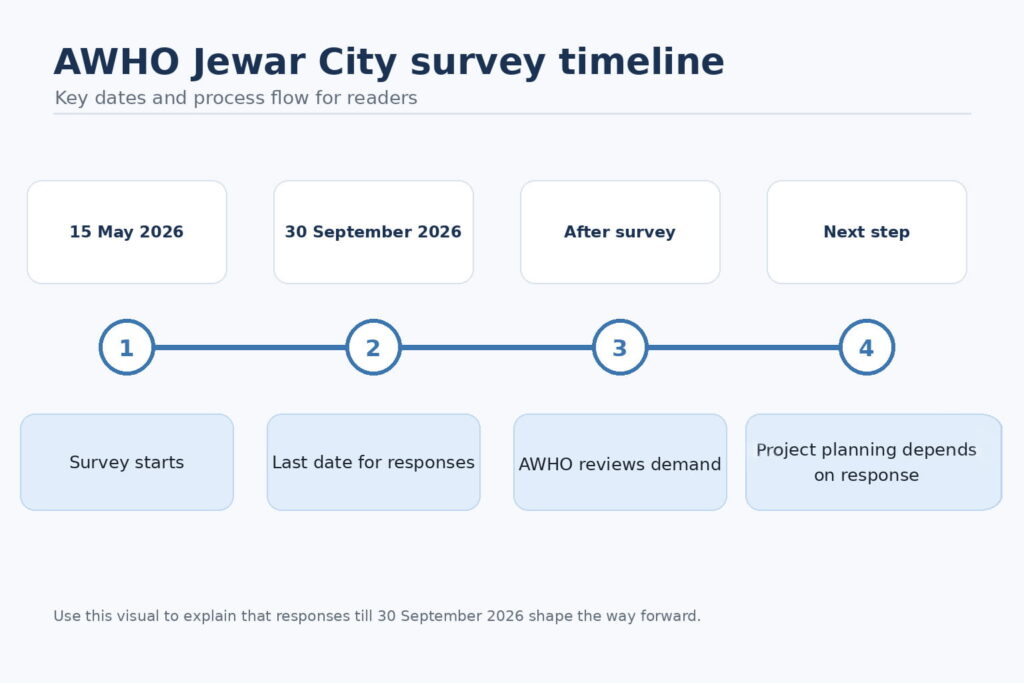
The notice means that demand is being checked. It means eligible Army-linked families can send their interest. It means the response may help AWHO decide whether the Jewar City proposal should move ahead.
But it does not mean booking has started. It does not mean flat allotment is guaranteed. It does not mean seniority has been decided. It also does not mean that price, payment plan or possession timeline has been announced.
This is the most important caution for readers.
Many times, when a location is connected with a major airport or infrastructure project, people become excited very quickly. They may assume that a survey automatically means a confirmed project. In this case, the correct reading is simple: AWHO is assessing demand, not offering flats for allotment at this stage.
The human side of this notice is also important. For a serving soldier, a future home is often planned from a distance while posted elsewhere. For a retired soldier, housing is linked with stability after service. For a widow or family pensioner, it may mean security, access and long-term settlement. That is why an AWHO survey can create genuine interest among Army families.
But interest must be matched with clarity.
Who can respond to the AWHO Jewar City survey?
The survey is not meant for the general public. It is for eligible Army-linked categories mentioned in the AWHO notice.
The eligible categories include serving Indian Army personnel, retired Indian Army personnel, widows, and parents of deceased Army personnel who are receiving family pension. The notice also mentions that existing AWHO registrants or allottees may be treated under Priority II, subject to providing details of earlier AWHO allotment or registration.
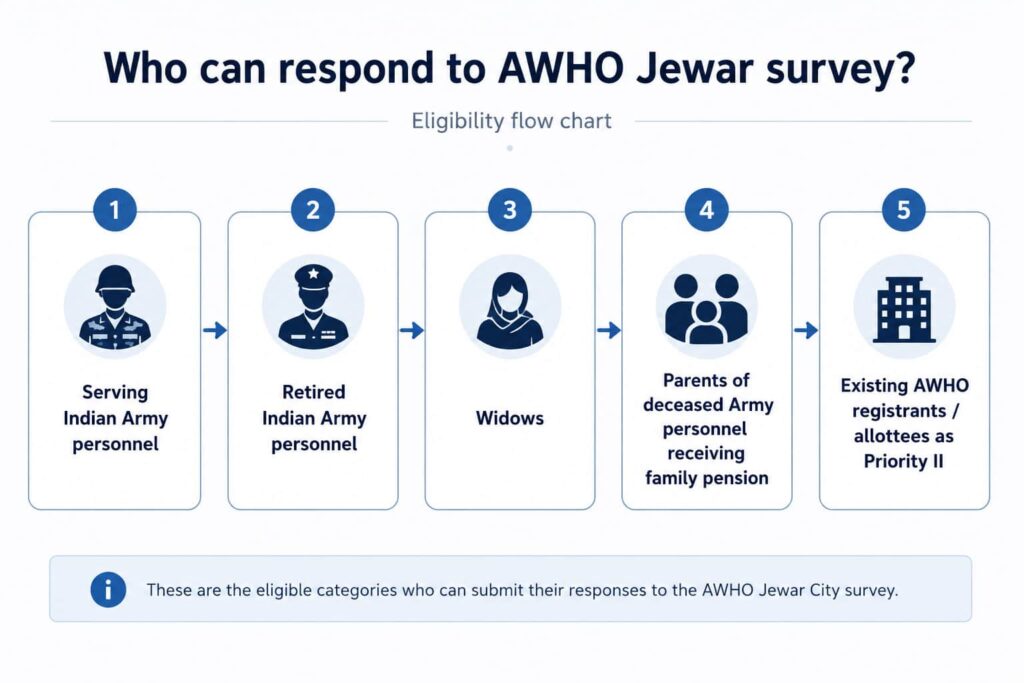
This eligibility point is important because a housing survey linked with Jewar may attract wider attention. But AWHO housing is welfare-oriented and meant for specific categories. Anyone responding to the survey should first check whether they fall under the eligible group.
If someone is already registered with AWHO or has already received an AWHO dwelling unit or plot earlier, that detail should not be hidden. The notice indicates that such applicants must mention their previous AWHO registration or allotment history.
This is not only a paperwork issue. Correct disclosure helps the organisation understand demand honestly and plan according to its rules.
Why the survey period matters?
The survey period runs from 15 May 2026 to 30 September 2026. The end date is important because responses received till 30 September 2026 will be considered for deciding the future course.
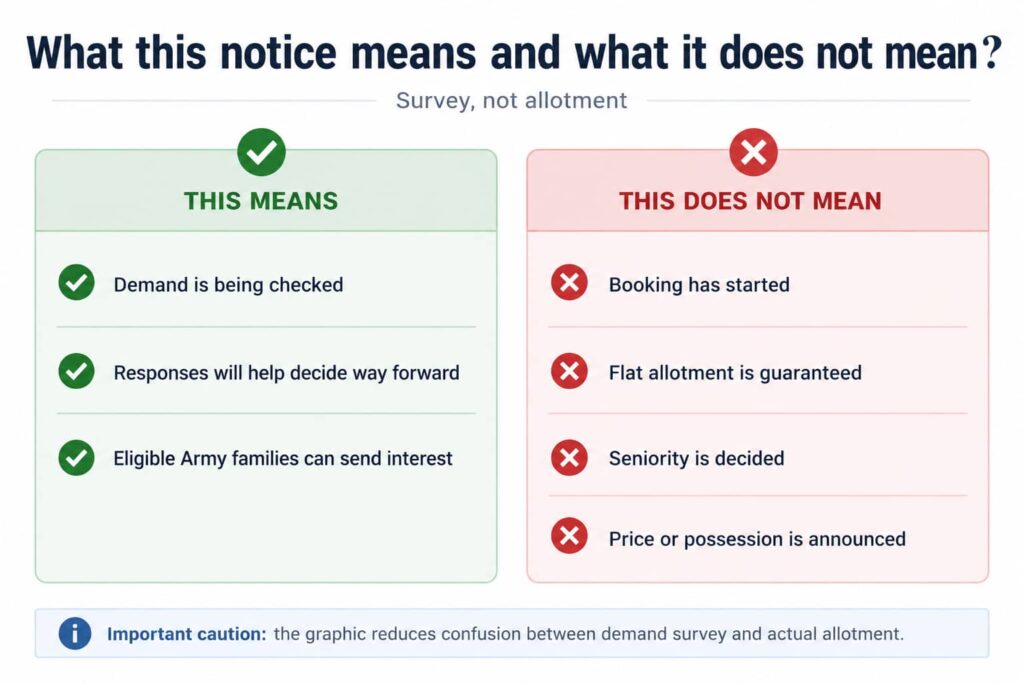
This means the survey is time-bound. Interested eligible persons should not treat it casually or wait until the last moment.
The timeline shows the basic process clearly. The survey starts on 15 May 2026. The last date for responses is 30 September 2026. After the survey closes, AWHO reviews the demand. The next step depends on the response received and further planning.
This also means that the survey is not the final stage. It is an early stage. The response may help AWHO understand whether there is enough demand for a possible project at Jewar City, what kind of flat sizes people may prefer and how serious the interest is among eligible Army families.
For readers, the key takeaway is this: if Jewar City interests you as a future housing location and you are eligible, your response should reach AWHO within the given timeline.
Why Jewar City is gaining attention?
Jewar has gained attention because of the Noida International Airport, Yamuna Expressway connectivity and the wider development story of western Uttar Pradesh. Once commercial flight operations begin, the region may move from future promise to passenger reality.
For Army families looking at long-term housing, location matters. Connectivity to an airport, access through expressways, future transport links, nearby urban development, healthcare access and civic infrastructure all influence the decision.
But one should not make a housing decision only because an airport is nearby.
Airport-led development can improve a location’s visibility, but it does not automatically guarantee quick appreciation, easy resale, confirmed returns or immediate urban comfort. A home decision should still be based on official project details, final location, price, approvals, construction plan, possession timeline, maintenance structure and allotment rules.
At this stage, AWHO has asked for demand and inclination. It has not announced final project terms.
Flat preference options in the survey
The survey form asks applicants to indicate their preferred flat configuration. The choices mentioned are 2 BHK, 3 BHK and 4 BHK. Applicants are expected to select one option.
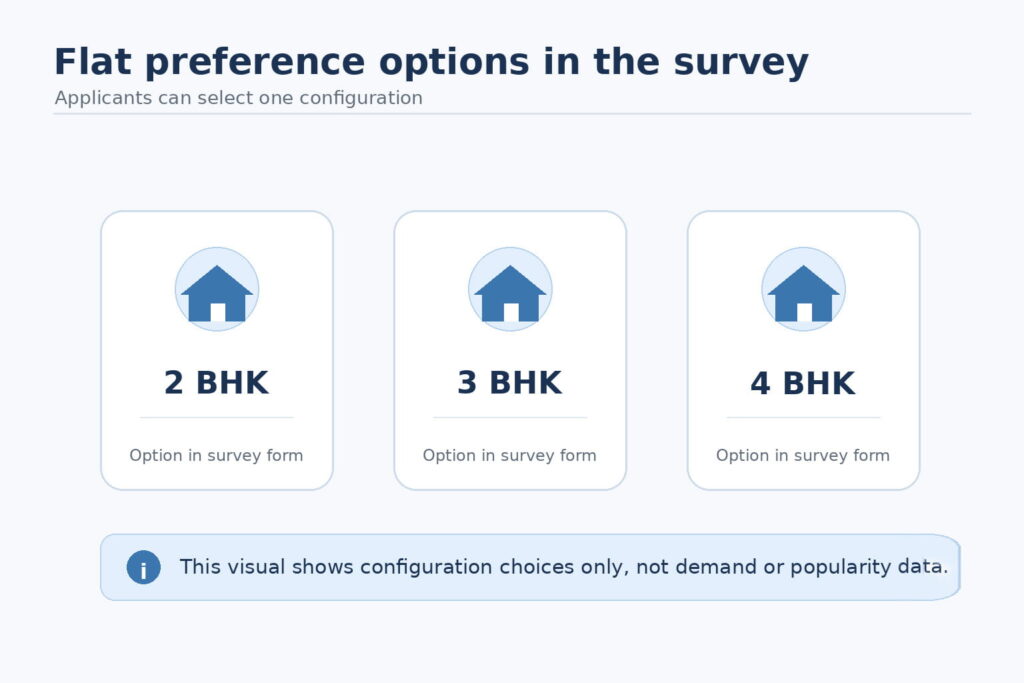
This does not mean these flats are already available for booking. It only means AWHO is trying to understand what type of housing configuration eligible applicants may prefer if the project moves ahead.
This kind of information is useful for planning. If most applicants prefer 2 BHK, the demand pattern may be different. If more applicants prefer 3 BHK or 4 BHK, the planning requirement may change. The survey helps collect this early preference.
Applicants should choose carefully. They should think about family size, budget expectation, long-term use and practical need before selecting a flat configuration.
Details applicants should keep ready
The survey form asks for several personal and service-related details. Applicants should keep these details ready before sending the response so that the form is accurate and complete.
The required details include Army number or personal number, PPO number if applicable, rank and name, regiment or corps, correspondence address, email, contact number, choice station, flat configuration and previous AWHO registration or allotment history.
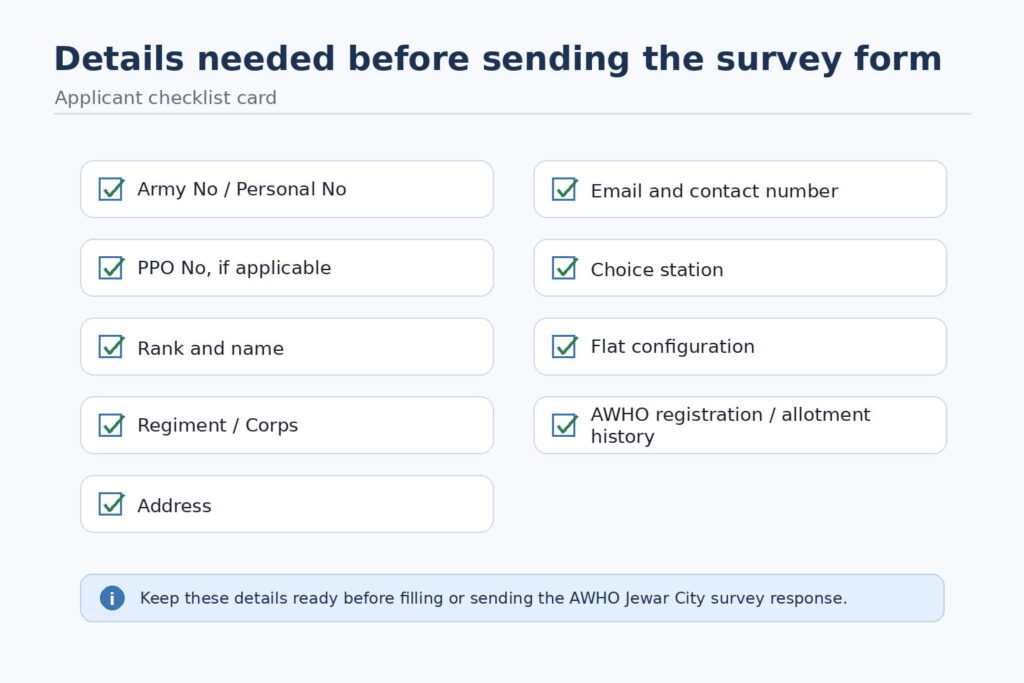
These details should be filled carefully. Any wrong or incomplete information can create confusion later. Applicants should also keep a copy of the filled form and the email or postal dispatch proof for their own record.
The notice mentions that interested Officers, JCOs, OR, ex-servicemen, widows, dependents and parents of battle or fatal casualty personnel may forward their demand as per the appendix by email or post. The email mentioned in the notice is mkt05@awhosena.org.
Why this survey should be read responsibly?
The strongest message of this notice is responsibility.
Eligible Army families should not ignore the survey if they are genuinely interested in Jewar City. At the same time, they should not misunderstand the notice as a booking advertisement.
AWHO is trying to measure demand. The response may help decide the way forward. But allotment, pricing, project launch, payment schedule, possession timeline and detailed project rules will depend on future decisions and official communication.
This is where many readers need caution. Housing-related news often spreads quickly, especially when the location is connected with a major infrastructure project like Jewar Airport. But every update should be read from the official document, not only from social media posts or forwarded messages.
A survey is a first step, not the final promise.
What Army families should do now?
If you are eligible and interested, read the notice carefully. Check your category. Keep your documents and details ready. Decide your preferred flat configuration. Fill the survey response correctly. Send it through the method mentioned in the notice before the deadline.
If you are not sure about eligibility, do not assume. Verify from the official AWHO communication or contact details provided in the notice.
If you are already an AWHO registrant or allottee, mention the required history honestly. If you are responding on behalf of a widow, dependent or family pensioner, ensure the details are correct and supported by relevant records.
This is not a stage for hurry. It is a stage for careful response.
Final thought
The AWHO Jewar City survey matters because it connects two important ideas: Army family welfare and the growing importance of Jewar as a future connectivity location.
For serving personnel, retired soldiers, widows and eligible family pensioners, this may be a chance to express interest in a possible housing project at a location that is gaining attention due to airport and expressway-linked development.
But the notice must be understood correctly.
It is a demand and inclination survey. It is not a booking announcement. It is not a guarantee of allotment. It is not a final price or possession notice. It is an early step to understand whether eligible Army families are interested in Jewar City.
So the final advice is simple: respond if you are eligible and genuinely interested, but respond with full clarity.
Jewar may be moving from future promise to practical infrastructure reality. Now AWHO is asking Army families whether there is real housing interest in that location. That is why this survey deserves attention, but also careful reading.




Leave a Reply