

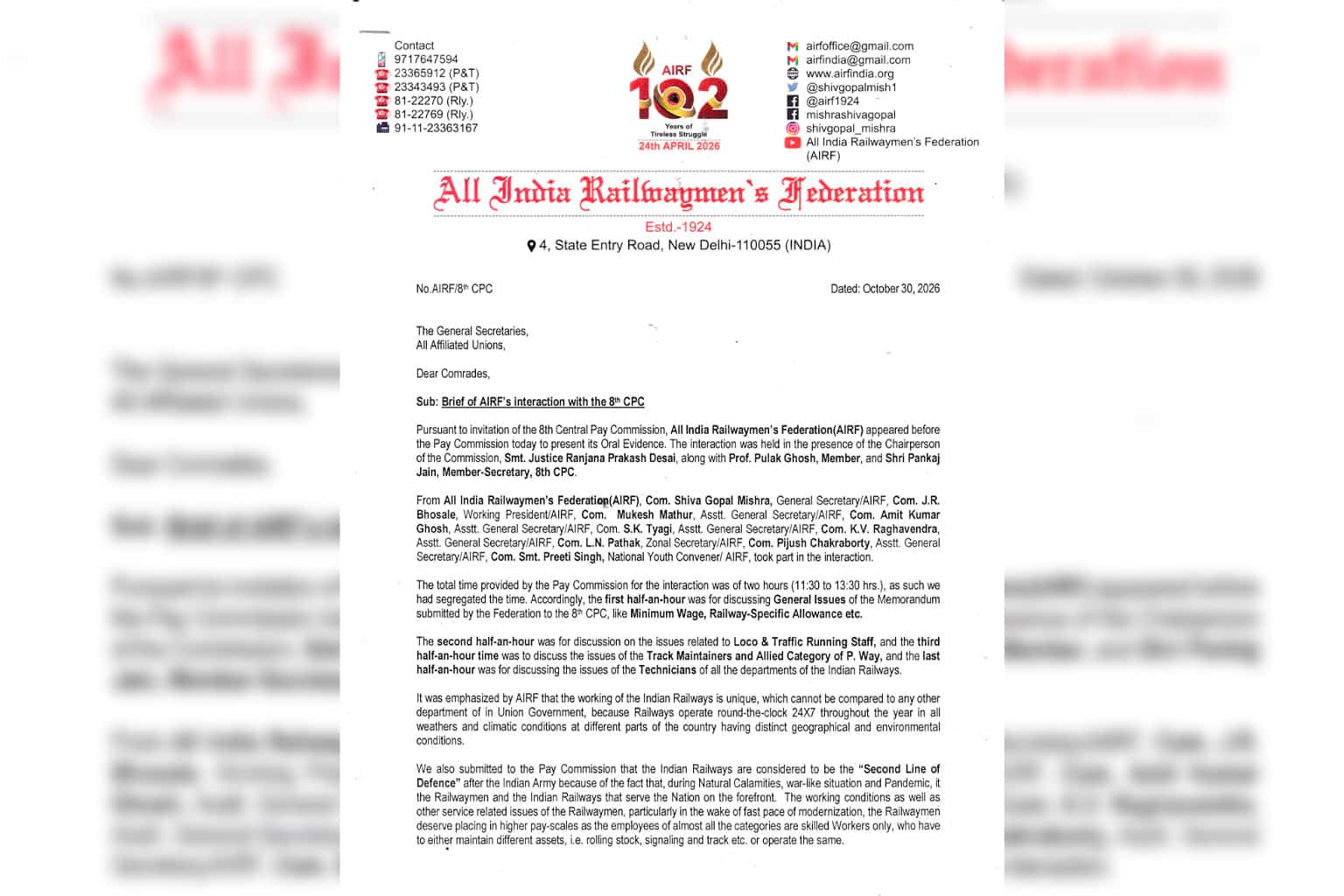
Download the brief of AIRF’s interaction with 8th CPC
Will the 8th Central Pay Commission recognise the increasing technical responsibilities and occupational risks of railway employees while recommending a new pay structure?
This question has gained attention following a representation by the All India Railwaymen’s Federation (AIRF), which presented several proposals to the Commission on 30 October 2026.
The federation raised concerns about minimum wages, higher pay levels, special allowances and limited promotional opportunities in different railway categories.
The discussions covered Loco Pilots, Running Staff, Track Maintainers, Technicians and women employees working in operational roles.
The significance of these proposals extends beyond a general salary increase. AIRF wants the Commission to examine whether the existing pay structure adequately reflects the complexity, working conditions and career progression of railway personnel.
Why AIRF wants railway pay elvels reconsidered?
Indian Railways relies on employees responsible for complex equipment, train operations, signalling systems, maintenance and infrastructure safety.
AIRF argued that technological changes have increased the technical expertise required for many of these jobs.
The federation also highlighted round-the-clock railway operations, challenging weather conditions and responsibilities during emergencies.
Its position is that salary structures should reflect professional skills, operational responsibilities and exposure to workplace risks.
The federation described Indian Railways as the country’s “Second Line of Defence”, referring to its contribution during national emergencies and other critical situations.
This was an argument supporting its representation, not a change in the legal classification of railway employees.
Minimum Wage and Higher Pay Scales: What was proposed?
Minimum wage determination was among the broader issues discussed during AIRF’s interaction with the Commission.
The federation also sought higher pay scales for railway categories whose responsibilities have evolved over time.
However, the two-page communication released after the meeting does not specify a revised minimum basic pay, fitment factor or proposed percentage increase.
This distinction matters because demands for a stronger pay structure should not be confused with an approved salary calculation.
Any eventual change will depend on the Commission’s recommendations and subsequent Government decisions.
Which Railway Employees could be affected by the proposals?
AIRF’s representation addressed different occupational groups rather than treating the entire railway workforce as one category.
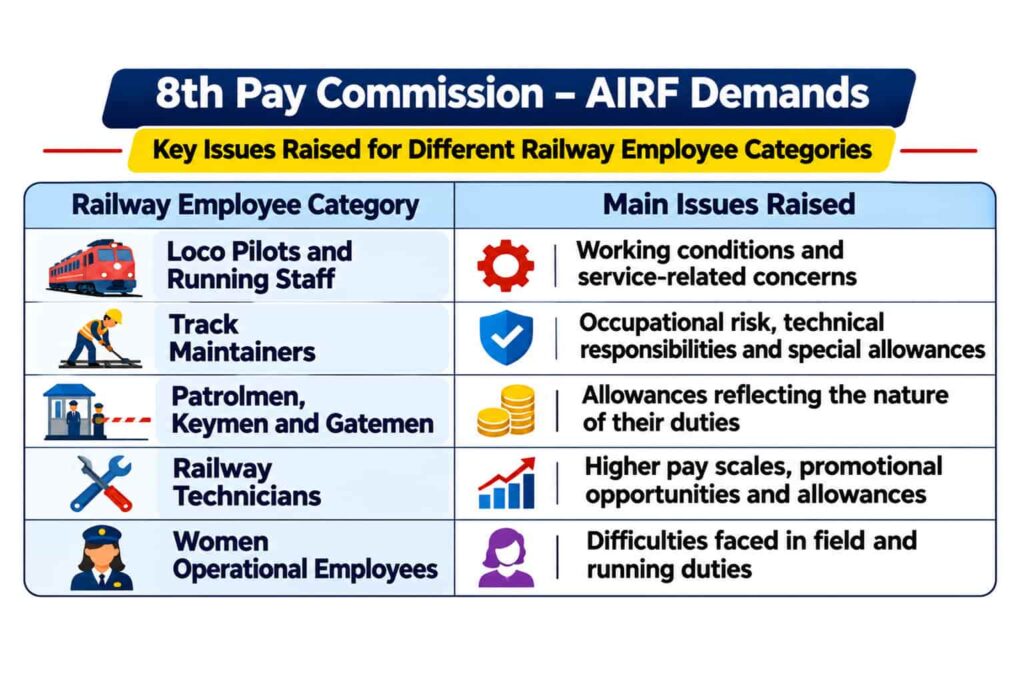
The proposals have different implications for each group. Some concern pay placement, while others relate to working conditions or additional compensation for particular duties.
Risk and Hardship Allowances: Why are they important?
Many railway employees work in environments that involve operational hazards, physically demanding conditions or exposure to severe weather.
AIRF raised the need for appropriate Risk and Hardship Allowance, along with Hazardous Duty, Hill and Dress Allowances.
The demand is particularly relevant to personnel carrying out track-related and technical work.
The important distinction is between basic pay and duty-specific allowances. A higher pay level addresses the employee’s position within the salary structure, whereas a special allowance may recognise the conditions attached to a particular assignment.
AIRF’s communication does not announce revised rates for these allowances.
Technician Pay-Scale merger: Could promotion opportunities improve?
An important aspect of AIRF’s representation concerns the career progression of railway technicians.
The federation proposed merging certain intermediate pay scales to improve promotional opportunities.
This issue deserves attention because an employee’s financial progression depends not only on the initial basic salary but also on the pay levels and promotional positions available during service.
A revised structure could affect career progression if the Commission ultimately recommends changes and the Government approves them.
The federation’s brief, however, does not provide a final revised pay-level chart. Therefore, no specific new technician pay matrix can be calculated from this communication.
Women Railway Employees also presented their concerns
The interaction included representations about difficulties faced by women working in operational railway positions.
AIRF identified Ms Ashima and Ms Dolly Kumari as participants who discussed problems affecting female Loco Pilots, Assistant Loco Pilots, Train Managers and Track Maintainers.
Their participation brought working conditions into the discussion alongside salaries and promotional matters.
The federation characterised the interaction positively, although its assessment does not amount to a formal decision by the Commission.
How did the 30 October Consultation take place?
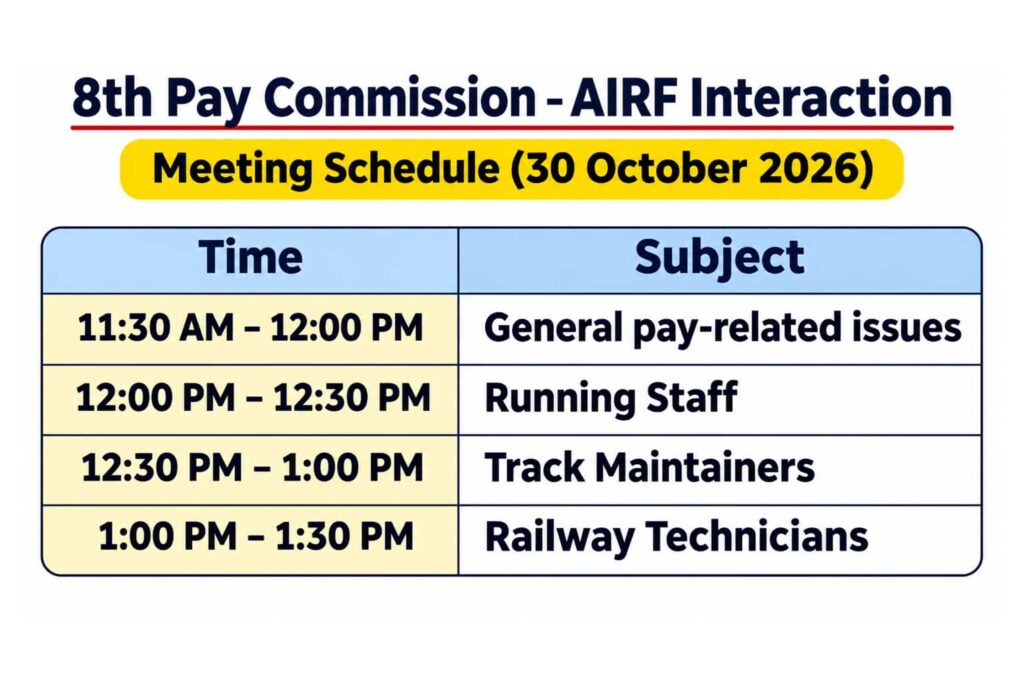
The meeting lasted approximately two hours, from 11:30 AM to 1:30 PM, and was organised into four half-hour sessions.
The Commission was represented by Chairperson Justice Ranjana Prakash Desai, Member Prof. Pulak Ghosh and Member-Secretary Pankaj Jain.
AIRF General Secretary Shiva Gopal Mishra and other federation representatives participated in the discussions.
The details were circulated through AIRF’s communication dated 30 October 2026, bearing letter number AIRF/8th CPC.
What happens to these demands next?
The consultation forms part of the process through which employee organisations present their views to the 8th Central Pay Commission.
The next important development would be whether the Commission incorporates any of these proposals into its recommendations.
For railway employees, the matters to watch are revised minimum pay, category-specific pay levels, allowances and promotion-related changes.
As of the AIRF communication dated 30 October 2026, no revised pay matrix, fitment factor or allowance increase was announced through this meeting.
The document also contains no decision on Defence pensions, OROP or Military Service Pay.
Conclusion
AIRF’s proposals highlight a broader question for the 8th Pay Commission: how should the Government evaluate technical skills, occupational risks and career progression when revising compensation for railway employees?
The federation’s demands address several distinct concerns, from minimum pay and specialised allowances to the promotional structure of technicians.
Their eventual impact will depend on the Commission’s recommendations and Government approval. Until then, these remain proposals submitted for consideration rather than sanctioned financial benefits.
1. All India Railwaymen’s Federation (AIRF)
Brief of AIRF’s Interaction with the 8th Central Pay Commission, held on 30 October 2026.
Letter No.: AIRF/8th CPC
Date: 30 October 2026
Issued by: Shiva Gopal Mishra, General Secretary
Read the Original AIRF Communication (PDF)
2. 8th Central Pay Commission — Government of India
Visit the Official 8th CPC Website
Source clarification: The AIRF communication records the federation’s account of its meeting with the Commission. It is not a Government order approving revised salaries or allowances.

Leave a Reply