


A death sentence delivered by a US military court in 2013 has reached a decisive new stage. Former US Army Major Nidal Malik Hasan, convicted for the 2009 Fort Hood shooting that claimed 13 lives, is scheduled to be executed by firing squad on 3 December 2026.
The US Army confirmed the schedule following President Donald Trump’s approval of the death sentence on 2 October 2026. If carried out, the execution would be the first conducted by the American military since 1961.
The development has renewed attention on military capital punishment, the lengthy appellate process and the legal safeguards that remain available before an execution can proceed.
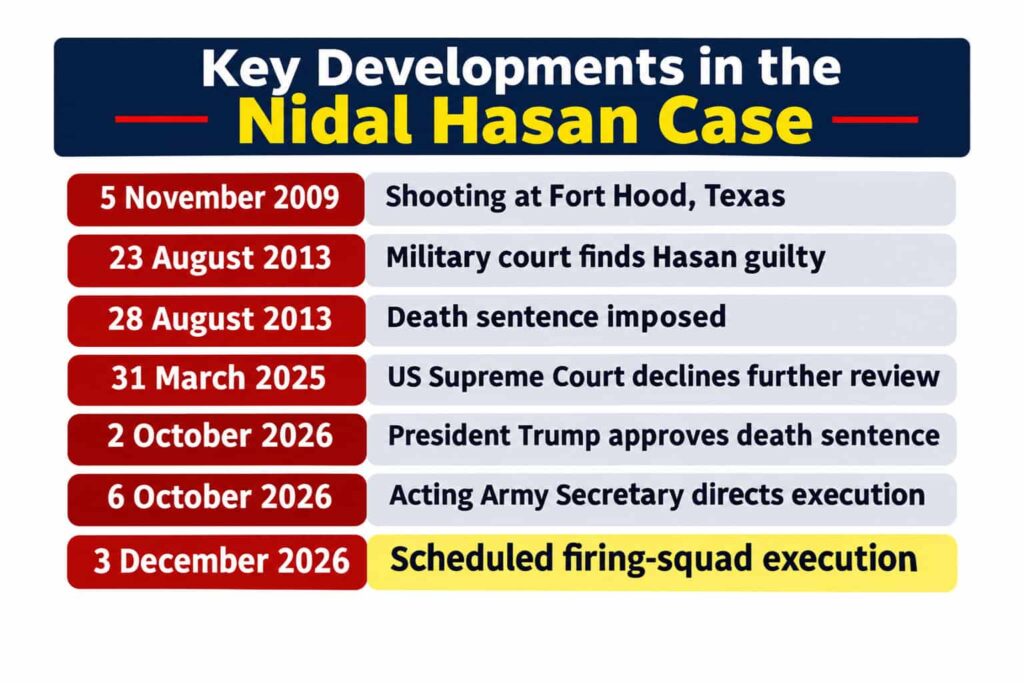
The timeline demonstrates the distinction between imposing a death sentence and obtaining the final authorisations needed to carry it out under American military law.
How the Fort Hood Attack Became a Landmark Military Case?
On 5 November 2009, Nidal Malik Hasan, then serving as a US Army psychiatrist, opened fire at the Soldier Readiness Processing Center at Fort Hood in Texas.
The attack killed 12 soldiers and one civilian. Another 32 people were injured.
Hasan was wounded by responding law-enforcement personnel and survived. The injuries left him paralysed.
The case attracted exceptional scrutiny because the perpetrator was a commissioned military officer responsible for providing psychiatric care to service members.
Beyond the criminal proceedings, the attack prompted questions about military security, internal warning procedures and the protection of personnel at military facilities.
What the Military Court Established in 2013?
Hasan faced trial before a general court-martial, the US military judicial forum authorised to hear serious criminal cases involving service personnel.
On 23 August 2013, the panel convicted him of 13 specifications of premeditated murder and 32 specifications of attempted premeditated murder.
Five days later, on 28 August, the court-martial imposed the death penalty. His punishment also included dismissal from military service and forfeiture of pay and allowances.
The verdict established his criminal responsibility, but the death sentence remained subject to mandatory judicial and executive procedures.
Unlike an ordinary disciplinary punishment, a military death sentence cannot be implemented solely on the original court-martial decision.
Why the US Supreme Court and President Became Involved?
One of the most important aspects of the Nidal Hasan death sentence 2026 development is the distinction between judicial review and presidential approval.
The US Supreme Court declined Hasan’s petition for review on 31 March 2025, in Case No. 24-5225, Hasan v. United States.
This decision did not constitute a fresh conviction or a new death sentence. It meant that the Supreme Court would not undertake the requested review of the military appellate decision.
Presidential approval represents a separate legal requirement.
Under the US military justice framework, a death sentence cannot be executed without approval from the President.
On 2 October 2026, President Donald Trump approved Hasan’s sentence following the military appellate process.
Acting Secretary of the Army Adam Telle subsequently issued the execution direction on 6 October.
This sequence explains why a punishment imposed in 2013 remained unimplemented for more than a decade.
Why a Firing Squad Has Been Selected?
The US Army has officially designated Fort Hood, Texas, as the execution location and specified a firing squad as the method.
The execution is scheduled for 1:00 PM Central Standard Time on 3 December 2026.
Under Army Regulation 190-55, the Army Secretary must select an execution date within the prescribed period following presidential approval. The Army’s October announcement identifies that period as 60 to 150 days.
The firing-squad decision was recommended by senior defence authorities and approved through the executive process.
However, the official announcement does not establish that a firing squad was legally the only available method. It identifies the method selected for this particular case.
Why the Scheduled Execution Is Historically Significant?
The American military has not carried out an execution since 13 April 1961, when Army Private John A. Bennett was executed by hanging following his conviction for rape and attempted murder.
If Hasan’s sentence is implemented on the announced date, it would end a period of approximately 65 years without a US military execution.
A military firing-squad execution would also be particularly unusual in the modern era.
The case therefore has implications beyond the individual conviction, drawing attention to the continued existence of capital punishment within the American armed forces.
Can the 3 December Execution Still Be Postponed?
Presidential approval and the completion of military appellate review do not necessarily eliminate every remaining legal remedy.
Hasan may pursue further challenges through civilian federal courts. Such proceedings could result in a judicial stay and affect the announced execution date.
The Death Penalty Information Center has specifically identified the possibility of additional federal judicial review.
Separately, October 2026 reports concerning a proposed public livestream generated controversy. President Trump subsequently announced that the execution would not be livestreamed.
That decision concerned public broadcasting arrangements rather than cancellation of the death sentence.
As of 13 November 2026, the officially announced execution date remains 3 December, subject to further legal developments.
What the Case Means for Military Justice?
The Hasan proceedings illustrate the extensive distinction between conviction, sentencing, appellate scrutiny and executive authorisation in military capital cases.
Nearly 17 years after the Fort Hood shooting, the judicial process has reached an advanced stage, yet the actual implementation of the sentence remains dependent on the absence of further legal intervention.
For international defence observers, the case offers an important example of how military justice and civilian judicial oversight can intersect in serious criminal proceedings.
It concerns United States military law and does not represent any change to India’s military justice system.
US Army — Execution Announcement (7 October 2026)
https://www.army.mil/article/295989/army_sets_execution_date_for_convicted_murderer_nidal_hasanUS Army — Original Death Sentence Report (2013)
https://www.army.mil/article/110393/Fort_Hood_shooter_Hasan_sentenced_to_death/US Supreme Court — Hasan v. United States, Docket No. 24-5225
https://www.supremecourt.gov/search.aspx?filename=%2Fdocket%2Fdocketfiles%2Fhtml%2Fpublic%2F24-5225.htmlUS Army — Regulation 190-55, Military Execution Procedures
https://api.army.mil/e2/c/downloads/2024/08/16/264d455f/ar-190-55-u-s-army-corrections-system-procedures-for-military-execution.pdfDeath Penalty Information Center — Scheduled Military Execution and Legal Review
https://deathpenaltyinfo.org/nidal-hasan-may-be-executed-on-december-3-by-firing-squad-first-military-execution-in-65-yearsAssociated Press — Decision Against Livestreaming the Execution
https://apnews.com/article/9b48781e88660064bf0f5aa020db8df7





Leave a Reply