

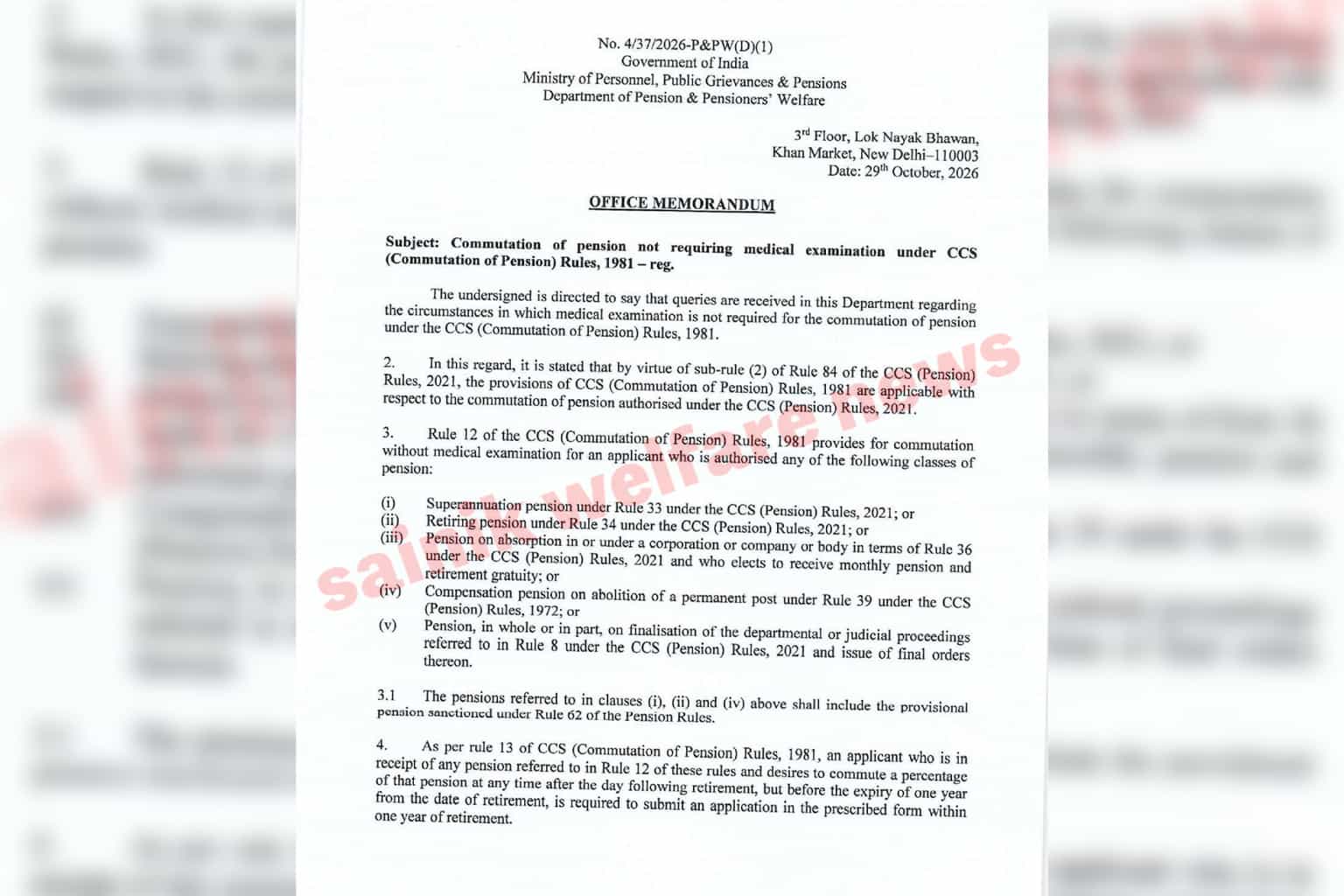
Download the official document
A Central Government employee can retire while departmental or judicial proceedings are still continuing. In such a situation, pension may initially be sanctioned on a provisional basis, but commutation cannot be processed in the normal manner until the proceedings are finally resolved.
The Department of Pension & Pensioners’ Welfare clarified this position through Office Memorandum No. 4/37/2026-P&PW(D)(4), dated 29 October 2026. The clarification deals with cases covered under Rule 8 of the CCS (Pension) Rules, 2021 and explains when commutation becomes available after proceedings conclude and when medical examination becomes necessary.
For affected pensioners, the most important question is not simply when they retired. The more important question is whether final pension has been authorised and when the commutation application reaches the Head of Office.
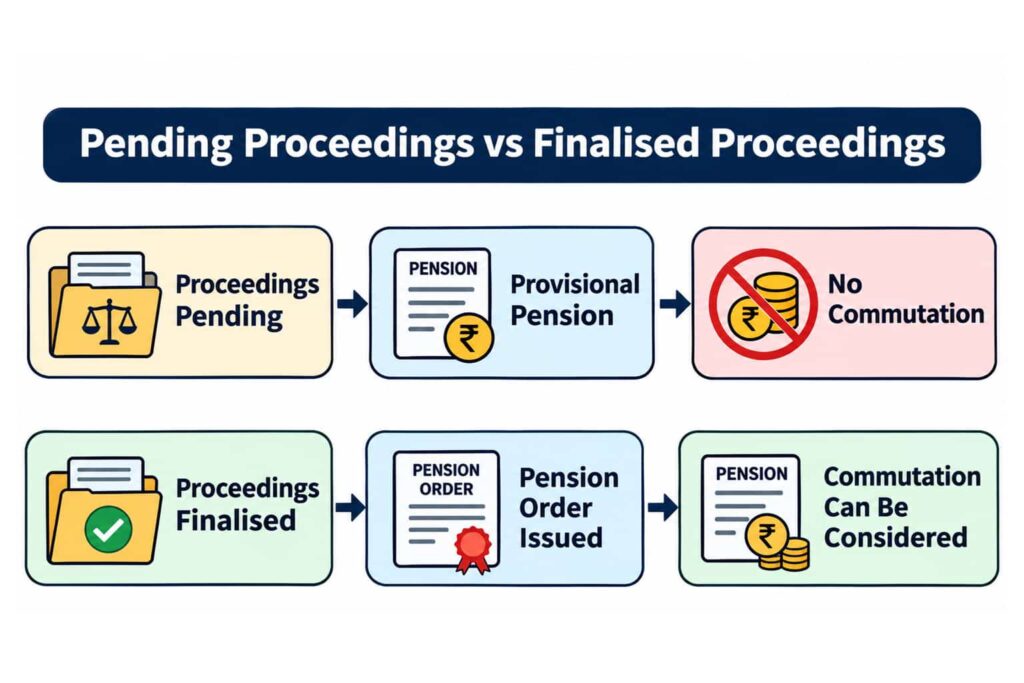
Stage Two: Final Pension is authorised
Once the departmental or judicial proceedings are concluded, the competent authority may issue an order authorising pension either wholly or partly, depending on the outcome of the case.
After such an order is issued, an eligible pensioner may apply for commutation under the applicable CCS commutation provisions. The crucial change is that the pensioner is no longer seeking commutation of provisional pension; there is now an order authorising pension on which the commutation request can be based.
This pension-authorising order also becomes important for determining the next deadline.
When does the one-year period start?
In the specific Rule 8 cases covered by the October 2026 clarification, the one-year period does not automatically begin from the employee’s original retirement date.
Instead, it begins from the date of issue of the order authorising pension after the proceedings are concluded.
This matters greatly where disciplinary or judicial proceedings continue for a long period after retirement. A person may have retired two or three years earlier, but that does not by itself mean the one-year commutation window has already expired.
A simple example
Suppose an employee retires in March 2024 while departmental proceedings remain pending. During that period, provisional pension is paid and commutation is not allowed.
Now assume that the proceedings are concluded and the competent authority issues the pension-authorising order on 15 December 2026.
For this Rule 8 case, the relevant one-year commutation period begins from 15 December 2026, not from the March 2024 retirement date.
The example shows why pensioners should identify the correct order date before deciding whether they are already outside the medical-free commutation period.
When is medical examination required?
The requirement depends on when the commutation application is received by the Head of Office.
If an eligible application is received within one year from the date of the pension-authorising order, medical examination is not required under the clarification.
If the application reaches the Head of Office after that one-year period, medical examination becomes mandatory under Rule 18 of the CCS (Commutation of Pension) Rules, 1981.
Importantly, crossing the one-year period does not automatically mean commutation is permanently lost. It means that the pensioner has to proceed through the medical-examination route prescribed under the rules.
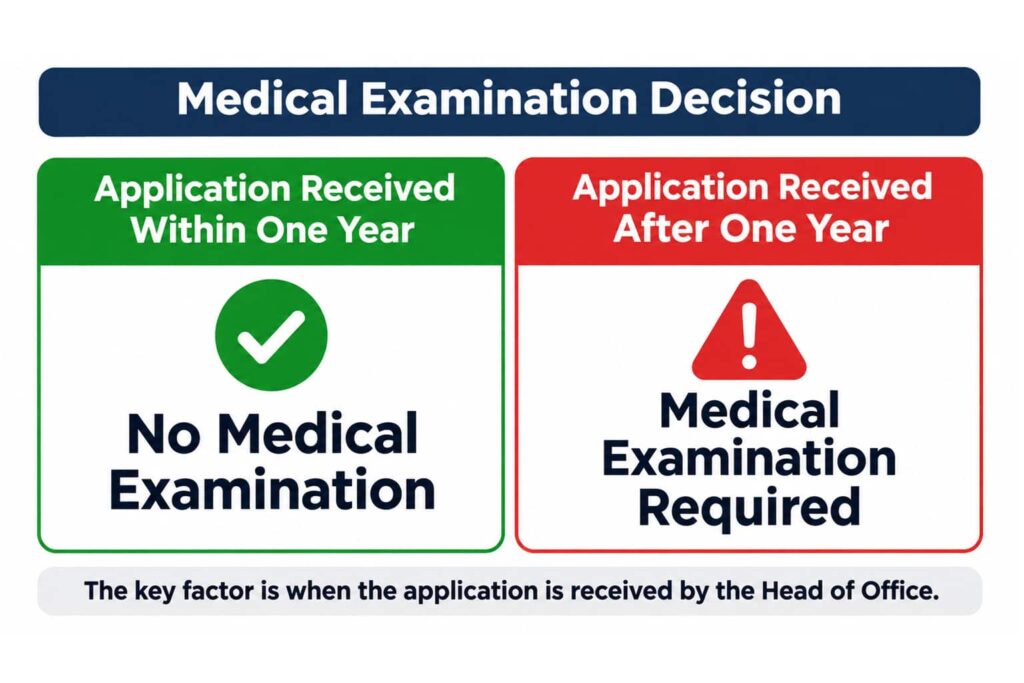
Why the head of office receipt date matters?
Affected pensioners should pay particular attention to the word received.
It is not enough simply to sign the commutation form within the one-year period. The application should reach the Head of Office within the applicable deadline.
That is why a pensioner should preserve an acknowledgement, diary number, official receipt, email acknowledgement or another reliable record showing when the office actually received the application.
The pension-authorising order and proof of application receipt together can become the most important documents if any dispute later arises regarding the one-year period.
What should a pensioner preserve?
Once proceedings are concluded, the pensioner should retain the final order relating to the departmental or judicial proceedings, the pension-authorising order, the commutation application and proof showing when that application was received.
These documents establish the sequence of events and help determine whether the case falls within the no-medical-examination route or the Rule 18 medical route.
For practical purposes, the pensioner should note four dates separately: retirement, conclusion of proceedings, pension-authorising order and receipt of commutation application.
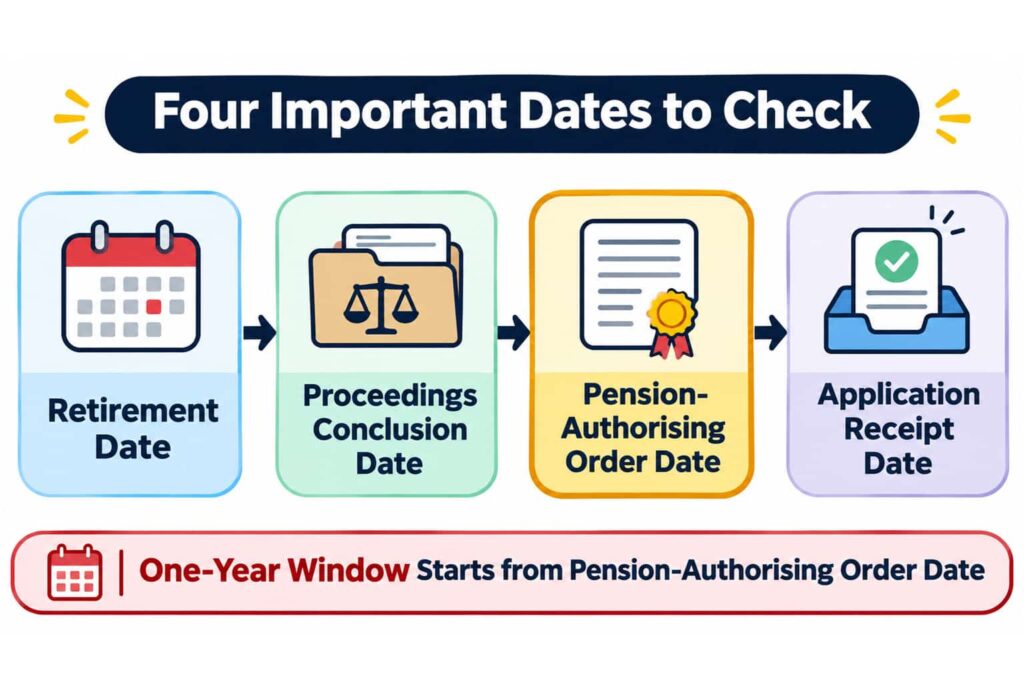
Does This Clarification Change the 15-Year Restoration Rule?
No. The Office Memorandum dated 29 October 2026 does not announce any change to the existing restoration period of commuted pension.
The clarification is concerned with the admissibility of commutation after proceedings covered under Rule 8 and the timing that determines whether medical examination is required.
It also does not announce a new percentage of pension that can be commuted or introduce a new general commutation benefit for all pensioners.
Does this apply automatically to Defence Pensioners?
No automatic extension should be assumed.
The memorandum specifically refers to the CCS (Pension) Rules, 2021 and CCS (Commutation of Pension) Rules, 1981, which apply to the relevant categories of Central Government civilian pensioners.
Armed Forces pensioners are governed under separate defence pension regulations. The 29 October 2026 clarification does not expressly extend this Rule 8 interpretation to military pensioners.
Defence pensioners should therefore check the applicable defence pension provisions rather than automatically using the civilian CCS deadline.
What should an Affected Pensioner do after proceedings end?
The first step is to obtain and carefully read the pension-authorising order issued by the competent authority.
The pensioner should note the exact date of that order, prepare the commutation application without unnecessary delay and ensure that it reaches the Head of Office within the applicable one-year period if the no-medical route is to be used.
Where the one-year period has already expired, the pensioner should not assume that commutation is unavailable. The case can instead be processed in accordance with the medical-examination provisions under Rule 18.
Final Takeaway
For Rule 8 pension cases, three stages should be kept separate. Pension cannot be commuted while the covered proceedings remain pending. Once the proceedings end and pension is authorised, the commutation window opens. Whether medical examination is required then depends on when the application reaches the Head of Office.
The key practical rule is simple: identify the pension-authorising order date and do not delay submitting the commutation application.



Leave a Reply