

An Agniveer receiving ₹47,500 a month during the sixth year of service is not necessarily drawing the same salary or entitled to the same retirement benefits as a regular soldier.
That distinction has become important following the Union Cabinet’s 4 November 2026 decision to introduce an additional two-year engagement under the Agnipath Scheme.
The revised policy creates new opportunities for continued military service, but the financial outcome depends on whether an individual exits after four years, completes six years or enters the regular Armed Forces.
For families assessing future earnings, Agniveer remuneration, Seva Nidhi and regular military pay must be understood separately, particularly when considering the possible impact of the 8th Central Pay Commission.
What happens after an Agniveer completes four years?
The revised arrangement retains merit-based selection of 25% of Agniveers for regular service after their initial four-year engagement.
Those not selected at this stage may opt for another two years of service. Following this extension, willing Agniveers are offered a pathway to regular enrolment, subject to meeting the prescribed selection criteria.
The Cabinet has also confirmed higher remuneration, an enhanced Seva Nidhi arrangement and seniority benefits for the additional engagement.
However, the opportunity to seek regular enrolment is not an unconditional guarantee of permanent service.
Agniveer Salary 2026: How much is paid during six years?
The original Agnipath financial structure provides a customised monthly remuneration package, with 30% contributed towards the Agniveer Corpus Fund and a corresponding Government contribution.
The fifth- and sixth-year figures were reported following the briefing by Chief of Defence Staff General N. S. Raja Subramani.
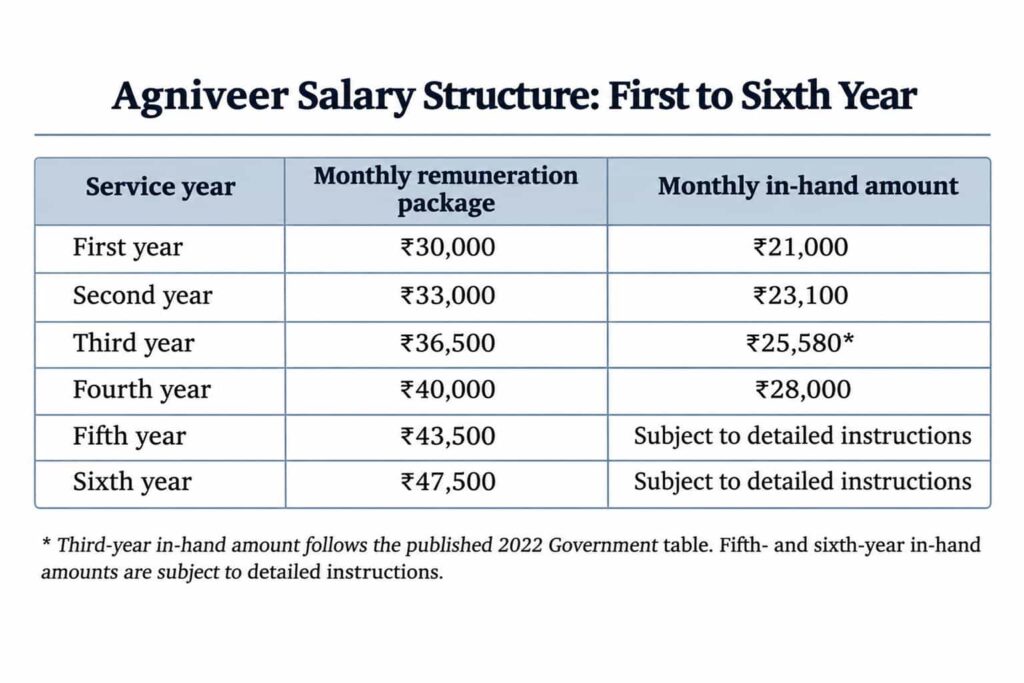
Applicable risk and hardship allowances may be payable separately.
The revised two-year engagement has also been described as having a different Seva Nidhi contribution arrangement. Therefore, the original 70% in-hand formula should not automatically be applied to years five and six.
Seva Nidhi: How do four-year and six-year exit payments differ?
The original scheme provides a Seva Nidhi corpus consisting of contributions from both the Agniveer and the Government.
For four years of service, the combined contributions amount to approximately ₹10.04 lakh before accrued interest. The original 2022 announcement estimated a settlement of about ₹11.71 lakh including interest.
For personnel leaving after six years, defence officials have reportedly indicated a total of ₹15.94 lakh, comprising:
₹5.02 lakh associated with the initial four-year engagement.
₹10.92 lakh under the additional two-year arrangement.
These figures represent reported contribution-based settlement calculations, excluding any additional interest treatment.
The ₹15.94 lakh amount should not be presented as an independently verified final disbursement applicable to every Agniveer. Detailed accounting instructions remain important, particularly for personnel selected for regular service.
Agniveer vs Regular Soldier: Why are their pay structures different?
Agniveers serve under a special engagement package. Regular military personnel draw pay under the applicable Armed Forces pay matrix.
Under the existing 7th CPC structure, an illustrative entry-level Army Sepoy receives ₹21,700 basic pay in Level 3, along with ₹5,200 Military Service Pay (MSP) and other applicable allowances.
These are starting-pay components, not a universal take-home salary or an automatic pay-fixation figure for every regularised Agniveer.
Regular personnel are also governed by separate service rules covering career progression, medical benefits, gratuity and pension eligibility.
An Agniveer selected for the regular cadre therefore undergoes a change in service status, rather than simply receiving another increment under the Agnipath package.
Will the 8th CPC apply after regular enrolment?
This is the central financial question arising from the revised scheme.
The 8th Central Pay Commission is examining pay and related service conditions for covered Government personnel, including the Armed Forces.
However, Agniveers continuing under their special engagement package do not automatically become entitled to regular military pay-matrix revisions.
An individual subsequently enrolled in the regular Armed Forces would come under the applicable regular service pay rules. Any benefit arising from the 8th CPC would then depend on the approved recommendations, implementation instructions and the individual’s service conditions.
As of 12 November 2026, no verified Government order establishes a final 8th CPC fitment factor or a separate 8th CPC salary revision for Agniveers.
It would therefore be premature to calculate a new Agniveer salary using speculative Pay Commission multipliers.
Will the additional two years count towards seniority & pension?
The Cabinet announcement specifically refers to seniority benefits under the revised engagement arrangement.
Subsequent reporting, citing defence officials, indicates that Agniveers regularised after six years would be placed immediately below their own batchmates selected for regular service after four years, rather than below personnel from later batches.
Reports have also discussed counting the extended engagement towards pensionable service following regular enrolment.
Nevertheless, the detailed application of these provisions requires the relevant service-specific instructions.
Completing six years as an Agniveer does not independently establish entitlement to a military pension. Pension benefits depend on regular service status, qualifying service and applicable regulations.
Which financial questions still need clarification?
The next important documents will be the detailed service instructions covering fifth- and sixth-year take-home remuneration, contribution deductions, Seva Nidhi settlement for different service outcomes, seniority placement and treatment of qualifying service.
These instructions will determine how the broad Cabinet decision operates in individual cases.
For those planning continued military service, the immediate priority is to understand their selection status and the terms applicable to their next engagement.
Conclusion
The revised Agnipath Scheme provides additional service opportunities and potentially different financial outcomes after four or six years.
However, the dividing line for regular military pay and future Pay Commission benefits remains enrolment in the regular Armed Forces, not simply the completion of an additional two years as an Agniveer.
Until detailed Government instructions are issued, reported financial figures should be understood alongside the conditions governing each service pathway.
1. Ministry of Defence — Cabinet Decision, 4 November 2026
Cabinet Creates a Pathway for All Agniveers to Be Absorbed in Defence Forces — PIB Release 2332524
2. Ministry of Defence — Original Agnipath Financial Provisions, June 2022
Original Agnipath Scheme Announcement — PIB Release 1834227
3. Department of Expenditure — Seventh Central Pay Commission Report
4. The Indian Express — Agniveer Extension and Salary Details, 5 November 2026
5. The Times of India — Agniveer Seva Nidhi and Seniority Clarification, 6 November 2026
6. Eighth Central Pay Commission — Government of India
Source clarification: The November 2026 Cabinet decision confirms the revised service pathway and enhanced benefits. Specific remuneration, Seva Nidhi distribution and seniority details cited from media reports should be distinguished from final implementing instructions. The article does not claim that any 8th CPC salary increase for Agniveers has been approved.



Leave a Reply